


Bitcoin’s August 10 session turned the $65,000 area from a headline into a test. It traded as high as roughly $65,330 during the UTC window, then slipped toward $63,900 as Nvidia closed near $217. Palantir moved the other way, holding gains a week after its earnings jump.
The useful read is not “all risk assets are falling together.” It is a three-clock check: Bitcoin’s range, AI leadership in Nvidia and Palantir, and the scheduled US inflation event. When two or more clocks align, the cross-asset signal is stronger; when they diverge, conviction should stay lower.
Key takeaways
- Bitcoin lost the $65K area during the August 10 UTC window, but the move still needs cross-asset confirmation.
- Nvidia weakened while Palantir stayed firm, so AI risk appetite was selective rather than uniformly risk-off.
- US July CPI on August 12 is the next scheduled test for rates, technology shares and crypto liquidity.
What does Bitcoin below $65K actually signal?
It signals that sellers controlled the second half of the observed session, not that a larger breakdown is guaranteed. Yahoo Finance’s BTC-USD hourly data show Bitcoin opening the August 10 UTC window near $64,839, reaching an intraday high around $65,330 and a low near $63,739. The last complete hourly observation was near $63,929.
That path matters more than the round number by itself. Bitcoin briefly traded above $65K but did not hold there through the observed window. A reclaim that survives several liquid trading hours would suggest the break was rejected. Continued acceptance below $65K, especially with weaker technology shares and firmer yields, would make the move look more macro-driven.
The $65K area should therefore be treated as a decision zone, not a precise support line. Crypto trades continuously, while US equities have a defined cash session. Comparing the two requires matching timestamps rather than treating every price on a screen as simultaneous. For an earlier example of range-first analysis, see Bitcoin’s $73K consolidation.
Why did Nvidia weaken while Palantir stayed firm?
The divergence says investors were reducing some liquid AI exposure without abandoning the entire theme. Nvidia closed the August 10 US session at $217.55, down about 2.9% from the prior close of $223.96. Its session range ran from roughly $216.77 to $224.14, so the close landed near the low end of the day.
Palantir closed at $175.23, up about 1.9% from $172.01, after trading between $170.87 and $179.60. That relative strength followed its August 3 earnings release. Associated Press reported that Palantir jumped 29.5% on August 4 after revenue grew 93% and the company raised its full-year 2026 revenue forecast.
This is also why the original “earnings tonight” framing needs correction: Palantir had already reported a week earlier. Nvidia’s next scheduled results call is August 26, according to Nvidia Investor Relations. For the immediate session, Palantir is a post-earnings momentum check and Nvidia is the broader AI-liquidity check.
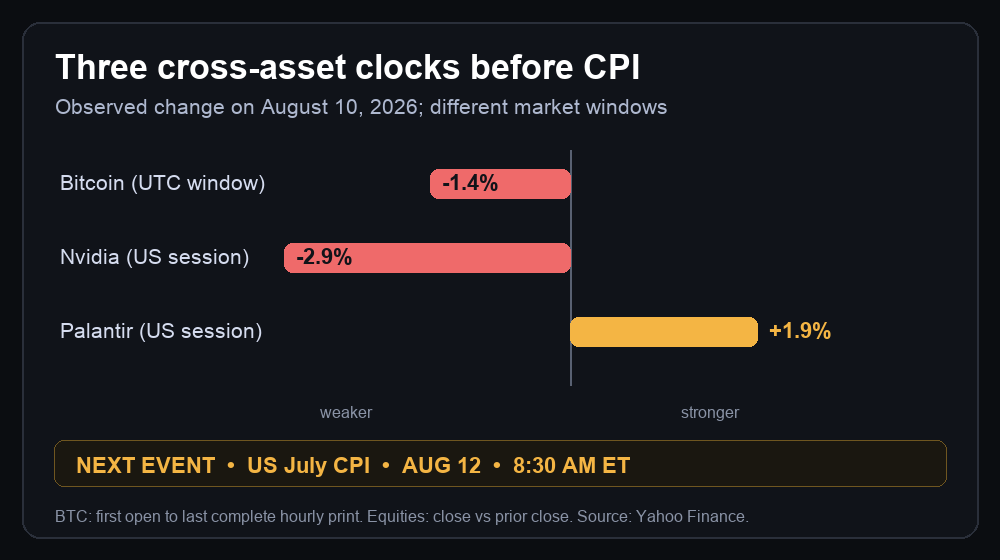
Observed windows differ: Bitcoin uses the August 10 UTC session; Nvidia and Palantir use the US regular session. Source: Yahoo Finance.
Why is CPI the next cross-asset test?
CPI can move the rate path that connects technology valuations, dollar liquidity and crypto risk appetite. The US Bureau of Labor Statistics schedules July CPI for August 12 at 8:30 a.m. Eastern Time. The release can shift Treasury yields and the dollar before the US cash equity open, while Bitcoin is already trading.
A softer inflation read does not automatically make every risk asset rise. It would first need to pull yields lower or ease policy expectations; then traders can see whether Nvidia and Bitcoin respond together. A firmer inflation read matters through the opposite chain: higher yields and a stronger dollar can tighten financial conditions, but price confirmation still matters more than the headline alone.
Bitcoin offers the first continuous reaction. Nvidia then shows whether the move reaches high-liquidity AI leadership when US equities open. Palantir helps distinguish a broad growth selloff from a narrower adjustment in the largest semiconductor name.
How can traders separate confirmation from noise?
Require at least two clocks to agree. A Bitcoin move alone can be crypto-specific; one weak equity close can reflect positioning; one economic print can reverse after the first reaction. The combined pattern is more informative.
| Clock | Constructive confirmation | Cautious confirmation |
|---|---|---|
| Bitcoin | Reclaims $65K and holds through liquid hours | Stays below $65K and retests the session low |
| AI leadership | Nvidia stabilizes and Palantir retains relative strength | Nvidia extends weakness and Palantir loses its divergence |
| Macro | CPI reaction pulls yields lower and risk assets respond | CPI reaction lifts yields and the dollar while risk assets weaken |
Prices can move materially after the cited window. The table describes confirmation conditions, not forecasts or fixed levels.
Final thoughts
Bitcoin near $65K is the fastest clock, but not the only one. Nvidia’s close near $217 shows pressure in the most liquid AI leader; Palantir’s resilience shows that pressure was not yet universal. CPI is the event that can bring those signals together—or expose them as separate trades. The cleanest read comes after the market shows alignment, not before. Live product details are available on the BTCUSDC page.