


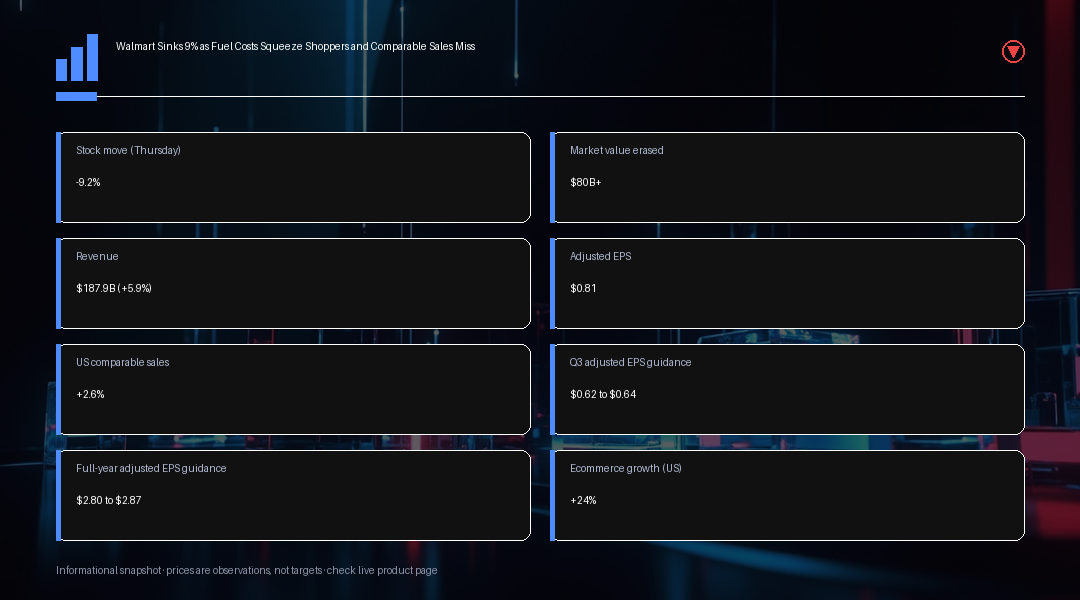
Walmart just delivered one of its more uncomfortable trading days in years. Shares fell roughly 9.2% on Thursday, the worst single session for the stock since May 2022, wiping out more than $80 billion in market value in a matter of hours. For a company whose stock had spent much of the past two years looking almost immune to bad news, the reaction says as much about elevated expectations as it does about the results themselves.
The headline numbers were not bad. Revenue for the quarter ended July 31 rose 5.9% to $187.9 billion, and adjusted earnings per share came in at $0.81, both ahead of Wall Street's estimates. The problem was underneath the headline: US comparable sales, which combine established stores and ecommerce, grew just 2.6%, well short of the roughly 3.8% analysts had modeled. It was Walmart's first miss against same store sales expectations in at least five years, breaking a streak that had made the stock a market darling.
The composition of the miss matters. Transactions rose 1.5%, but average spending per visit increased just 1.1%, sharply down from 3.1% growth a year earlier. Management pointed to gasoline prices above $4 a gallon as a key culprit, saying higher fuel costs are forcing many shoppers, particularly lower income households, into visible trade-offs at the register. The company also flagged a meaningful fuel related cost headwind on its own operations, without providing a single precise dollar figure investors could underwrite with confidence, so the safest reading is that fuel is a real and growing drag rather than a rounding error.
Pharmacy deflation added another 1.25 percentage points of drag to US comparable sales, as regulated drug pricing changes pushed prices lower. Strip that out, and underlying growth would have been closer to 3.4%, still below consensus but a meaningfully less alarming number than the 2.6% headline suggests. Walmart is also using $2.9 billion in tariff refunds to help fund roughly 11,000 price rollbacks across its US stores, a move that should support traffic and market share over time but works against near term margins.
Not everything in the report was soft. Ecommerce remained the clear bright spot, growing 24% in the US and 23% globally. Walmart Connect, the company's advertising business, grew 43% in the US, and global membership fee revenue rose 17%. Selling advertising space alongside groceries continues to be a far more profitable business than selling the groceries themselves, and that mix shift is a big part of why Walmart's margins have held up even as core retail growth has slowed.
Guidance is where the market's disappointment concentrated. Walmart raised its full year outlook, now guiding to sales growth of 4% to 5% and adjusted earnings per share of $2.80 to $2.87. But third quarter adjusted earnings guidance of $0.62 to $0.64 landed below Wall Street's $0.68 estimate, giving traders one more reason to sell first and ask questions later. After a strong multi-year run that had left the stock priced for consistently smooth execution, a same store sales miss paired with soft near term guidance was enough to trigger the sharpest single day repricing in years.
The reaction also fits into a broader macro story. Walmart's warning about gasoline driven consumer stress landed the same week that Brent crude approached $94 a barrel amid prolonged Gulf supply tension, and it helped drag the Dow Jones Industrial Average sharply lower the same day. When the country's largest retailer says lower income households are trimming spending because of fuel costs, that is not just a company specific data point, it is a read-through on discretionary spending more broadly heading into the back half of the year.
None of this means Walmart's underlying business is broken. The company still grew revenue nearly 6%, beat on earnings, and is compounding an advertising and membership business that increasingly looks more like a technology platform than a traditional retailer. What Thursday's move really punished was valuation: a stock priced for near flawless execution got a same store sales miss instead, and in a market already nervous about consumer health, that combination proved expensive.
Walmart's report also landed at a moment when investors were unusually sensitive to any sign of consumer fatigue. The stock had outperformed the broader market for much of the past two years on the strength of its ecommerce and advertising growth, and that outperformance had pushed its valuation multiple well above its historical average. When a company trading at a premium multiple delivers a same store sales miss, even a modest one, the market tends to punish the stock disproportionately relative to the size of the miss itself, which helps explain why a 2.6% comparable sales print, only about a percentage point below expectations, was enough to trigger a single day decline of this size.
Trading Insight
Walmart's selloff is best read as a valuation reset rather than a verdict on the underlying business. Revenue and earnings both beat estimates, and ecommerce, advertising, and membership all continued to grow at a healthy clip, so the stock's move says more about how richly it was priced heading into the print than about a fundamental deterioration in the business. For traders, the key signal to watch going forward is whether fuel driven consumer pressure shows up in other retailers' comparable sales over the coming weeks; if it does, this stops being a Walmart story and becomes a broader read on discretionary spending. Because Walmart does not have an approved single stock trading symbol on this platform, MC Markets clients looking to position around this theme may prefer broad US equity index exposure that captures the retail and consumer spending signal without concentrating risk in a single name. Watch how peer retailers frame gasoline and fuel costs in their own upcoming reports, since a shared pattern across multiple companies would carry more weight than any single earnings call.