


No—the Kharg Island strike did not make 90% of Iran’s oil disappear overnight. The widely repeated percentage describes how concentrated Iran’s crude exports are at one terminal. It does not mean 90% of Iranian production, reserves or global supply was destroyed.
That correction does not make Kharg unimportant. It makes the real market question sharper: was the loading system physically damaged, were tankers prevented from reaching it, and how long could lost export flows last? Those are the tests that separate a geopolitical headline from a durable move in USOIL.
Key takeaways
- About 90% refers to Iran’s crude-export concentration at Kharg, not oil destroyed.
- The March 13 strike hit military targets; contemporary reports said oil-loading facilities remained intact.
- For crude, verified lost barrels and outage duration matter more than the strike headline alone.
Did the Kharg Island strike wipe out 90% of Iran’s oil?
No. The claim mixes up an export share with physical destruction. Iran International reported tanker-tracking data showing that Kharg handled about 1.54 million barrels per day in 2025 out of roughly 1.60 million b/d of Iranian crude exports. That is about 96%, consistent with the commonly rounded “around 90%” description.
The denominator matters. The figure measures crude loaded for export through Kharg. It does not measure all oil produced inside Iran, oil consumed domestically, stored barrels, underground reserves or the share of worldwide output. A terminal outage can strand production and choke revenue, but it is not the same event as destroying the oil itself.
| Claim | What it actually means | Trader implication |
|---|---|---|
| “90% of Iran’s oil” | Rough shorthand for the share of crude exports routed through Kharg | High concentration risk, not proof of a 90% supply loss |
| “Kharg was struck” | A location was attacked; the target and damage still need verification | Headline premium can fade if loading continues |
| “Exports stopped” | Tankers or terminal operations are not moving barrels | Price impact grows with volume lost and outage duration |
Why is Kharg Island such a critical oil chokepoint?
Kharg concentrates pipelines, storage and deep-water loading berths in one export hub. The U.S. Energy Information Administration identifies Kharg, Lavan and Sirri as the terminals handling almost all Iranian crude exports, with Kharg the largest. That network lets crude from inland and offshore fields converge where very large tankers can load.
Concentration creates efficiency in normal conditions and fragility in a crisis. If one hub handles nearly every exported barrel, a damaged jetty, severed pipeline, power failure, fire, blockade or tanker-insurance shock can interrupt flows well beyond the footprint of the immediate incident.
Iran does have alternatives. Lavan, Sirri, Qeshm and other facilities provide storage or limited loading capacity. AP quoted energy analysts saying smaller ports mean a Kharg disruption would not reduce exports to a literal zero. The trade-off is a smaller, costlier and less efficient system that cannot rapidly absorb Kharg’s full normal load.
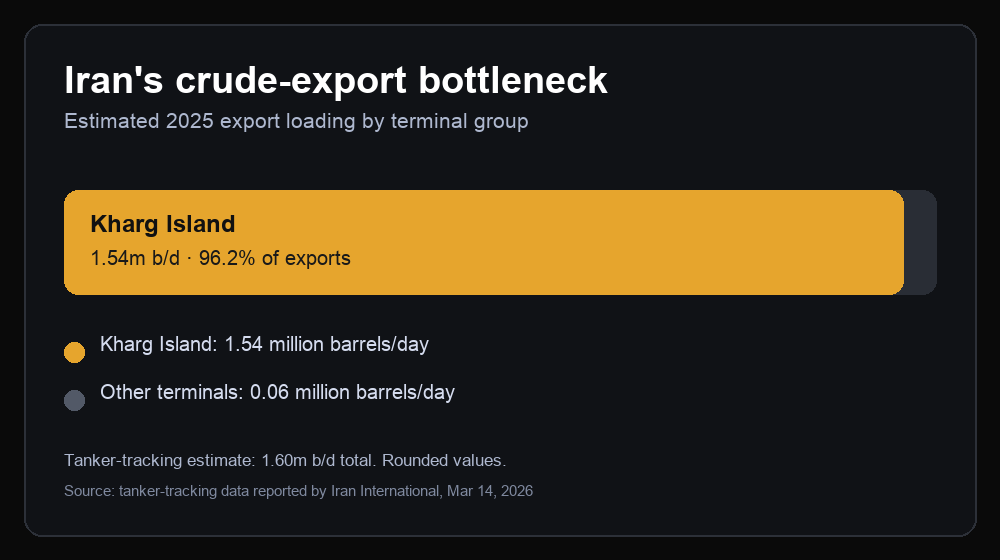
The chart uses a 2025 tanker-tracking estimate reported on March 14, 2026. Values are rounded and do not represent live terminal flows.
What did the March 13 strike actually hit?
Contemporary reporting said the strike hit military sites on Kharg, not the island’s oil-loading infrastructure. AP and Reuters reported on March 13 that U.S. forces targeted military facilities while warning that oil infrastructure could be targeted later. Iranian reporting summarized by AP the following day named air-defence, naval, airport-control and helicopter facilities and said no oil infrastructure had been damaged.
The physical-flow check supported that distinction. Windward’s March 15 maritime review said the export terminal remained operational after the strikes and satellite imagery showed continued tanker activity, although volumes were below pre-war levels.
This is why “strike on an oil island” and “strike on an oil terminal” cannot be used interchangeably. The first can raise the probability of a future disruption. The second can remove loading capacity immediately. Markets may price both, but usually not by the same amount or for the same duration.
Why didn’t the oil price automatically reach $200?
Because oil prices balance lost supply against available barrels, demand, inventories and expected duration—not against the most dramatic headline. Even a severe Iranian export loss would be measured against a global market of roughly 100 million barrels per day, while other producers, commercial stocks and weaker consumption can cushion the initial shortfall.
China provided a major demand offset in 2026. The American Petroleum Institute reported that estimated Chinese seaborne crude arrivals were running near 5 million b/d through June 25, almost 60% below February if the estimate held. Axios later reported imports through June more than 40% below a year earlier. Lower buying by the world’s largest crude importer reduced competition for disrupted cargoes.
The result was still volatile, just not mechanical. Kiplinger reported front-month WTI near $76 a barrel on August 4, down from above $90 during heavier fighting. AP reported Brent near $79.45 on August 5. Those are dated snapshots, not ceilings: confirmed terminal damage or a broader shipping outage could change the balance quickly.
How can traders tell a headline shock from a lasting outage?
Track the physical chain in order: terminal damage, tanker access, export volume and time. Price action becomes more durable when several links confirm each other.
Scenario 1 — the terminal remains intact
Military targets are hit, but jetties, pipelines, tanks and power remain functional; tankers keep loading. Crude can jump on escalation risk, then give back part of the premium when physical exports are verified. The March episode most closely matched this pattern.
Scenario 2 — loading is blocked without major terminal damage
The infrastructure survives, but tankers cannot arrive or depart because of naval action, insurance withdrawal, port restrictions or crew risk. Exports can still fall sharply. The market then watches vessel queues, storage filling and whether smaller terminals can redirect cargoes.
Scenario 3 — export infrastructure is disabled
Verified damage closes key berths, pipelines, pumping systems or power for an extended period. This is the strongest supply case because nearly all normal export flow must find limited alternatives. The price response would depend on repair time, replacement supply, inventories and whether retaliation spreads to other Gulf assets.
| Evidence to monitor | Why it matters | Signal of persistence |
|---|---|---|
| High-resolution damage assessment | Separates military-site strikes from loading-system damage | Multiple independent confirmations of disabled oil assets |
| Tanker arrivals and departures | Shows whether barrels are physically moving | Loaded departures remain depressed for several days |
| On-island storage | Rising tanks can reveal a blocked export outlet | Storage fills while production is curtailed upstream |
| Prompt spreads and freight | Tests whether nearby barrels are genuinely scarce | Front-month strength and shipping costs stay elevated |
| China’s import recovery | Demand can amplify or absorb the supply shock | Chinese buying rebounds while Gulf flows remain constrained |
What does Kharg Island risk mean for crypto and core assets?
The first transmission runs through crude, inflation expectations and risk appetite. A sustained oil move can push inflation-sensitive bond yields higher and pressure growth equities. Gold and the U.S. dollar may attract defensive demand, although their reactions can diverge when rates move sharply.
Bitcoin is not a guaranteed geopolitical hedge. During a fast liquidity shock it can trade like a high-beta risk asset, especially if higher oil revives inflation and rate concerns. If the crude premium fades and liquidity conditions stabilise, crypto can recover even while the political story remains unresolved.
The useful cross-asset comparison is therefore conditional: does USOIL hold the move, do freight and prompt spreads confirm physical tightness, and do equities and crypto continue to price tighter financial conditions? A related example of the oil-to-equities channel appears in MC Markets’ Nasdaq futures and Iran oil-risk analysis.
Final thoughts
Kharg Island deserves attention precisely because Iran’s export system is so concentrated there. But concentration is not destruction, and a strike headline is not a measured outage. The cleanest read comes from moving one step at a time—from what was hit, to whether tankers can load, to how many barrels stop, to how long the interruption lasts.
That discipline also explains why dramatic supply headlines do not produce a fixed oil-price target. Physical losses can be offset, delayed or amplified by demand and shipping conditions. Kharg is the bottleneck; verified flow data tell traders whether the bottleneck is actually closed.