


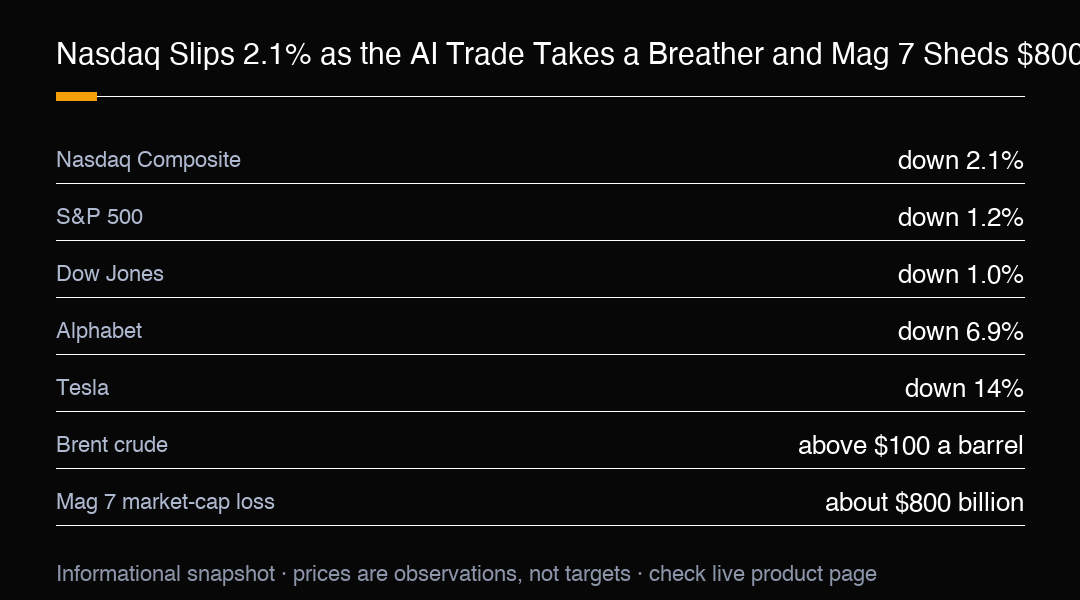
Wall Street hit the brakes Thursday as the Nasdaq Composite sank 2.1%, the S&P 500 lost 1.2%, and the Dow fell 1%. The session looked less like a single bad day and more like the market finally asking the question it had been avoiding: can Big Tech keep spending like this without delivering matching returns? That question has been bubbling under the surface for weeks, but earnings season made it impossible to ignore.
Behind the drop was a familiar but potent mix. Brent crude pushed above $100 a barrel for the first time in two months, reigniting inflation fears just as investors were already digesting disappointing reactions to earnings from Alphabet and Tesla. When oil spikes at the same time that tech capex is under scrutiny, risk assets tend to suffer. The two forces fed each other throughout the session.
The Magnificent Seven collectively slid around 5%, wiping roughly $800 billion off their combined market value. It was the group's worst one-day performance since the tariff-driven selloff of April 2025. The names that had led the market higher for months were suddenly the ones dragging it lower, and that reversal sent a clear signal: leadership had changed. When the market's favorite stocks stop working, the index follows.
Alphabet tumbled 6.9% after lifting its AI spending forecast to as much as $205 billion, even as it reported blockbuster revenue. Investors fixated instead on the company's first-ever negative free cash flow, meaning more cash went out than came in during the quarter. For a stock that trades on future growth expectations, that detail mattered more than the headline beat. The market was pricing in perfection, and perfection requires more than just strong revenue.
Tesla did even worse, plunging 14% after posting negative free cash flow for the first time in two years as it doubled down on robotaxis, robotics and AI infrastructure. The market was already skeptical about how quickly those bets will pay off, and the earnings report did little to ease those concerns. Ambition is expensive : and this week, Wall Street sent the invoice.
The selling spread beyond the usual suspects. Apple and Microsoft wilted alongside the Magnificent Seven, while chipmakers such as Broadcom and Marvell gave back portions of recent gains. Breadth was weak, which matters because a broad retreat is harder to reverse than a single-name panic. When everything falls together, there are fewer safe places to hide, and that accelerates the selling pressure.
Part of the frustration is timing. Earnings season was supposed to be a relief valve, a chance for companies to prove the AI boom is translating into real money. Instead, some of the best-capitalized names in the world are signaling that the costs are rising faster than the revenue, and investors are starting to wonder whether the return on AI investment will ever justify the sums being thrown at it. The gap between spending and payoff is widening, and markets hate uncertainty.
Markets also had fresh policy news to chew on. The US Trade Representative imposed new tariffs under Section 301 of the Trade Act, targeting 60 economies over forced-labor enforcement. Duties range from 10% to 12.5%, covering nearly all US imports. The new trade measures add another layer of uncertainty to an already nervous week. Tech companies rely on global supply chains, and new duties threaten to raise input costs for hardware makers already coping with higher chip prices and freight expenses.
The tariff news could not have come at a worse time. Hardware makers are already coping with higher chip prices and freight expenses. Every percentage point added to import costs is another squeeze on margins that investors had assumed would keep expanding. The combination of higher oil, weaker earnings, and new tariffs created a triple headwind that was impossible to ignore.
Looking ahead, futures suggested traders were catching their breath rather than rushing back into risk. The session ended with a familiar question: is this a healthy digestion of a sharp rally, or the start of something worse? In previous years, sharp Nasdaq pullbacks were often followed by quick recoveries, but this cycle feels different because the underlying driver is structural, not cyclical.
One thing is certain. The AI trade has become the market's most crowded position, and crowded trades correct hard when sentiment turns. Thursday was a reminder that even the best stories can be sold when the valuation bar gets too high and the cost bar gets too steep. The next few sessions will reveal whether buyers step in at lower levels or whether the selling has more room to run.
For medium-term investors, the key question is whether Big Tech can restore confidence in its capital allocation. Companies that miss on earnings while simultaneously raising spending often face a credibility test. Management teams will be on the road explaining why the incremental dollar delivers more than the last one, and the market will be watching revenue growth and margin commentary closely. A steady cadence of reinvestment paired with improving returns should gradually rebuild trust.
From a technical standpoint, the Nasdaq Composite is testing support near its 50-day moving average after breaking below the 20-day trendline. That combination is rarely a bullish signal in the short run, but it does mark the first real test of whether buyers are willing to defend the trend. Money managers who stayed fully invested through the rally may trim exposure into bounces rather than chase lower. That means rallies in this environment should be watched for participation and breadth, not just point gains.
Global links matter too. Weakness in US tech reverberates through Asian supply chains, European luxury exposure, and emerging-market portfolios weighted to dollar-funded liquidity. A reassessment of US AI spending is not just a domestic story. Semiconductor equipment orders, data-center construction plans and cloud-lease commitments all feed back into the same risk narrative. That feedback loop explains why the Nasdaq session spilled into broader market declines rather than remaining an isolated tech setback.
Position sizing will also differ from earlier this year. After the April pullback, many buyers treated dips as opportunities. Now the market is less forgiving because the macro backdrop is less benign. Traders should therefore use smaller core positions and maintain optionality through structures that do not require being directionally correct on every leg. In an environment where headline moves are large but follow-through is weak, flexibility often outperforms conviction.
Trading Insight
The selloff highlights how quickly the AI trade can shift from optimism to cost-concern. Big Tech's capex surge is now being scrutinized for returns, while oil above $100 and new tariffs add macro headwinds that keep risk appetite in check.