


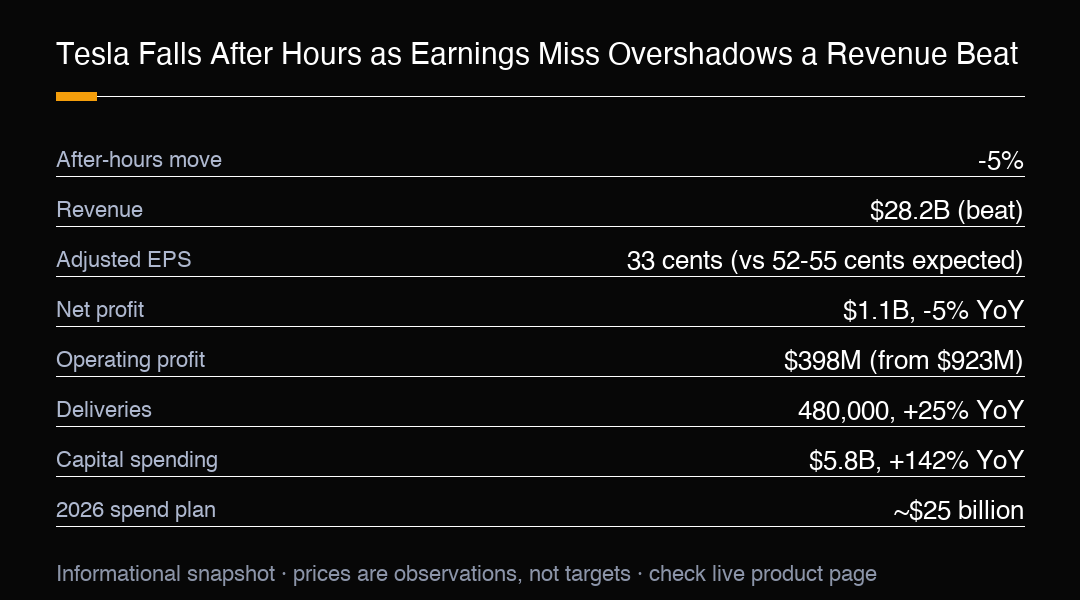
Tesla delivered the kind of quarter that splits a room. Revenue came in at $28.2 billion, ahead of estimates, and the company shipped a record 480,000 vehicles, up 25% from a year earlier. On paper that is a beat and a growth story. The market, however, fixated on the part that disappointed: adjusted earnings of just 33 cents per share, far below the roughly 52 to 55 cents analysts had modeled. Shares slid about 5% in after-hours trading, and the move captured exactly how the stock is now being judged.
The earnings miss was not a one-line footnote. Net profit totaled $1.1 billion, down about 5% from a year earlier, while operating profit fell much harder, to $398 million from $923 million. Automotive margins stayed under pressure even as volumes rose, which is the tension at the heart of the Tesla debate. Selling more cars is good. Making less money on each one is the part investors notice first, and they noticed it here. The gap between the operating line a year ago and today is the single clearest signal that the core business is carrying more weight for less return.
Beneath the current business sits the future the stock is really priced for. Capital spending surged 142% from a year earlier to $5.8 billion as Tesla pours money into factories, AI infrastructure and next-generation vehicles. Elon Musk said the company still plans to spend around $25 billion this year building its AI future, including ramping production of the Cybercab in Texas while keeping the Tesla Semi on track for a 2026 production launch. Investors usually tolerate big spending when it leads to bigger profits. Right now, they are still waiting for that second half of the equation, and the wait is getting priced into the shares.
The most talked-about moment on the call had little to do with cars. An analyst asked about SpaceX, and Musk acknowledged meaningful overlap between the two companies but quickly cooled any merger talk, saying an earnings call was not the place to debate it. He did point to deeper collaboration ahead, including plans to bring Grok, SpaceX's AI assistant, and Starlink satellite internet into Tesla vehicles. Synergies, yes. A merger announcement, not today. The episode underscored how much of the bull case now rests on connections and products that are not yet in the income statement.
That exchange captured the wider dynamic. Tesla trades as much on what it could become as on what it earns now. The robotaxi and AI narratives are powerful, but they sit alongside a car business where price cuts and competition have squeezed margins. When the earnings print shows the core struggling while the promise stays deferred, the premium valuation gets harder to defend. A stock priced for perfection leaves little room for an imperfect quarter, and this was one.
The record delivery number is worth holding onto. A 25% year-over-year increase to 480,000 vehicles shows demand is not collapsing, and it gives the company volume to amortize its manufacturing investments against. The problem is that volume alone no longer impresses a market that has seen the stock priced for perfection. Without margin recovery, each strong delivery quarter risks being read as 'more units, less profit.' The market has heard the growth story; what it wants now is proof the growth is profitable.
For traders, the setup is a familiar one. The stock is a battle between a compelling long-term story and a disappointing present. Bulls will argue the AI and autonomy spending is the right move and that margins will recover as newer platforms scale. Bears will point to the operating profit collapse and ask why a company with this much promise is posting this little current income. Both can be true at once, which is precisely why the shares whipsaw on every print. The after-hours drop is the market re-pricing the present while keeping the future on probation.
The bottom line is that Wednesday's report gave investors little fresh reason to pay tomorrow's prices for today's profits. Tesla beat on the top line and grew deliveries, but the earnings miss and margin pressure overshadowed the good news. Until the core business shows firmer profitability, the stock will keep trading on faith in the future rather than proof in the present. That is not a verdict on the company's potential; it is a statement about what the tape is rewarding today, and today it is rewarding earnings, not promises.
None of this changes the longer arc. Tesla remains the most followed carmaker in the world, with a brand, a manufacturing footprint and an AI narrative that few competitors can match. The delivery growth proves the products still resonate. What the market wants now is evidence that scale is starting to flow through to the bottom line, and this quarter did not provide it. The coming quarters, with new platforms and the Cybercab ramp, are where the bull case will be tested against the bear case in the only place that ultimately matters: the income statement.
Reading the print without the noise, the picture is a company at an inflection point. The top line is growing, the factories are running, and the AI optionality is real. But the profitability that once looked inevitable has, for now, slipped. That is the gap the after-hours move is pricing. Tesla has surprised skeptics before, and the history of the stock argues against counting it out. Still, the burden of proof has shifted, and the next few quarters will decide whether the promises become profits or merely persist as potential.
The after-hours move itself is informative. A 5% drop on a revenue beat is not a panic; it is a repricing of expectations. It tells you the market was paying for perfection and got a strong but flawed quarter instead. That is a healthy correction in sentiment, not a crisis in the business. The task for bulls is to show that the margin trend can turn before the premium fully compresses, and the next earnings call will be judged almost entirely on that single question.
Trading Insight
Tesla beat on revenue but missed badly on earnings, and the market is once again fixated on the gap between the AI story and current profitability. Until margins recover, the stock trades on promises more than results.