


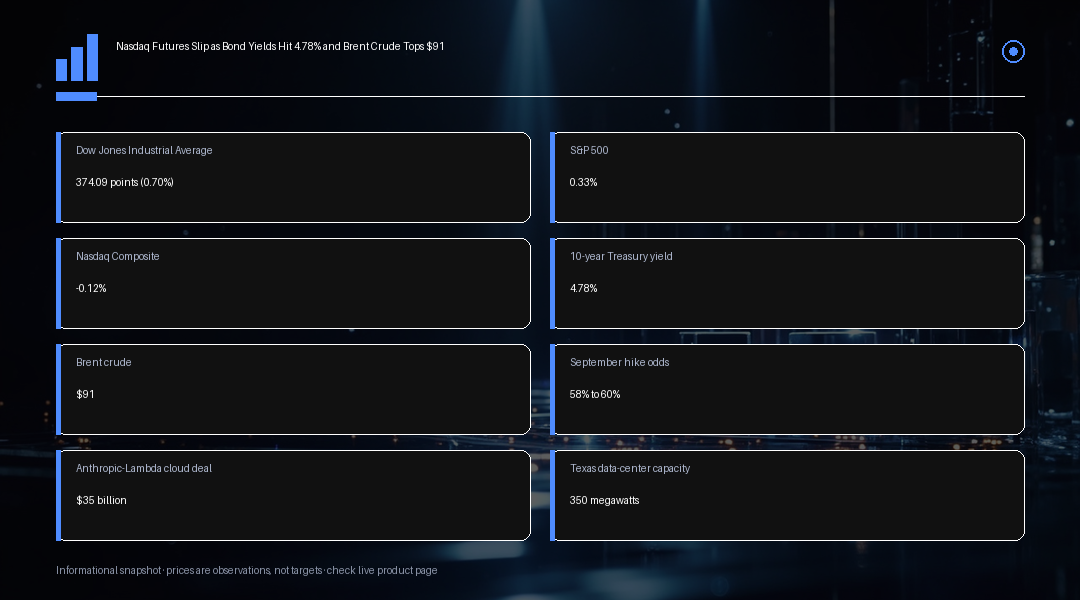
Wall Street opened September on a weaker footing after a soft finish to August. On Monday, August 31, the Dow Jones Industrial Average fell 374.09 points, or 0.70%, the S&P 500 lost 0.33% and the Nasdaq Composite slipped 0.12%. All three indexes still finished August with gains, but the tone shifted quickly as a fresh set of pressures built into the new month: a sharp move higher in bond yields, a jump in oil prices, and a batch of labor market data due later in the week.
The US 10-year Treasury yield climbed to around 4.78% on September 1 after touching approximately 4.768% intraday in the prior session, its highest level since January 15, 2025. Higher long-term yields make bonds more attractive relative to equities and reduce the present value of profits that technology companies are not expected to earn for several more years, which is why richly valued software and semiconductor names tend to underperform when yields move sharply higher. The move was not confined to the United States: Japan's 10-year government bond yield approached 3%, a level market commentary described as a multi-decade high, while long-dated German and French yields also pushed higher.
The yield move followed Federal Reserve Chair Kevin Warsh's hawkish remarks at the Jackson Hole symposium, which lifted market expectations for a September rate increase. Estimates for the probability of a hike varied across different market-pricing readings in the days that followed, clustering in a range of roughly 58% to 60%, with some readings running modestly higher depending on timing and methodology. Traders should treat any single probability figure as a snapshot rather than a fixed number, since it will keep moving with incoming economic data through the rest of the week.
Oil added another layer of pressure. Brent crude pushed above $91 a barrel during Asian trading on September 1, building on a prior US session settlement of $90.49, while West Texas Intermediate settled around $85.76. The move followed renewed fighting between the United States and Iran, which raised concerns about potential disruption to shipping through the Strait of Hormuz, a waterway that carries a substantial share of global oil flows, though there has been no confirmation that the route has actually been closed. Higher energy costs raise input costs for businesses and squeeze consumer spending power at the same time as they complicate the inflation picture the Federal Reserve is trying to manage, a combination that has historically weighed on risk assets even when the immediate trigger is geopolitical rather than economic.
Traders are also weighing a busy data calendar. The Labor Department's July JOLTS report on job openings was due September 1, followed by Friday's more closely watched nonfarm payrolls release. A stronger than expected reading on either report would tend to reinforce the case for a September hike, while a weaker print could ease pressure on yields and offer some relief to rate-sensitive technology shares. Separately, Nvidia received a fresh demand signal after Anthropic reportedly agreed to a cloud-computing deal worth roughly $35 billion with Nvidia-backed Lambda, according to people familiar with the matter, covering about 350 megawatts of data-center capacity at a Texas facility being developed by Hut 8. The scale of the reported deal underscores how much capital is still flowing into artificial intelligence infrastructure even as the broader market grapples with higher borrowing costs.
The pressure was not limited to the major indexes. Amazon shares remained under pressure following a separate advertising-related lawsuit from the FTC, while Shein's shares fell sharply in their Hong Kong trading debut, adding to a broadly cautious tone across individual names even though both situations were unrelated to the macro backdrop driving index-level moves. Gold and Bitcoin both traded lower alongside equities, consistent with a session in which higher real yields weighed on a range of asset classes rather than triggering the kind of rotation into traditional safe havens that geopolitical stress sometimes produces.
Within the technology sector, the yield-driven pressure showed up most clearly among chip-related names outside the United States. Japanese semiconductor and semiconductor-equipment stocks including Tokyo Electron, Renesas and Lasertec each declined between roughly 3% and 4% as the Nikkei slipped, illustrating how a global bond selloff can transmit quickly into the most rate-sensitive corners of the technology supply chain regardless of where a company is listed. Energy shares were a rare bright spot in an otherwise soft session, benefiting directly from the jump in crude prices, a reminder that a single macro catalyst such as an oil price spike can simultaneously help one sector while weighing on most others.
For traders, the interplay between bond yields, oil prices and Friday's payroll report is likely to set the tone for index direction through the rest of the week. A 10-year yield that keeps climbing would extend pressure on high-multiple technology names, while a meaningful retreat from current levels could offer near-term relief for the Nasdaq. Brent's move above $91 bears watching for signs of a durable geopolitical premium versus a short-lived spike; a quick fade back toward the prior week's range would suggest markets are pricing the Iran-related risk as contained, while a continued climb would signal growing concern about a broader supply disruption. Because the current setup combines a hawkish Fed narrative, rising energy costs and a still-uncertain jobs picture, traders should expect continued two-way volatility into Friday's report rather than a clean directional trend in either direction.
Trading Insight
For traders, the interplay between bond yields, oil prices and Friday's payroll report is likely to set the tone for index direction through the rest of the week. A 10-year yield that keeps climbing would extend pressure on high-multiple technology names, while a meaningful retreat from current levels could offer near-term relief for the Nasdaq. Brent's move above $91 bears watching for signs of a durable geopolitical premium versus a short-lived spike, while a continued climb would signal growing concern about a broader supply disruption.