


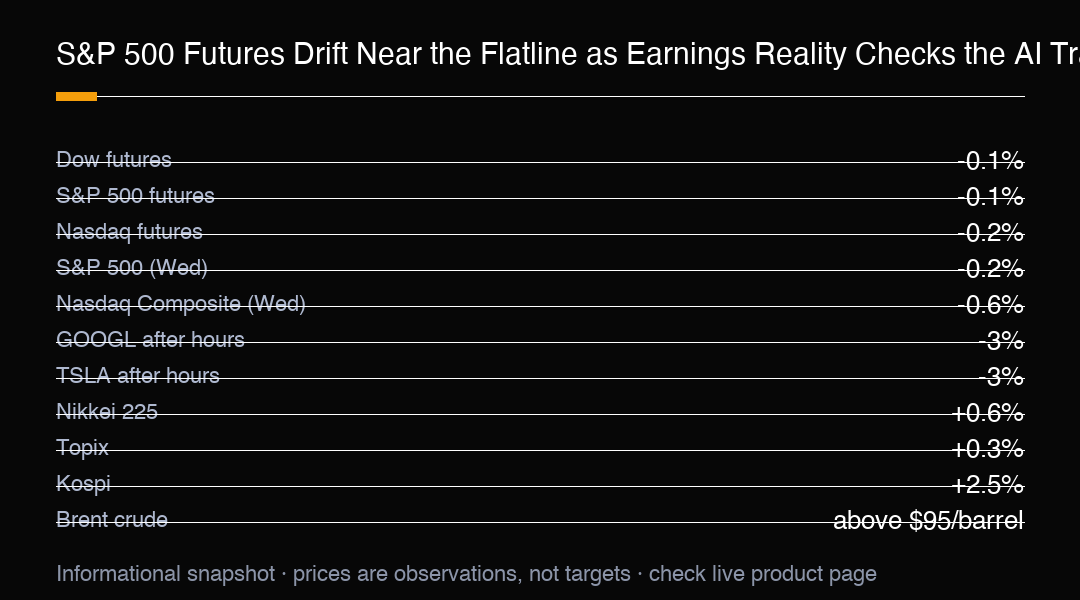
US stock futures drifted near the flatline early Thursday as Wall Street digested another round of heavyweight earnings. Dow futures slipped 0.1%, while S&P 500 and Nasdaq futures eased 0.1% and 0.2%, respectively. It was a collective shrug. Wednesday's regular session was just as uninspired: the Dow finished virtually unchanged, the S&P 500 dipped 0.2%, and the Nasdaq Composite lost 0.6% as investors hesitated to chase technology higher ahead of the results. The index is marking time, not making a statement.
The mood has shifted from 'AI hype' to 'show me the numbers.' Earnings season is entering its busiest stretch, and investors are becoming far less forgiving. The first mega-cap prints set the tone, and they were mixed enough to keep traders on the sidelines. The market is no longer content to reward a good story; it wants proof that the spending is producing profit. That change in posture is itself a market event, because it resets how much benefit of the doubt the index is willing to grant.
Alphabet fell about 3% after hours after raising its 2026 capital expenditure forecast to as much as $205 billion. Capex, short for capital expenditures, is the money a company sinks into long-term assets like AI data centers and chips. More spending signals confidence in the build-out, but it also raises the central question of when those investments actually pay off. Tesla also dropped roughly 3% after reporting adjusted earnings of 33 cents per share, well below expectations, even as revenue beat at $28 billion. Together the two reports reinforced a familiar lesson: beating estimates is not enough if investors were quietly hoping for magic.
The spillover matters because these two names sit at the center of the index. Alphabet and Tesla are not just holdings; they are sentiment gauges for the whole AI and growth complex. When they slip after results, the rest of the market tends to wait rather than lead. That is why futures barely moved: there was no new reason to take risk, and a couple of reasons to be cautious. The index follows its heaviest weights, and today those weights were the ones reporting.
Asia offered a brighter read overnight. Japan's Nikkei 225 gained 0.6%, the Topix rose 0.3%, and South Korea's Kospi jumped 2.5%, extending a recent rebound. The divergence is a reminder that the earnings-driven caution is, for now, a US mega-cap story more than a global one. Strength in Asian tech and semiconductor names suggests the AI build-out thesis still has believers abroad even as US investors pause. Regional markets can decouple for a session or two before the US tape pulls them back, but the split is worth noting.
Commodities added a wrinkle. Brent crude climbed above $95 a barrel, more than $20 above its early-July lows, as disruptions persisted across key global shipping routes. Higher oil complicates the inflation picture just as investors had started to believe price pressures were calming. For an index already nervous about margins and rates, a fresh energy shock is an unwelcome variable heading into the back half of the week. Energy prices feed directly into the inflation debate that sets the tone for rate expectations, and that debate is far from settled.
The calendar offers no rest. Thursday keeps the earnings conveyor belt moving, with American Airlines, T-Mobile, Union Pacific and Norfolk Southern reporting before the open and Intel headlining after the close. Weekly jobless claims also land today, giving traders another read on the health of the US economy. Each print is a potential catalyst that could break the index out of its wait-and-see drift, and the sheer density of the schedule means the flatline is a pause, not a destination.
The setup is delicate because expectations are already elevated. The S&P 500 does not need a miss to stall; it often fades when guidance merely meets a high bar. With oil firm, rates in focus and the biggest names having set a cautious tone, the path of least resistance is range-bound until something forces a decision. For now the market is content to watch, and the flatline is the signal. Traders should treat the calm as a coil being wound, not a trend that has ended, because the next two sessions of prints will decide which way it springs.
The bigger lesson for the week is that the index has become a referendum on the AI trade. Alphabet and Tesla are the two most visible expressions of that trade, and both stumbled after reporting. That does not mean the theme is broken; it means the market now demands evidence that the spending is paying off, not just promises that it will. Until the next cluster of results, the S&P 500 is likely to chop in a narrow band, with each earnings surprise acting as the spark that finally breaks the standoff between patience and proof.
For anyone watching the tape, the message is to stay nimble. A flat futures session is not neutrality; it is compressed energy. With the earnings calendar this dense and oil back above $95, the index is one print away from choosing a direction. The prudent read is that the mood is cautious but not bearish, and that the AI thesis is being tested rather than rejected. How the rest of the week's reporters handle their own numbers will tell us whether the flatline was a pause before the next leg or the top of the range.
In the end, the S&P 500 is waiting on proof. The AI build-out is real, the earnings are mostly fine, and the macro is stable enough. What is missing is conviction that the next quarter will be better than the guidance implies. Until that conviction returns, the index will hug the flatline, and every futures tick will be read as a verdict on a market that is still deciding what it is willing to pay for growth.
Trading Insight
The index is stuck in wait-and-see mode as earnings reality checks the AI narrative. With oil back above $95 and a heavy earnings slate ahead, the path of least resistance is range-bound until a fresh catalyst breaks it.