


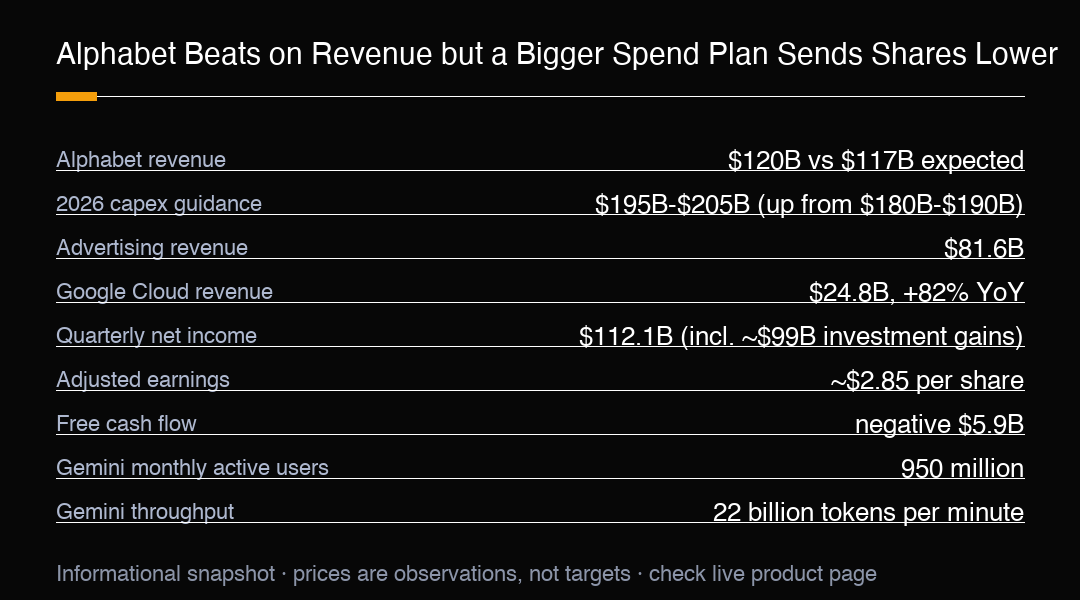
Alphabet delivered a quarter that looked like a victory on the surface and a warning sign underneath. The Google parent posted $120 billion in revenue, comfortably ahead of the $117 billion analysts expected, and adjusted earnings also beat forecasts. Yet the stock slipped after hours, because the market's attention snapped to what Alphabet said it intends to spend rather than what it just earned. In a market that has spent two years rewarding artificial-intelligence winners, the reaction was a reminder that even the winners are now being graded on cost as much as on growth.
The flashpoint was capital expenditure. Alphabet raised its 2026 capex guidance to a range of $195 billion to $205 billion, up from the prior $180 billion to $190 billion. Capex is the money a company pours into long-lived assets such as AI chips, servers and data centers. For most of the past decade that spending was welcomed as the cost of staying ahead. At this scale, it reads less like a line item and more like a bet the size of a small economy, and investors began asking when the returns would show up. The revision matters because it signals the build-out is accelerating, not peaking, and the market had hoped the opposite.
The core businesses told a strong story. Advertising revenue reached $81.6 billion, narrowly beating estimates, while Google Cloud stole the spotlight with 82% year-over-year growth to $24.8 billion, well beyond expectations. Cloud has become one of Wall Street's favorite ways to track whether artificial intelligence is actually translating into revenue, and the answer here was clearly yes. Google also said its Gemini AI app now has 950 million monthly active users and processes 22 billion tokens per minute, a reminder of how quickly the AI ecosystem around Search is scaling. Those are not vanity metrics; they show the products are being used at a scale few peers can match.
The headline profit figure deserved a closer look. Alphabet reported $112.1 billion in quarterly net income, but roughly $99 billion of that came from gains on equity investments, much of it tied to stakes in companies such as Anthropic and SpaceX. Strip those investment gains out and adjusted earnings landed near $2.85 per share. That is still a solid result, but it is far less dazzling than the top-line number implied, and it is exactly the kind of gap that makes a fundamentals-focused investor pause. The market has learned to separate operating performance from mark-to-market gains, and on the operating line the quarter was good rather than spectacular.
One number raised eyebrows more than any other: free cash flow turned negative $5.9 billion as Alphabet funneled cash into AI infrastructure. Negative free cash flow is not unusual for a company in a heavy build-out phase, and Alphabet can fund it comfortably from balance sheet and operations. Still, the signal is clear. The AI race is expensive, and the bills are arriving faster than the profits in some parts of the income statement. For a company that historically generated cash with remarkable consistency, a negative print is the kind of detail that gets discussed on every earnings call until it turns positive again.
The market's reaction fits a pattern that has repeated across mega-cap tech this cycle. Investors will forgive a lot when growth is obvious, but they turn impatient the moment a company asks them to fund a much larger future while current margins soften. Alphabet is not in trouble; it is in the middle of the most capital-intensive chapter of its history, and the stock is now being graded on discipline as much as on innovation. The question is no longer whether the AI strategy is real, but whether the spending will be rewarded with returns before patience runs out.
What comes next is a test of narrative versus numbers. If cloud growth stays near 82% and the AI products keep adding users, the spend will look prescient. If growth cools even slightly while capex keeps climbing, the same investors who cheered the AI story will question the pace. For now, the market has voted with a lower after-hours price, betting that the spending will take longer to pay off than the headline earnings suggested. That is a reasonable stance when the proof of a giant build-out is still a few quarters away.
There is a second thread worth watching. The investment gains that flattered net income are themselves a sign of how entangled Alphabet has become with the broader AI startup world through stakes in private companies. Those paper gains can swing with private-market sentiment, so they should not be read as recurring operating cash. The durable story is the advertising and cloud businesses, and both are healthy. The risk is that the market starts to discount the headline and focus on the cash engine underneath.
For the broader market, Alphabet's report is a useful compass. The company is the heaviest weight in several major indices and a bellwether for the AI trade that has carried the bull market. When its shares dip on a strong quarter, it tells you the bar for mega-cap tech has moved from 'show growth' to 'show discipline.' That reset in expectations can weigh on the whole index even when the underlying business is fine, because these names move together. Investors should read the after-hours slip as a message about sentiment, not just about one company's spreadsheet.
The takeaway for readers is simple. Alphabet's quarter was genuinely strong on the parts that matter for the long term, but the company is choosing to spend aggressively to defend its position in artificial intelligence. That choice is defensible, even smart, yet it shifts the burden of proof onto future quarters. Until then, the stock will trade on a question the earnings call could not fully answer: when does the spending start paying for itself? Investors who believe in the AI thesis will see a temporary cash dip; skeptics will see a warning. Both are reading the same numbers.
Trading Insight
Alphabet's quarter shows the AI build-out is real and monetizing fast, but the market is now punishing heavy spend over headline profit. The capex trajectory, not the beat, is what traders will watch into the next print.