


The UK economy grew 0.4% in the second quarter of 2026, matching consensus forecasts but slowing from the 0.6% pace recorded in the first quarter. The reading is neither a breakout number nor a recession signal. It describes an economy that is still expanding, just at a noticeably gentler pace than earlier in the year. June's monthly GDP figure added a modestly encouraging footnote, rising 0.3% from May and beating expectations after growth had flatlined the month before.
Services output, the backbone of the UK economy, rose 0.4% in June, with the quarter's expansion led by information and communication activity, up 2.7% over the quarter. Consumer-facing sectors also got a lift from an unusual combination of catalysts: a stretch of record-hot summer weather and a men's football World Cup that together boosted spending at pubs, in clothing retail, and online. It is a reminder that even a modest headline growth number can hide a genuinely mixed set of underlying drivers.
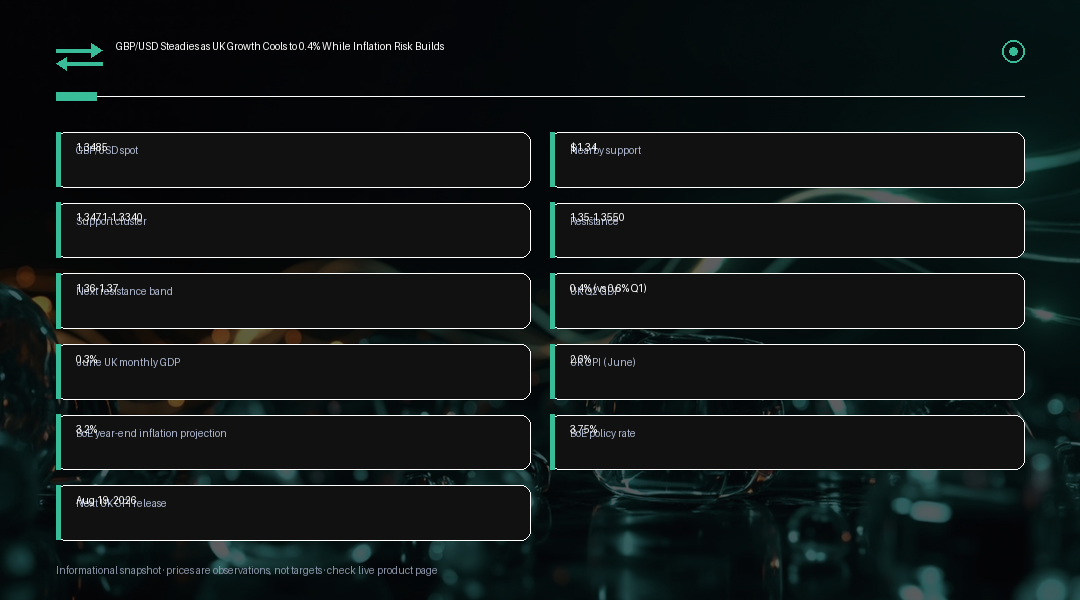
In currency markets, GBP/USD has been trading just under $1.35, recently changing hands near 1.3485, as traders weigh the UK's resilient-but-slowing growth story against a softer US dollar. The greenback lost some support after benign US consumer inflation data reduced near-term expectations for a Federal Reserve rate increase in September. That dynamic has offered sterling some breathing room, though Thursday's US producer-price report is the next data point capable of shifting the calculation quickly in either direction.
The inflation backdrop is where the story gets more complicated for UK policymakers. Headline UK inflation eased to 2.6% in June, a 15-month low, yet the Bank of England's own central projection sees inflation accelerating back toward 3.2% by the end of the year as elevated energy costs work their way through household bills and business costs. The Bank held its policy rate at 3.75% at its July 30 meeting, but the vote was closer than it might appear: three of nine Monetary Policy Committee members favored an immediate increase to 4%. Markets currently price roughly a one-in-three chance of a September hike, while most economists still expect the Bank to hold steady through the remainder of 2026. The next inflation reading, covering July, is due August 19 and will be watched closely for signs of whether that energy-driven pickup is already showing up in the data.
Put together, the combination facing the UK is an awkward one: growth that is cooling rather than accelerating, alongside an inflation path that the central bank itself expects to get worse before it gets better. That is not the kind of setup that typically produces decisive central-bank action in either direction, which helps explain why the Bank has so far preferred to hold rather than tighten preemptively, even with three members pushing for an increase in July.
For UK households, the practical takeaway is less abstract than the underlying data suggests. Slower growth combined with a re-acceleration in inflation is one of the least comfortable combinations for real incomes, since wages typically take longer to catch up with prices during exactly this kind of environment. Businesses face a parallel squeeze: energy costs that feed into input prices arrive well before pricing power allows companies to pass those costs on to consumers, particularly in competitive retail and hospitality sectors that also benefited from the World Cup- and weather-driven spending boost this summer.
The pound's next move will not be decided by UK data in isolation. Cable trades at the intersection of two central banks' policy paths, and the current setup, a resilient but unspectacular UK economy against a Federal Reserve that markets currently expect to hold steady into September, is why GBP/USD has held a relatively narrow range beneath $1.35 rather than breaking decisively in either direction. Any broadening of the US-UK rate differential, in either direction, is likely to matter more for the pair over the next fortnight than incremental revisions to UK growth data alone.
On the charts, GBP/USD continues to respect a familiar structure. $1.34 remains the nearest meaningful support, with a broader support cluster in the 1.3471-1.3340 area underneath that. On the upside, resistance is mapped at 1.35-1.3550, with a deeper band at 1.36-1.37 above that. A hot July inflation print on August 19 would likely revive Bank of England rate-hike chatter and could lend sterling support on a break above 1.3550, while a cooler print would probably reinforce the case for a longer policy pause and leave the pair more vulnerable to a retest of the lower support band.
Trading Insight
The setup into the next two weeks of UK and US data is genuinely two-sided rather than a one-way sterling trade. A resilient UK growth print removes one source of downside risk for the pound, but the more powerful driver from here is likely to be the inflation path: if the July CPI release on August 19 shows energy costs accelerating faster than the Bank of England's own 3.2% year-end projection, market pricing for a September hike could move up quickly from its current roughly one-in-three level, and GBP/USD would have a reasonable case to push through 1.3550 and test the 1.36-1.37 band above. A softer July print, by contrast, would support the case for a longer Bank of England pause and could pull the pair back toward $1.34, with a deeper retreat toward the 1.3471-1.3340 support cluster possible if US data over the same period turns more dollar-supportive. Thursday's US producer-price report and next week's UK jobs data are worth watching alongside the headline inflation figures, since a hawkish US surprise could offset even a firm UK number by lifting the dollar broadly. Traders should treat $1.35 as the key pivot: sustained trade above it keeps the recovery narrative intact, while a slide back under $1.34 would suggest the market is starting to price in the growth-slowdown side of the story more than the inflation-risk side.