


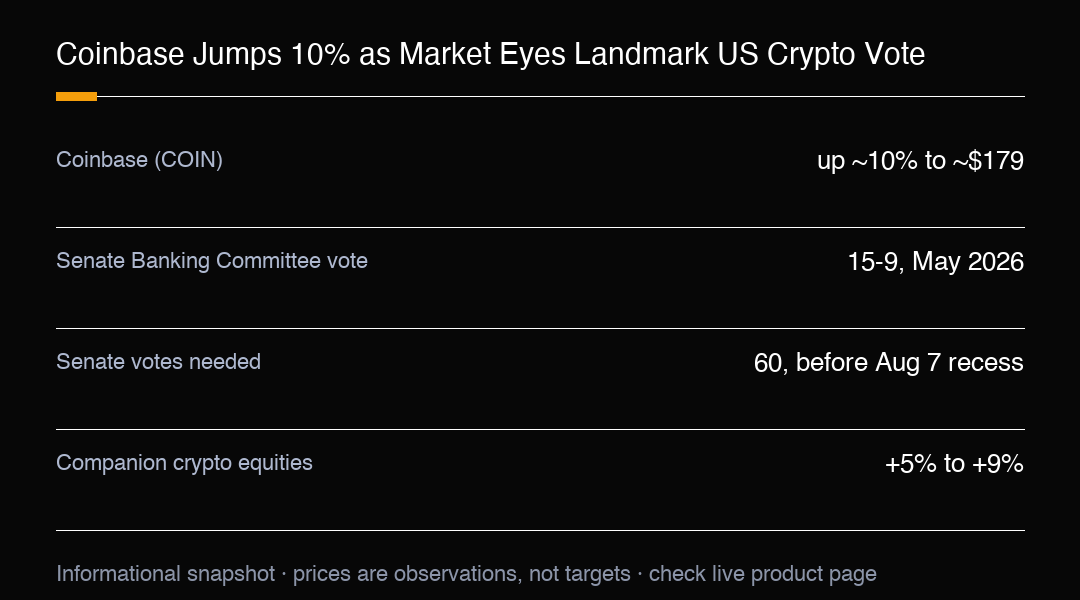
Coinbase shares jumped about 10% to roughly $179 on Tuesday, leading a broad rally across crypto-linked equities. The move came as investors positioned ahead of a closely watched US Senate vote on the CLARITY Act, a bill that would overhaul how digital assets are regulated in the United States.
The optimism was not limited to one name. Other crypto-linked companies also advanced, with several posting gains in the 5% to 9% range as sentiment toward the sector turned sharply positive. The market is reading the coming vote as a potential turning point for an industry that has long operated in a grey zone.
The CLARITY Act aims to do something the market has wanted for years: draw a clean line between the agencies that oversee securities and those that oversee commodities, and give crypto firms a clear rulebook. For most of the past decade, companies have juggled overlapping and sometimes contradictory expectations, a drag that the bill is designed to remove.
The legislative path is concrete. The proposal passed the House in July 2025, cleared the Senate Banking Committee 15-9 in May 2026, and is scheduled for a full Senate floor vote during the week of this publication. To become law it needs 60 Senate votes before the August 7 congressional recess, a narrow but achievable bar if momentum holds.
Why the market cares is simple: clearer rules lower legal risk and open the door to far more institutional capital. Pension funds, banks and large asset managers have largely watched from the sidelines because the regulatory picture was too uncertain. A defined framework changes the calculus, and the exchange that sits closest to that flow stands to benefit most.
The bill would also set expectations for how traditional financial institutions can offer custody, trading and lending around digital assets. That widens the pool of potential users well beyond today's active traders. For an exchange whose revenue tracks activity and adoption, a larger, more confident user base is the prize.
Beyond the headline vote, the bill signals a shift in how Washington views the asset class. After years of enforcement-led uncertainty, a statute that spells out who regulates what would replace ambiguity with a process. Markets tend to reward predictability, even when the rules are strict, because they let participants plan instead of guessing.
There is also a knock-on effect for the broader crypto complex. A US framework rarely stays domestic for long; other jurisdictions watch American rulemaking as a template. A clear US law can ease the path for global operators and encourage conservative allocators abroad to treat digital assets as a sanctioned, if still volatile, part of a portfolio.
None of this is guaranteed. Floor votes can slip, amendments can dilute the original intent, and a single procedural hurdle can push the timeline past the recess. Traders are pricing in a favorable outcome, which means any delay or setback could be punishing for stocks that have already run hard.
The risk cuts both ways. A watered-down bill might pass yet disappoint the market by leaving key questions unresolved, while a clean passage could remove the very uncertainty that has been suppressing institutional flows. Either way, the outcome will reset expectations for the sector's next move.
For now, the narrative is firmly risk-on. The sector is treating the week as its moment, and the price action reflects a belief that the US is finally close to giving digital assets a workable home. Whether the Senate delivers will shape the next leg for the whole crypto-equity complex.
What happens after the vote may matter as much as the vote itself. Passage is a starting line, not a finish: the details of implementation, the agencies' rulemaking and the first enforcement actions under the new law will all test whether clarity translates into the adoption the market is hoping for.
For the exchange at the center of the move, the stakes are unusually direct. It sits at the intersection of retail trading, institutional onboarding and the custody rails that a clearer regime would legitimize. If the law does what supporters expect, the addressable market expands well beyond the current base, and the rally that began on Tuesday starts to look like a preview rather than a spike.
The honest caveat is that regulation is only one input. Token prices, rate expectations and overall risk appetite will keep driving the sector's day-to-day swings regardless of Washington. A landmark law can change the ceiling over time, but it cannot remove the volatility that defines the asset class in the short run.
If the week goes well for the bill's backers, the conversation will quickly turn from whether the law passes to how fast capital arrives. That second question is harder to answer, because institutions move on their own clocks, and compliance teams will want to see the final text before committing size. The rally is a bet that the door is opening; the size of the room beyond it is still unknown.
For everyday market participants, the practical takeaway is simpler than the legal text. A clearer rulebook tends to mean more durable liquidity and a steadier platform for the asset class, which matters more than any single day's move. Tuesday's 10% pop is the headline; the quieter story is whether the foundation under it gets stronger.
The session was a reminder that policy milestones can move markets as much as price action can. A single vote in Washington reframed the outlook for an entire sector in a matter of hours, and the size of the move shows how much pent-up demand was waiting for a clearer signal. The question now is whether the signal holds.
Worth noting is that the rally lifted the whole crypto-adjacent complex, not just the headline name. When breadth across a theme is this wide, it usually reflects a shift in narrative rather than a one-off earnings beat, which is why the move is being read as structural rather than incidental. That is precisely what gives the advance a better chance of sticking.
Trading Insight
The stock led a sector-wide rally on hopes that clearer US regulation will unlock institutional capital. The Senate floor vote this week is the catalyst; a slip past the August 7 recess would be the key risk.