


US stocks slumped on Wednesday as three separate pressures converged at once: an extended slide in chip shares, a fresh climb in oil prices, and a Federal Reserve decision that, while widely expected, revealed a central bank far from unified on how to handle a stubborn inflation backdrop. Equities had briefly pared their losses immediately after the Fed's announcement, as the decision to leave rates unchanged removed one source of uncertainty, but the relief proved short-lived once the scale of the internal disagreement, and the broader macro backdrop, came back into focus.
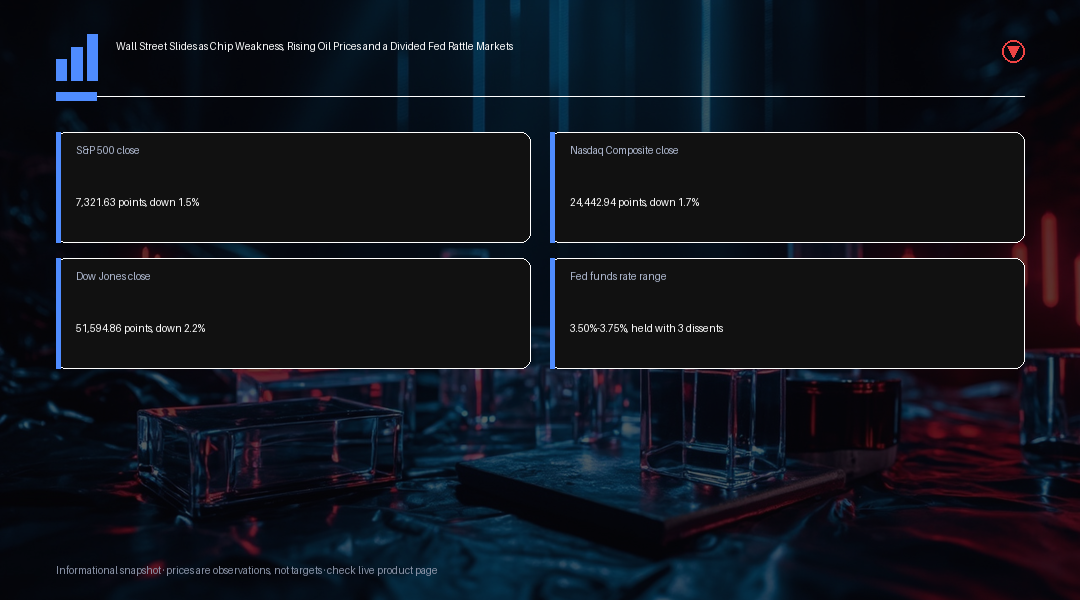
The Federal Open Market Committee kept the federal funds rate unchanged at a range of 3.50%-3.75%, leaving the spotlight on new Chair Kevin Warsh's post-decision remarks. The rate call itself was not the story; the dissent was. Three regional Federal Reserve presidents, Beth Hammack, Neel Kashkari and Lorie Logan, voted against holding rates steady and instead favored raising rates by 25 basis points, a level of internal disagreement that underscored how divided policymakers remain over how aggressively to respond to resurgent inflation pressure tied in part to the conflict in the Middle East.
The Fed's task has been complicated by a volatile run in oil prices stretching back to its last policy decision in mid-June. At that meeting, elevated crude prices had prompted nearly half of the committee's members to pencil in additional rate hikes for the year. Oil then eased following the signing of an interim peace arrangement between the United States and Iran, only for that arrangement to fall apart this month, triggering a fresh resurgence in crude prices that has once again complicated the inflation outlook policymakers are trying to manage.
At his post-decision press conference, Warsh described the internal FOMC discussion as a "good family fight," characterizing it as an "active, robust" debate that centered on four themes: persistent inflation, recent economic shocks, the price pressures flowing from those shocks, and the broader toolkit available to monetary policymakers. Warsh also pushed back on the idea that the three dissents told the full story of the meeting, saying they did not "capture the full essence of the discussion," and separately noted that softer June inflation data had only a modest influence on the final rate decision.
With the Fed decision digested, attention shifted quickly to the earnings due from two of the market's most closely watched AI spenders, Microsoft and Meta Platforms, both reporting after Wednesday's closing bell. Their results were widely seen as the next major test for a slumping artificial intelligence trade that has already been under pressure from valuation concerns and a broader rotation out of chip-heavy names in the days leading up to this week's reports.
By the close, the damage across the major averages was broad. The S&P 500 shed 1.5% to end the session at 7,321.63 points, the tech-heavy Nasdaq Composite declined 1.7% to close at 24,442.94 points, and the blue-chip Dow Jones Industrial Average fell 2.2% to settle at 51,594.86 points. The decline reflected the extended pullback in semiconductor and AI-linked names layered on top of the macro uncertainty from the Fed decision and the renewed climb in oil prices.
Not every market participant read the session as a turn toward outright bearishness. "I don't believe the overall environment is bearish now, while it is not especially bullish either. Revenues and earnings coming out now are generally very strong, inflation does seem to be coming down, etc. There is a rotation going on certainly in chips and related companies that probably got too extended and into more value names," said Peter Tuz, president at Chase Investment Counsel, adding that the market would be watching to see whether the rotation continues as more megacap companies report results this week and next.
The cross-asset picture reinforced the sense of a market caught between competing narratives. Higher oil prices tied to the fraying US-Iran arrangement fed directly into the same inflation debate that produced three FOMC dissents, while a Fed seen as more divided than expected has historically added a modest risk premium to longer-dated Treasury yields as markets price a wider range of possible policy paths. That combination, rising energy costs and a less unified rate-setting committee, tends to weigh hardest on the most richly valued growth names, which helps explain why chip and AI-linked stocks bore a disproportionate share of the session's losses even though the headline rate decision itself matched expectations.
Looking ahead, the market's next read on this tension will come quickly. Microsoft and Meta's results, delivered just hours after the close, were always going to be treated as a referendum on whether AI-related spending can keep justifying premium valuations, and Wednesday's broad-based index weakness raised the stakes for both reports to reassure rather than unsettle already jittery positioning.
Trading Insight
For traders, the session captured a market trying to reconcile three separate signals at once: a still-resilient earnings backdrop, a Fed that held rates steady but showed clear internal division over inflation risk, and an oil market that keeps reintroducing cost-push inflation pressure whenever Middle East tensions flare. That combination argues for treating index weakness as a rotation-driven pullback rather than a broad-based bear signal for now, particularly given Peter Tuz's observation that underlying revenue and earnings trends remain solid. The more important swing factor into the next few sessions will be how Microsoft and Meta's results, and their forward spending guidance, are received, since a continuation of heavy AI capex without matching profit growth could extend the chip-sector rotation, while oil's trajectory will remain a key input for how much latitude the Fed has to look past near-term inflation noise. A move back above the S&P 500's 7,321.63 points close would help confirm the pullback is stabilizing, while a slide toward fresh lows alongside further oil strength would raise the risk of a deeper, more macro-driven drawdown, particularly if rising energy costs and a more hawkish-leaning dissent bloc at the Fed begin to feed off one another.