


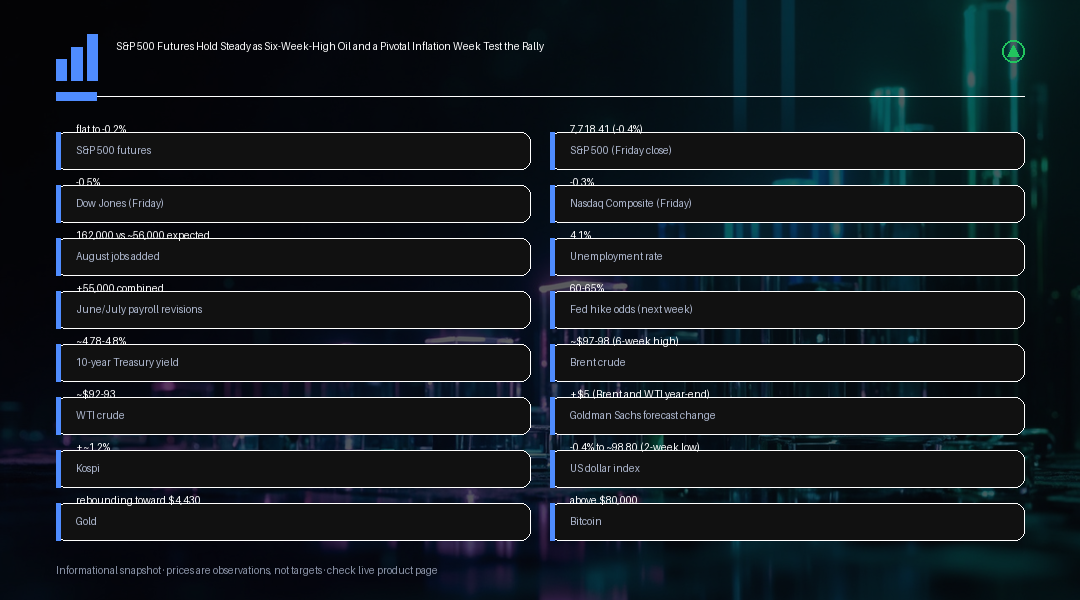
Wall Street is heading back to work with a hangover it did not get the usual long weekend to sleep off. S&P 500 futures were flat to slightly lower Tuesday, down around 0.1-0.2%, in the first session since US cash markets closed for Friday's trading and then shut entirely for Monday's Labor Day holiday. The mood is cautious rather than alarmed, but caution is doing a lot of work given everything traders now have to digest at once.
That backdrop starts with Friday's close, when the S&P 500 fell 0.4% to 7,718.41, the Dow lost 0.5% and the Nasdaq slipped 0.3% after an August jobs report that arrived far stronger than anyone expected. The US economy added 162,000 positions against a forecast of roughly 56,000, while unemployment held steady at 4.1% and June and July payrolls were revised higher by a combined 55,000. Resilient hiring is good news for workers, but it complicated the market's expectations for interest-rate relief almost overnight.
Traders now price roughly a 60-65% probability that the Federal Reserve raises rates by a quarter point at its meeting next week, up sharply from where odds sat before the jobs data landed. The ten-year Treasury yield has held near 4.78-4.8% as a result, offering bond investors more competition for capital that might otherwise flow into equities, particularly the richly valued growth names that are most sensitive to higher discount rates.
Oil is compounding the inflation anxiety rather than offsetting it. Brent crude has pushed to roughly $97-98 a barrel, its highest level in about six weeks, with WTI trading near $92-93, both up for a third straight session after Iran warned that Gulf energy infrastructure could come under attack following retaliatory strikes involving American and Iranian vessels. Goldman Sachs has responded by raising its year-end forecasts for both Brent and WTI by $5 a barrel. Energy producers stand to benefit from higher prices, but the broader index faces a less favorable trade-off, since rising fuel and transportation costs squeeze corporate margins, weigh on consumer spending, and give the Fed one more reason to keep policy tight.
The handover from Asia was mixed rather than uniformly weak, which is itself a signal that markets have not fully tipped into risk-off mode. South Korea's Kospi gained around 1.2% and the broader Asia-Pacific index added roughly 0.2%, while Australian equities fell about 0.6%. Japan's Nikkei struggled for a different reason: a sharply stronger yen mechanically reduces the yen value of profits that Japanese exporters earn overseas, a headwind that has little to do with the same inflation narrative weighing on US futures.
This week's inflation calendar is now the market's swing factor. US producer prices are due Thursday, with the Consumer Price Index following Friday. Hot readings on either would reinforce the case for a September hike and could pressure rate-sensitive sectors further, while softer prints could ease yields and revive the rally that stalled on Friday. Crude approaching the psychologically important $100 mark makes declaring an early victory over inflation increasingly difficult, regardless of what the CPI print itself shows.
Cross-asset markets, notably, have stayed calmer than the headlines might suggest. The US dollar index has slipped roughly 0.4% to a two-week low near 98.80, which has helped gold rebound toward $4,430 an ounce and allowed Bitcoin to hold above $80,000 even as equity futures wobble. That kind of dispersion, rather than a uniform flight from risk, suggests markets are still treating this week's setup as a data-dependent pause rather than the start of a broader deleveraging.
Two additional catalysts round out the week. Apple's product event Wednesday, headlined by its first foldable iPhone, adds a major single-stock risk to an index in which technology carries heavy weight, while the European Central Bank is expected to raise its own rates Thursday, adding a second global monetary-policy decision to a calendar already dominated by US inflation data. For S&P 500 traders, the combination means Thursday and Friday carry outsized importance: a benign inflation outcome paired with an uneventful ECB decision would likely support a relief rally back toward last week's levels, while a hot CPI print stacked on top of $100 oil would give the market its clearest reason yet to reprice for a more hawkish Fed than it had assumed just two weeks ago.
Sector positioning is likely to reflect that split outcome even before the data lands. Energy shares have been among the few consistent outperformers as Brent and WTI have climbed for three straight sessions, while rate-sensitive growth stocks and small caps have lagged given their greater sensitivity to a higher-for-longer Fed path. Defensive sectors such as utilities and consumer staples, which tend to hold up better when bond yields rise, have also drawn interest as investors hedge against the possibility that this week's inflation prints confirm rather than calm the market's rate-hike anxiety.
History offers a reasonable playbook for what happens next. Markets have repeatedly shown that a single strong jobs report does not guarantee a hawkish outcome if inflation data cooperates in the days that follow, and Friday's initial selloff already reflects a meaningful repricing of Fed expectations rather than a fresh shock. That leaves this week's PPI and CPI releases as the genuine tie-breaker: traders who are already positioned for volatility around Thursday and Friday are effectively betting that the index's next big move, in either direction, will be decided by inflation data rather than by the jobs report that has already been fully absorbed into current pricing.
Trading Insight
The setup into Thursday's PPI and Friday's CPI is a genuine two-way risk for the S&P 500, with futures only modestly lower (~0.1-0.2%) despite a hawkish jobs report, oil near six-week highs (~$97-98 Brent), and Fed hike odds near 60-65%. That combination argues against chasing either direction aggressively before the data: a soft inflation print could spark a fast relief rally back toward 7,750-7,800, while a hot print stacked on $100-adjacent crude would likely accelerate the pullback from Friday's 7,718.41 close. Keep half an eye on Apple's Wednesday event too -- a large single-stock surprise in either direction could move the tape independently of the macro calendar this week.