


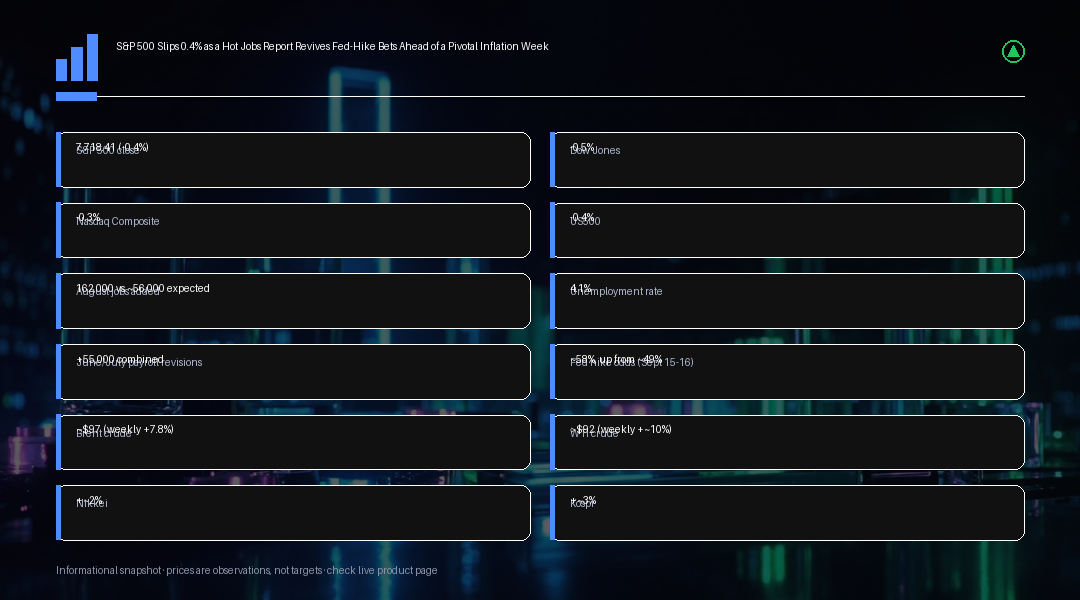
The S&P 500 closed Friday down 0.4% at 7,718.41, with the Dow Jones Industrial Average off 0.5% and the Nasdaq Composite slipping 0.3%, after an August jobs report that was simply too strong for a market that had been leaning on the idea of a cooling labor market. With US cash markets closed Monday for the Labor Day holiday, that Friday close is the freshest read on sentiment heading into a week that could reshape the interest-rate outlook.
The report itself was a genuine surprise. The US economy added 162,000 jobs in August, nearly three times the roughly 56,000 economists had penciled in, while unemployment held steady at 4.1% and labor-force participation ticked up. June and July payrolls were also revised higher by a combined 55,000, reinforcing the picture of a labor market that is not slowing anywhere near as quickly as some had expected.
That is where the market's "good news is bad news" dynamic kicks in. A resilient jobs market removes one of the strongest arguments policymakers had for easing, and traders responded by pushing the implied probability of a quarter-point Federal Reserve hike at the September 15-16 meeting up to roughly 58%, from about 49% before the report. Higher rates raise borrowing costs across the economy and reduce the present value of future corporate earnings, a dynamic that tends to hit richly valued growth stocks hardest, since more of their expected profits sit further out on the calendar.
Energy markets added a second inflationary thread to the story over the weekend. Brent crude approached $97 a barrel and WTI climbed above $92 after the US and Iran exchanged attacks on vessels around the Strait of Hormuz, a passage that normally carries roughly one-fifth of the world's oil-transit volume. Shipping traffic through the strait fell to its lowest level since May as the market priced in the risk of a longer disruption, with Brent up 7.8% and WTI up nearly 10% on the week. Higher energy costs feed directly into transportation, manufacturing and consumer prices, arriving at an inconvenient moment just as the Fed weighs whether to tighten policy again.
Asian markets, by contrast, opened the new week on a stronger footing. Japan's Nikkei gained around 2% and South Korea's Kospi jumped approximately 3%, helped by strength in semiconductor shares, suggesting at least part of the region chose to lean into the stronger-growth read on the US data rather than the rate-hike read. Whether Wall Street follows that more optimistic interpretation once trading resumes Tuesday may depend heavily on how close Brent crude gets to the psychologically significant triple-digit mark in the meantime.
That split reaction, Asia leaning into the growth story while US futures traders leaned into the rate-hike story, is a useful illustration of how differently the same data point can be read depending on what a market is most worried about. Export-heavy Asian economies with semiconductor-driven indices tend to respond well to signs of resilient US demand, since it points to continued strength in end markets for their products. US equity investors, by contrast, are more immediately exposed to the discount-rate mechanics of higher Treasury yields, which is why the same jobs report produced a rally in Seoul and Tokyo but a pullback on Wall Street.
Bond and currency markets are worth watching alongside equities this week for early confirmation of which narrative is gaining ground. A further rise in Treasury yields alongside a firmer dollar would tend to confirm the market is leaning further into the rate-hike case, reinforcing pressure on rate-sensitive equity sectors, while a stabilization or pullback in yields even after a hot inflation print could suggest the market views current Fed pricing as close to a ceiling rather than the start of a more aggressive tightening cycle.
The coming week's inflation data is really where this story gets decided. US producer prices are due Thursday, offering an early signal on cost pressures still working their way through supply chains, while the more closely watched Consumer Price Index follows on Friday and should carry more weight in determining whether the Fed actually moves at its September meeting. A hot combination of strong hiring and firm inflation would build a persuasive case for tightening, likely lifting Treasury yields further and pressuring technology, real estate and other rate-sensitive sectors that led much of the market's earlier gains.
A softer CPI print, on the other hand, could weaken the case for a September hike and give equities room to recover the ground lost on Friday, though the parallel surge in oil prices means one encouraging monthly inflation reading may not be enough on its own to settle the debate. That combination, resilient jobs data pulling one way and an oil-driven inflation risk pulling another, is precisely why this week's PPI and CPI releases carry outsized importance for how the S&P 500 trades from here.
With Tuesday marking the week's first full trading session, traders will be watching Treasury yields, energy shares and semiconductor leadership closely at the reopen for early signals on which narrative is gaining the upper hand. The S&P 500 finished last week essentially flat on a net basis, and this week's data flow looks set to finally force a clearer directional decision.
For traders, the setup into Thursday's PPI and Friday's CPI is genuinely two-sided rather than a one-way bet. A hawkish inflation surprise stacked on top of Friday's hot jobs data would be the cleanest bearish combination for rate-sensitive parts of the index, while a cooler set of inflation prints could ease some of the hike pressure built up since Friday, even with oil prices still elevated in the background.
Trading Insight
The S&P 500's 0.4% Friday pullback reflects a market recalibrating Fed-hike odds higher after a much stronger than expected jobs report, with Brent crude's Hormuz-driven surge adding a second inflation threat. Watch Thursday's PPI and Friday's CPI closely: a hot combination would reinforce the ~58% odds of a September hike and pressure rate-sensitive sectors, while a cooler CPI print could revive the rally that stalled on Friday.