


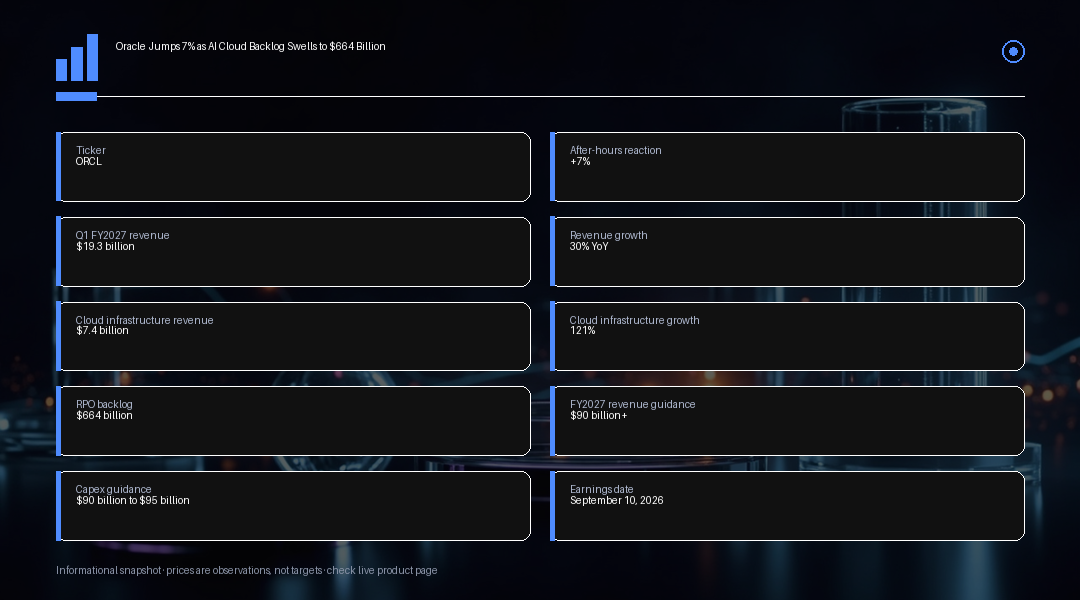
Oracle shares climbed about 7% in after hours trading on September 10, 2026, after the software giant delivered a fiscal first quarter that beat Wall Street's expectations on nearly every meaningful line. The rebound offered a welcome change of direction for a stock that had entered the results down more than 20% for the year, as investors had grown increasingly nervous about how much cash Oracle was burning to build out its artificial intelligence cloud business.
Revenue for the quarter rose 30% from a year earlier to $19.3 billion, comfortably ahead of the $19.14 billion analysts had penciled in, while adjusted earnings reached $1.92 a share against a consensus estimate of $1.74. The standout number sat inside the cloud division. Oracle's cloud infrastructure revenue, the business that rents out computing capacity to companies training and running AI models, surged 121% to $7.4 billion, while total cloud revenue across infrastructure and applications rose 62%, reaching $11.6 billion.
The figure that mattered most to long term investors was Oracle's backlog. Remaining performance obligations, meaning contracted business not yet booked as revenue, climbed to $664 billion after Oracle signed more than $30 billion of new AI cloud contracts during the quarter alone. That backlog is now $209 billion higher than a year ago and $26 billion higher than the prior quarter, giving Oracle an unusually clear window into future revenue, with management indicating that roughly half of it should convert into recognized sales within the next 36 months.
None of that growth has come cheap. Oracle spent $28.5 billion on capital expenditure in the quarter, more than its entire quarterly revenue, as it keeps building the data centers, chips and power infrastructure needed to serve AI customers, and the company continues to guide toward annual capital spending of $90 billion to $95 billion. Free cash flow came in at negative $5.4 billion for the quarter, a burn rate that sounds alarming in isolation but was actually far better than the roughly negative $9.6 billion analysts had expected, and a clear improvement from the $11.5 billion cash burn Oracle reported two quarters earlier.
Part of what made that improvement possible is a financing structure that shifts some of the cost burden onto Oracle's customers. About $11.4 billion of the quarter's capital spending was covered by customer prepayments, and a number of newer contracts have clients supplying their own hardware, which reduces Oracle's upfront outlay even as its data center footprint keeps expanding. It is a model that works well as long as demand for AI infrastructure keeps growing at its current pace, but it also means Oracle's cash flow profile is now closely linked to how reliably its largest AI customers keep paying ahead of usage.
Looking ahead, Oracle guided for total revenue growth of 30% to 34% in the current quarter and cloud revenue growth of 65% to 71% on a US dollar basis, alongside full year revenue guidance of at least $90 billion and adjusted earnings of $8.10 a share. Those targets would represent a meaningful acceleration from where Oracle stood just a few years ago, when its cloud business was a distant fourth behind Amazon Web Services, Microsoft Azure and Google Cloud in most investors' minds.
That competitive backdrop is exactly what makes this quarter's numbers significant. Oracle is no longer simply a legacy database and enterprise software company trying to defend its installed base. It has repositioned itself as a genuine, if still smaller, player in the AI infrastructure race, competing for the same hyperscale AI training and inference workloads as its much larger cloud rivals. The $664 billion backlog suggests that positioning is resonating with large AI customers looking for additional capacity outside the three dominant hyperscalers, even if Oracle's balance sheet will need to absorb years of heavy spending before that backlog fully converts into profit.
The scale of Oracle's ambition is easy to underestimate looking only at the headline revenue figure. A company guiding toward $90 billion or more in annual revenue while simultaneously committing to $90 billion to $95 billion in annual capital spending is effectively reinvesting nearly everything it earns, and then some, back into physical infrastructure. That level of spending intensity is normally associated with utilities or telecommunications carriers building out networks over decades, not enterprise software vendors, and it marks a genuine strategic pivot for a company whose core identity for most of its history was databases and licensing revenue rather than capital-intensive infrastructure.
Investors weighing the after hours rally against Oracle's spending trajectory are essentially deciding whether the backlog conversion story is credible enough to justify years of heavy up-front investment. The prepayment structure that covered $11.4 billion of this quarter's capex is one reason for confidence, since customers rarely hand over cash years in advance for capacity they do not expect to need, but the sheer size of the remaining $90 billion to $95 billion annual spending commitment means Oracle has little room for error if AI demand growth were to slow meaningfully from its current trajectory.
Trading Insight
Oracle's 7% after hours pop reflects relief that the company's AI infrastructure bet is generating bookings fast enough to justify its spending, but the trade from here hinges on execution rather than headline growth. The $664 billion backlog is the single number worth tracking most closely, since roughly half of it is expected to convert into recognized revenue within 36 months. Any signs that conversion is slowing, whether from data center delays, chip supply constraints or softer AI demand from Oracle's largest cloud customers, would quickly reopen the cash burn concerns that had pushed the stock down more than 20% for the year heading into this report. On the other side of the ledger, continued improvement in free cash flow, which came in far better than the roughly $9.6 billion loss analysts expected, and continued use of customer prepayments to offset the $90 billion to $95 billion annual capital spending guidance, would support the case that Oracle can scale its AI cloud business without permanently damaging its balance sheet. Next quarter's guided cloud revenue growth of 65% to 71% is the near-term benchmark to watch, since a print anywhere near the low end alongside slower backlog growth would likely reopen questions about how much of the AI infrastructure buildout can realistically be sustained. Given that Oracle now sits within the broader Nasdaq-listed AI infrastructure complex, traders can use Nasdaq tech index exposure to track how this earnings reaction fits into the wider AI cloud spending cycle playing out across Oracle's larger hyperscale rivals.