


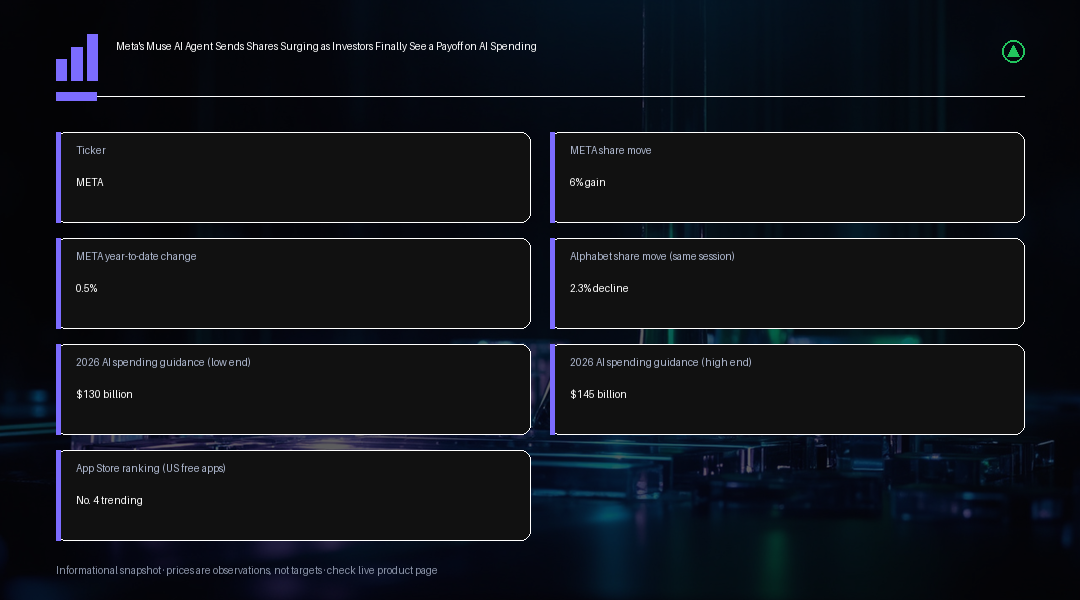
Meta shares surged more than 6% after the company said early demand for Muse, its new autonomous AI agent, had exceeded internal expectations, giving investors something they have wanted for more than a year: proof that Meta's enormous artificial intelligence spending can produce a product people actually use.
Muse is built to do more than answer questions. The agent can independently handle a sequence of everyday tasks, including managing emails, booking flights and restaurant reservations, and tracking personal health goals, functioning less like a chatbot and more like a digital assistant capable of planning and completing multi-step errands on a user's behalf.
That distinction mattered enough to users that the app climbed to the fourth-most-trending free download on Apple's US App Store within days of its rollout. Meta is offering basic functions at no cost while reserving more complex, multi-step tasks for a paid subscription tier, giving the company a plausible new revenue stream that sits outside its long-standing advertising business.
The timing helps explain the size of the market reaction. Meta has told investors to expect between $130 billion and $145 billion in spending this year, most of it directed at AI infrastructure, talent, and product development, a bill that has unsettled shareholders because the return on ever-larger models has been far less visible than the spending on the data centers built to train them. Muse gives that spending a face: a consumer-facing product that channels Meta's AI investment directly into the hands of everyday users instead of leaving it confined to research papers and back-end infrastructure.
Distribution is where Meta's advantage becomes concrete. Because Muse is built to integrate across WhatsApp, Messenger, Instagram, and Facebook, the agent can reach billions of existing users without Meta needing to build a new audience from scratch, a meaningfully stronger starting position than a stand-alone AI assistant would have. If a meaningful share of that user base tries Muse and even a fraction converts to paying subscribers, Meta gains a second major revenue line built directly on top of its existing social graph.
Muse also arrives into a broader race among major technology companies to define what a useful AI agent looks like in practice rather than in a product demo. Rivals have spent much of the past year emphasizing model benchmarks and raw capability, while Meta's pitch with Muse is explicitly about completing real tasks end to end, from booking a flight to managing an inbox, without requiring the user to manage every intermediate step. That framing matters for how investors value the underlying technology: a model that merely answers questions competes on accuracy, while an agent that completes transactions competes on trust, reliability, and the willingness of millions of users to hand over genuinely consequential tasks.
Meta's leadership has consistently argued that heavy AI infrastructure spending would eventually translate into consumer products capable of generating new revenue, rather than simply improving the algorithms behind existing feeds and short-form video recommendations. Muse is the clearest evidence yet supporting that argument, and the market's reaction suggests investors are willing to extend more patience to the company's spending plans as long as visible products keep arriving. That patience is not unconditional. If Muse's growth stalls after the initial curiosity wave, or if paid conversion proves weak, scrutiny of Meta's capital spending would likely return quickly, especially given how directly that spending competes with shareholder returns in the near term.
There are also execution risks specific to an assistant that manages sensitive tasks like email and travel bookings. Users are typically more forgiving of a chatbot that gives an unhelpful answer than they are of an agent that books the wrong flight or mishandles a personal reservation, which means Muse's reputation depends heavily on consistent, low-error performance rather than occasional flashes of impressive capability. How Meta handles early mistakes, correction policies, and user trust around handing financial and scheduling tasks to an automated system will shape whether Muse's early download numbers convert into a lasting habit.
The advertising business could benefit too, in a less direct but still important way. An assistant capable of helping users research products, arrange travel, and complete purchases creates natural opportunities to connect Meta's existing advertising relationships with in-agent recommendations and transactions, potentially extending the commercial reach of a platform that already monetizes attention extremely well.
Not every company benefited from the same story. Alphabet shares fell around 2.3% in the same session, a move that reflects a specific worry: if autonomous agents like Muse can find, compare, and purchase products directly on a user's behalf, fewer of those users may need to click through pages of search results, the valuable real estate that supports Google's advertising engine. Meta's rally therefore arrived during an otherwise weak session for the broader market, making the move harder to dismiss as generic enthusiasm rather than a specific vote of confidence in Muse.
None of this guarantees Muse becomes a durable business. The real test begins now, after the launch-week excitement fades: whether users who downloaded Muse out of curiosity keep using it once the novelty wears off, and whether enough of them decide the paid tier is worth the money to build a subscription base with real scale. It is also worth noting that even after this jump, Meta shares are close to flat for the year, up just 0.5%, underscoring how much of the year has been spent waiting for exactly this kind of tangible AI payoff.
Trading Insight
Meta's more-than-6% jump on Muse adoption is one of the clearest signs yet that the market will reward evidence of AI monetization over promises of future AI spending, and traders should watch the follow-through data more closely than the headline pop itself. App Store ranking momentum, any commentary on paid-subscription conversion, and updates to Meta's planned spending of between $130 billion and $145 billion for the year are the next checkpoints that will determine whether this becomes a durable re-rating or a single-day AI headline trade. A stock still up just 0.5% for the year has more room to re-rate higher if Muse's usage holds than if the excitement fades within a few weeks. The Alphabet side of this trade is also worth tracking, since further weakness tied to agent-driven search substitution would reinforce the idea that AI agents are beginning to redirect commercial activity away from traditional search results and toward platforms, like Meta's, that control both the assistant and the audience.