


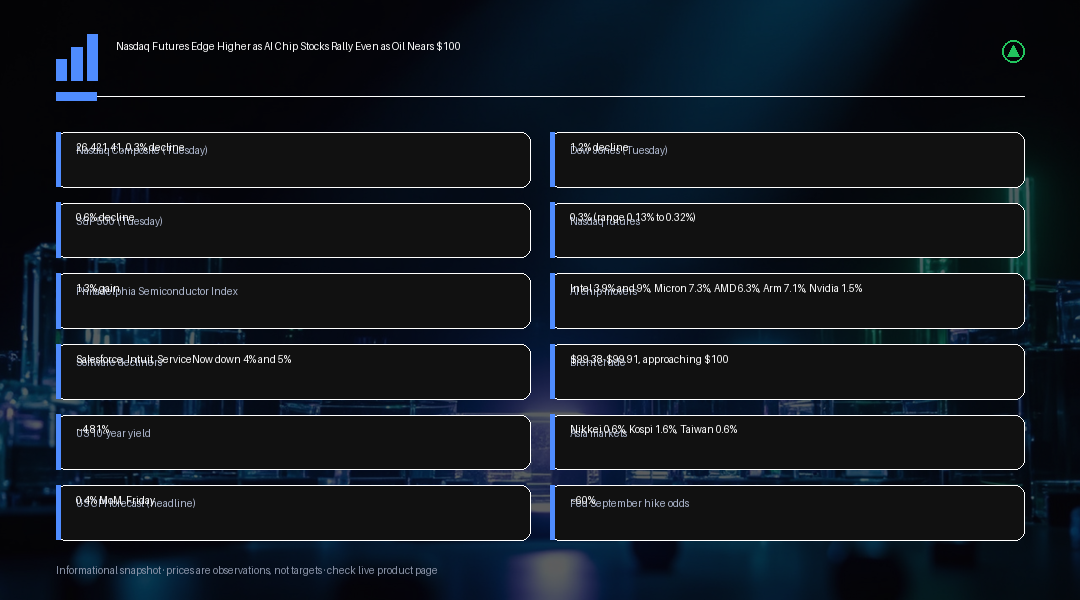
Tech stocks are holding up better than the wider market, but rising energy prices, elevated bond yields and Friday's inflation report leave the index facing a demanding three-part test this week. The Nasdaq Composite slipped 0.3% Tuesday to 26,421.41, outperforming the Dow's 1.2% drop and the S&P 500's 0.6% decline. That relative strength suggests investors are holding onto their tech positions despite rising inflation uncertainty. Nasdaq futures were up another 0.3% ahead of Wednesday's opening bell, with real-time pricing through the session showing gains in the 0.13% to 0.32% range.
Semiconductors provided the brighter side of the split. The Philadelphia Semiconductor Index gained 1.3%, helped by Intel, Qualcomm and other AI-infrastructure names. Pre-market strength extended further into Wednesday's session, with Intel gaining between 3.9% and 9%, Micron adding 7.3%, AMD gaining 6.3%, Arm climbing 7.1% and Nvidia up 1.5%, as AI optimism and OpenAI's GPT-6 Astra release added a fresh tailwind to the group.
Software names told a different story. Salesforce, Intuit and ServiceNow fell between 4% and 5%, dragging the broader software-and-services group down 1.4%. The split within technology is notable: hardware and infrastructure names tied directly to AI compute buildout are rallying, while subscription-software names face pressure, a pattern consistent with traders rotating toward the physical build-out side of the AI trade rather than the application layer.
Oil is joining the valuation debate. Brent crude climbed toward $100 a barrel this morning, trading in a $99.38-$99.91 range with an intraday high near $99.46, after fresh attacks involving Saudi cities, Iranian tankers and a US base in Jordan. Higher oil can lift transportation and production costs across the economy, potentially slowing growth while keeping inflation elevated, a combination growth-stock investors traditionally dislike.
Nasdaq companies are especially sensitive to interest rates because much of their valuation reflects profits expected years into the future. When Treasury yields rise, those future earnings are worth less in today's money. The 10-year yield recently touched roughly 4.81%, a level that keeps the discount-rate pressure on richly valued AI names firmly in view.
Still, US equity futures were broadly steady Wednesday and AI-heavy Asian markets proved resilient. Japan's Nikkei rose about 0.6%, South Korea's Kospi gained 1.6% and Taiwan advanced 0.6%, suggesting the AI-driven optimism supporting chip stocks is a global phenomenon rather than a narrowly American one.
The divergence between Nasdaq futures and the rest of the market was equally visible in futures pricing itself. Dow futures declined roughly 0.77% to 1.03% and S&P 500 futures fell 0.24% to 0.39%, reflecting sector rotation into technology even as energy-sensitive and rate-sensitive names lagged. Energy shares, meanwhile, have been among the more consistent beneficiaries of oil's climb toward the $100 mark.
Friday's US consumer price report is the next scheduled test. Economists expect headline inflation to rise around 0.4% month over month. The market reaction may depend on whether the oil shock has started spreading into broader prices. Traders currently price the Federal Reserve's September decision at close to a coin toss, with roughly 60% odds now assigned to a quarter-point hike following the recent run of stronger data.
Nasdaq resilience becomes more convincing if chips keep outperforming while yields stabilize. If oil clears $100 and bonds continue selling off, Tuesday's modest 0.3% decline could prove merely the opening notification of a tougher stretch, one in which the same AI enthusiasm currently lifting chip stocks would need to work considerably harder to offset a genuinely hawkish inflation surprise.
History offers a reasonable playbook for what tends to happen next in setups like this one. A single hot jobs report does not guarantee a hawkish outcome if inflation data cooperates in the days that follow, and this week's modest pullback already reflects a meaningful repricing of Fed expectations rather than a fresh shock arriving out of nowhere. That leaves Thursday's producer prices and Friday's consumer prices as the genuine tie-breaker for where the index heads next, rather than the jobs data that markets have already absorbed into current pricing.
Sector rotation within technology deserves particular attention heading into the print. Hardware and chip names tied to physical AI infrastructure build-out have clearly outperformed software and subscription names this week, a split that traders should watch for signs of either continuing or reversing once the inflation data lands. A cooler CPI print could allow the rotation to broaden back into software, while a hot print would likely keep capital concentrated in the semiconductor names that have shown the most resilience so far.
Positioning into the print also carries a geopolitical dimension that is easy to overlook amid the domestic data focus. The same Middle East tensions pushing oil toward $100 are contributing directly to the inflation uncertainty driving this week's rate-hike repricing, which means any escalation or de-escalation on that front could move markets independently of Thursday and Friday's scheduled releases. Traders positioning purely around the US data calendar risk being caught off guard by a geopolitical headline that shifts the oil leg of this trade overnight.
Trading Insight
The Nasdaq's relative outperformance this week is being carried almost entirely by semiconductors, with the Philadelphia Semiconductor Index up 1.3% and individual AI-infrastructure names posting gains from 1.5% up to 9%. That leadership is fragile: it is being tested simultaneously by Brent crude near $99.50, a 10-year yield around 4.81% and Friday's CPI print, where the Fed's September hike odds are already priced near 60%. A soft inflation number alongside oil holding below $100 would likely extend the chip-led rally into a broader Nasdaq advance, while a hot CPI print stacked on oil breaking through $100 would hit richly valued AI names hardest given their sensitivity to discount rates, potentially erasing this week's relative strength quickly. Keep position sizing conservative into Thursday and Friday given how much of the current chip-led leadership still depends on inflation data that has not yet been confirmed.