


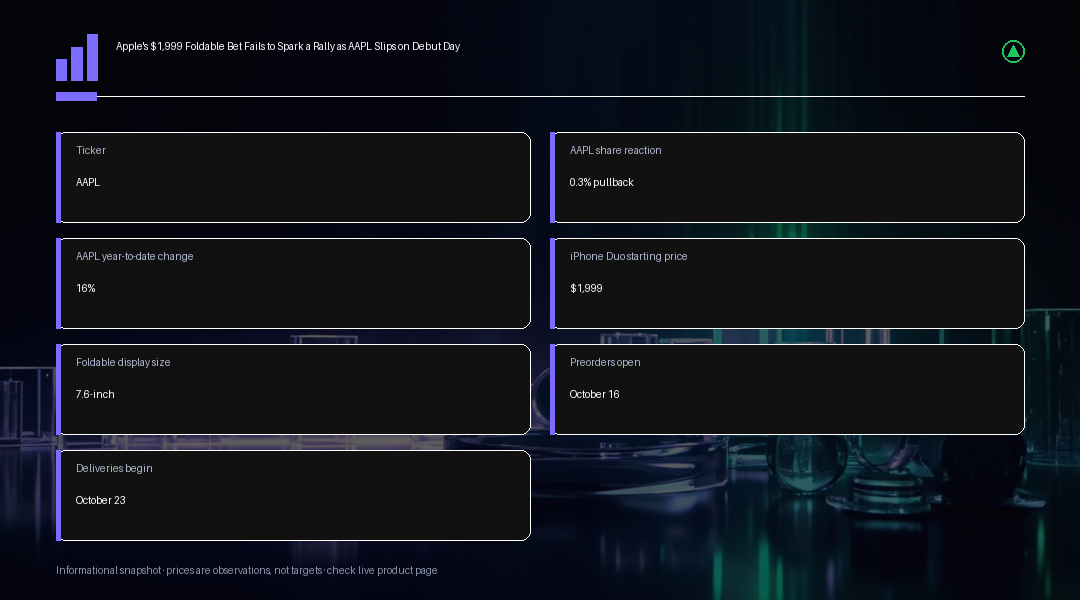
Apple has finally answered the question of when it would build a folding iPhone, and the market's initial answer arrived almost as quickly: a shrug. Shares of Apple eased about 0.3% after the company unveiled its long-rumored foldable handset, the iPhone Duo, priced from $1,999, in what doubled as the first major product keynote led by new chief executive John Ternus since he succeeded Tim Cook atop the world's most valuable consumer electronics company.
The iPhone Duo is a passport-shaped device that pairs a conventional outer display with a 7.6-inch folding inner screen designed for multitasking, video calls, and running several apps side by side. Under the hood, Apple packed the phone with a titanium body, its A20 Pro chip, a custom-engineered hinge, and the company's new C2 modem, positioning the Duo as a flagship-grade device rather than a stripped-down first attempt at the category. Preorders are scheduled to open October 16, with deliveries beginning October 23, giving prospective buyers roughly a week to decide whether a folding phone is worth laptop-level money.
The Duo was not the only headline item on stage. Apple also introduced the iPhone 18 Pro and Pro Max, refreshed Apple Watch models, and new AirPods, while the standard iPhone 18 is expected to follow later. Every product unveiled leaned toward the premium end of Apple's lineup, and priced accordingly, reinforcing a strategy of protecting average selling prices even as unit growth across the broader smartphone market has slowed. Alongside the hardware, Apple showed a revamped Siri and a privacy-focused artificial intelligence hub, an attempt to close the perception gap that has built up against rivals seen as further along in consumer AI.
Apple's broader investment case has increasingly leaned on services and ecosystem stickiness rather than pure hardware novelty, and the Duo tests both sides of that equation at once. A device priced well above the standard iPhone lineup only pays off if enough existing owners view it as a genuine upgrade rather than a curiosity, and if the surrounding software, from multitasking gestures to app compatibility, makes the extra screen space feel indispensable rather than gimmicky. Hardware launches of this scale also tend to pull forward analyst commentary on Apple's services attach rate, since a costlier device typically comes bundled with higher-margin subscriptions, extended warranties, and accessories that matter more to long-term profitability than the initial hardware sale itself.
For Ternus, the event functioned as an early test of his leadership. Succeeding a chief executive as consequential as Tim Cook means every early decision draws extra scrutiny, and a foldable phone, Apple's most significant new hardware category in years, was always going to be read as a signal of how the company plans to keep growing once smartphone upgrade cycles stop doing the heavy lifting. A revamped Siri and deeper on-device intelligence could help distinguish the Duo from rival foldables on the software side, but investors still need evidence that Apple Intelligence itself can generate fresh device demand rather than simply keep pace with competitors.
That evidence has not fully arrived yet, and the market's initial reaction reflects it. Apple shares slipping about 0.3% following the presentation suggests that much of the excitement around a first-generation foldable was already built into the stock beforehand, extending a familiar pattern in which Apple's keynotes tend to generate more enthusiasm among customers lining up outside stores than among shareholders watching from a trading desk. None of this means the launch failed. It means the market is waiting for proof rather than promises.
Competitively, Apple arrives well behind schedule. Samsung and Huawei have led the foldable category for years, refining hinge durability, software multitasking, and pricing tiers long before Apple's first entry reached shelves. Apple's advantage is less about being first and more about scale. Its enormous installed base and tightly integrated ecosystem give the Duo a distribution channel that newer foldable entrants simply do not have. Still, a $1,999 starting price narrows the buyer pool considerably, limiting the device to Apple's most committed customers and enterprise buyers rather than the mass market that eventually made the standard iPhone ubiquitous.
The financial case now shifts from keynote applause to unit economics. A higher price tag lifts revenue per device sold, which helps offset a maturing smartphone replacement cycle, but specialized foldable displays, custom hinges, and additional memory requirements also raise Apple's manufacturing costs. Whether the Duo becomes a genuine margin contributor or a niche flagship depends on how many units actually ship past the early-adopter wave, and on how efficiently Apple can scale production of components it has never mass-manufactured before.
Apple has navigated similar skepticism before. The original Apple Watch drew comparable questions about whether a premium wearable justified its price, and later iterations of AirPods faced doubts about whether wireless earbuds were worth a premium over wired alternatives. In both cases, muted initial reactions eventually gave way to durable, high-margin product categories once software and accessory ecosystems matured around the hardware. Whether the Duo follows that trajectory or ends up as a niche experiment is precisely the debate now playing out across trading desks watching Apple's next few quarters of guidance.
Traders now have a specific data trail to follow instead of stage presentations. Early preorder demand when sales open October 16, delivery timelines once shipments begin October 23, and any adjustments analysts make to unit and revenue estimates in the following days will carry more weight than anything said during the keynote itself. Apple shares remain up 16% for the year even after the post-keynote pullback, which means the stock heads into this stretch with a cushion, but also with a higher bar for what success needs to look like from here.
Trading Insight
Apple's modest 0.3% pullback after a major foldable unveiling looks like a textbook priced-in reaction rather than a rejection of the product itself, and traders should treat the keynote as the start of a data window rather than the end of one. With the stock still up 16% for the year, the near-term setup depends less on stage presentation and more on preorder velocity once sales open October 16 and on how cleanly Apple manages the October 23 delivery ramp. Strong early demand signals or upgraded analyst estimates around the $1,999 entry price would support a resumption of the year's uptrend, while soft preorder data or supply commentary tied to the Duo's specialized hinge and display components would likely extend the current consolidation. Keep an eye on how Apple's premium pricing strategy across the Duo, iPhone 18 Pro and Pro Max, and refreshed Watch lineup holds up against Samsung and Huawei's more established foldable offerings, since any sign of price resistance from buyers would matter more to the multi-quarter story than the single-day share move.