


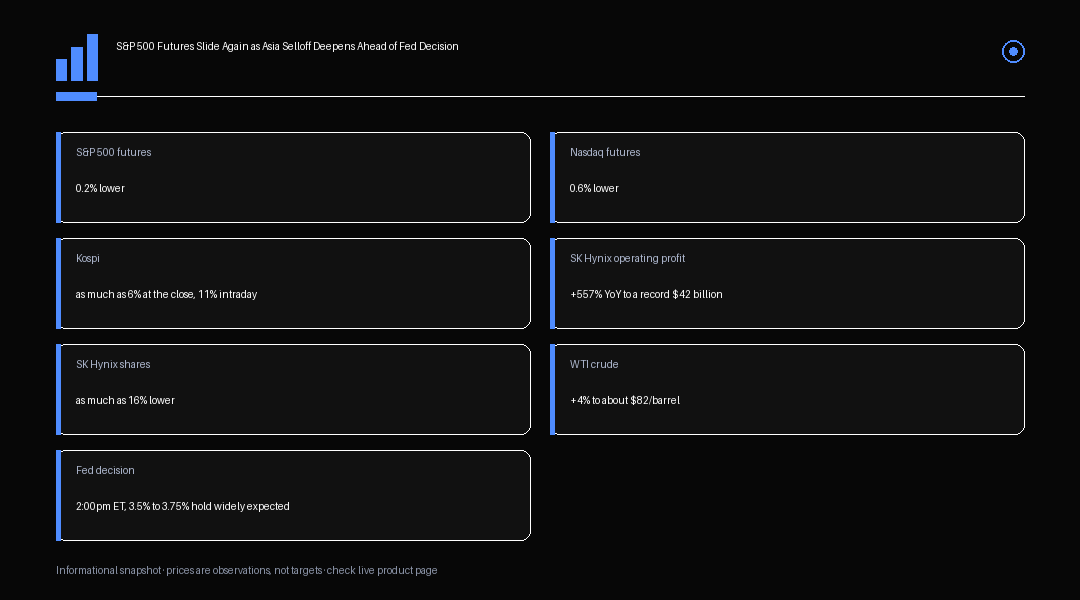
US stock futures pointed lower heading into Wednesday's session after another bruising night across Asian markets reignited doubts about how much further the artificial intelligence trade can run without a matching acceleration in earnings. S&P 500 futures slipped about 0.2%, Nasdaq futures fell roughly 0.6%, and Dow futures shed close to 60 points, as traders leaned back into a risk-off posture that has become familiar over the past several sessions.
South Korea's Kospi was once again at the center of the storm. The index tumbled as much as 6% at the close, having been down more than 11% at one point intraday, a swing sharp enough to trigger a trading halt under the exchange's circuit-breaker rules. Japan's Nikkei 225 slipped a comparatively milder 2.2%, but the direction of travel across the region was unmistakable: investors are pulling back from the chip-and-AI complex that has driven so much of this year's gains.
The proximate trigger was SK Hynix. The memory-chip maker reported operating profit that jumped an eye-catching 557% year-over-year to a record $42 billion, a number that would ordinarily be celebrated as a blowout quarter. Instead, it fell short of Wall Street's even loftier expectations, and revenue growth of 257% to $55 billion also missed forecasts. SK Hynix shares tumbled as much as 16%, extending a heavy decline from the prior session, while Samsung Electronics was dragged sharply lower alongside it.
Independent market reporting on the same results places SK Hynix's operating profit at roughly $41.6 billion and revenue at roughly $54.5 billion, broadly consistent with the figures above once currency-conversion snapshots are accounted for, and notes that part of the shortfall traced to the timing of next-generation memory-chip shipments rather than a demand problem. That distinction matters: a shipment-timing miss is a different story for investors than a genuine slowdown in AI-driven chip demand.
The market's reaction captures a shift that has been building for weeks. For much of this AI cycle, any headline tied to chip demand or data-center spending was treated as an automatic buy signal. That reflexive optimism appears to be fading. Investors are increasingly demanding that reported earnings clear an ever-higher bar, and a record quarter that merely meets rather than beats elevated expectations is now being read as a disappointment rather than a win.
That is a meaningfully different market regime than the one that prevailed earlier this year, when almost any AI-adjacent earnings beat was rewarded regardless of how the numbers compared with whisper expectations. The current mood suggests traders have grown more selective about which parts of the AI supply chain still deserve a valuation premium, and memory-chip makers, despite genuinely record results, are currently on the losing side of that reassessment.
Geopolitics added a second layer of pressure overnight. Iran launched ballistic missiles toward US forces in the Middle East, according to US Central Command, though the missiles were intercepted before reaching their targets. The episode was enough to send West Texas Intermediate crude climbing roughly 4% to around $82 a barrel, reviving inflation concerns just as investors are trying to gauge how much room the Federal Reserve has to maneuver on interest rates.
Oil's move matters beyond the energy sector itself. A sustained rise in crude prices tends to filter through into broader inflation expectations, complicating the picture for central bankers who have spent much of the past year trying to bring price growth back toward target without tipping the economy into a harder landing. A roughly four percent jump in a single session is unlikely to change the Fed's calculus on its own, but it adds another variable to an already crowded list of considerations heading into Wednesday's decision.
That decision is the other major event still ahead. The Federal Reserve is scheduled to announce its policy decision later Wednesday at 2:00pm ET, with Chair Kevin Warsh's press conference to follow at 2:30pm ET, and markets are overwhelmingly positioned for no change, with pricing implying roughly a 70% probability that rates stay on hold at 3.5% to 3.75%. As is often the case with this Fed, the post-meeting statement and Warsh's remarks are widely expected to matter more for markets than the rate decision itself, given how little forward guidance the central bank has offered in recent meetings.
Earnings season is not pausing to let markets catch their breath. Microsoft, Meta Platforms and Qualcomm are all scheduled to report after Wednesday's closing bell, giving investors another substantial read on the state of AI-related spending and demand just hours after the Fed's decision lands. That clustering of catalysts, a rate decision followed within hours by megacap tech earnings, sets up one of the more consequential 24-hour windows of the summer for US equity markets.
For traders watching the S&P 500 specifically, the index sits at the intersection of all of these crosscurrents: a global chip-sector selloff pressuring sentiment, an oil-driven inflation scare, and a Fed decision that could either validate or upend the market's current rate-path assumptions. None of these forces operates in isolation, and the combination is why futures are trading defensively even before the first earnings report of the evening crosses the wire.
The broader question hanging over the session is whether this marks a genuine inflection point in how the market prices AI-related earnings, or simply a bout of profit-taking after an unusually strong run. Markets have absorbed similar chip-sector selloffs before and recovered within days once the initial shock faded. What is different this time is the proximity to a live Fed decision and a wave of megacap earnings landing in the same 24-hour window, which raises the stakes for how durable today's risk-off mood turns out to be.
Trading Insight
The S&P 500's next move likely hinges less on today's Asia-driven selloff and more on how the Fed's 2:00pm ET decision and Wednesday evening's megacap earnings land within hours of each other. A steady hold alongside reassuring capex commentary from Microsoft and Meta could help stabilize sentiment quickly; a hawkish surprise layered on top of cautious AI-spending guidance would give the current risk-off mood more room to run.