


This week's Federal Reserve policy decision is shaping up to be one of the more genuinely uncertain rate calls in recent memory. Analysts at Goldman Sachs, including David Mericle, describe the outcome of Wednesday's meeting as unusually uncertain, even as most market participants still expect policymakers to hold off on an immediate rate hike. That combination, an unusual amount of uncertainty paired with a base case that leans toward no change, is precisely the kind of setup that tends to keep both equity and currency markets on edge heading into a Fed announcement.
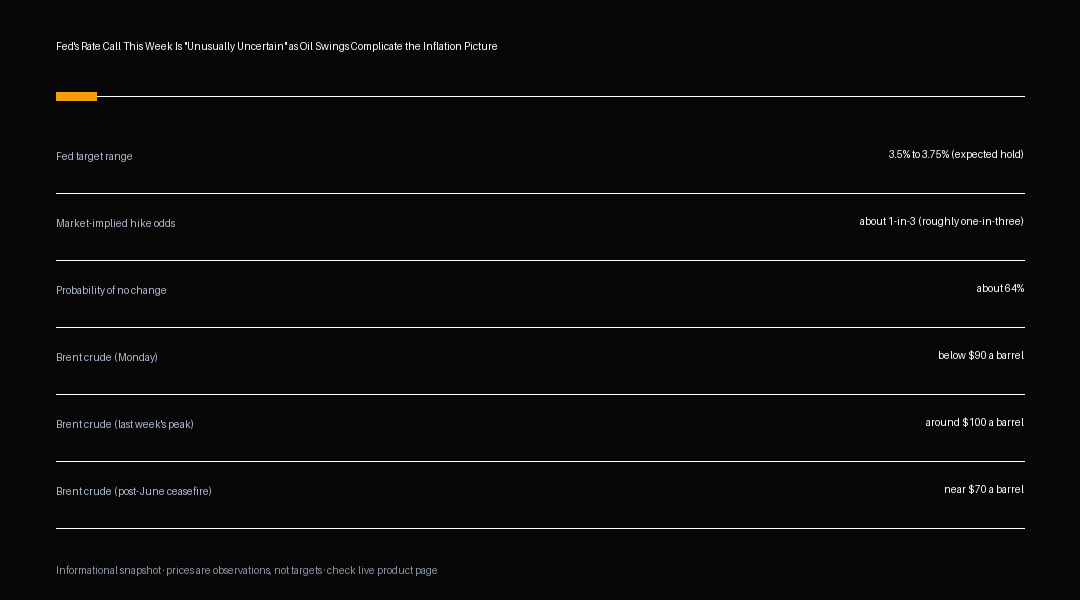
Market pricing captures that tension well. According to CME's FedWatch tool, traders are assigning a roughly one-in-three probability to a rate hike this week, while pricing in about a sixty-four percent probability that borrowing costs are left unchanged within the current 3.5 percent to 3.75 percent range. Neither outcome is treated as a foregone conclusion, and the gap between those two probabilities is narrow enough that incoming data or fresh geopolitical developments could meaningfully shift sentiment before Wednesday's announcement.
Part of what makes this meeting unusual is the interplay between improving inflation data and a deteriorating geopolitical backdrop. Goldman's analysts note that softer June inflation figures should, in isolation, have reduced the case for an immediate rate increase. At the same time, they point out that geopolitical news has worsened in recent weeks, a reference to swings in Middle East tensions that have driven some of the sharpest oil-price moves markets have seen this year.
Those oil-price swings have been dramatic by any recent standard. Brent crude tumbled to below $90 a barrel on Monday after a pause in fighting between the United States and Iran eased immediate concerns about supply disruption. Just last week, by contrast, worries over a widening conflict that could further disrupt oil flows out of the Middle East had sent Brent surging to as high as around $100 a barrel, underscoring how quickly sentiment in energy markets can reverse when geopolitical risk is this fluid.
For context, Brent crude was trading close to pre-conflict levels near $70 a barrel shortly after the signing of a ceasefire framework back in June, an agreement that has since proven fragile. The round trip from roughly $70 a barrel to $100 a barrel and back below $90 within a matter of weeks illustrates just how sensitive oil markets remain to developments in the region, and why energy prices have become such a central input into this week's rate debate.
The connection between oil prices and monetary policy runs through inflation expectations. A sustained spike in energy costs raises the risk of a broader burst of inflation, since oil feeds into transportation, manufacturing and a wide range of downstream prices across the economy. In theory, central banks can respond to that risk by raising interest rates to help contain price pressures, though doing so also carries the risk of slowing growth and softening the labor market at a time when neither may be able to fully absorb the impact.
Goldman's analysts expect the Fed's policy statement this week to acknowledge the upside inflation risk posed by renewed geopolitical conflict, even as the committee likely holds rates steady. They also anticipate at least one dissent in favor of a hike, a signal that not every policymaker shares the same read on how much weight to give the recent oil-driven inflation risk relative to the improving underlying inflation trend.
That underlying trend remains a genuine source of support for the case to hold rates steady. Despite the geopolitical noise, Goldman's analysts argue the inflation data have actually improved in recent weeks, and they expect upcoming core personal consumption expenditures figures for June, due for release this week, to start on what they describe as a softer trend. That data point, alongside the Fed's own statement, will likely shape how markets interpret the coming week's tone on future policy.
History offers a useful reference point for how markets have handled similarly uncertain Fed meetings in the past. Periods where a major research desk flags outsized uncertainty ahead of a policy decision have often coincided with wider intraday trading ranges across rates, currencies and commodities in the days immediately surrounding the announcement, as positioning adjusts quickly once the actual statement and any accompanying press conference remove some of the ambiguity that built up beforehand.
The stakes of getting this week's read right extend well beyond a single rate decision. Equity markets, currency pairs and commodity prices are all sensitive to shifts in the perceived path of US interest rates, and a meeting billed as unusually uncertain by a major Wall Street research desk raises the probability of a larger-than-typical market reaction regardless of which way the committee ultimately leans.
Energy markets in particular are likely to stay volatile around this week's events. Any further de-escalation between the United States and Iran could extend Monday's decline in Brent crude, reinforcing the disinflationary argument for holding rates steady. Conversely, a renewed flare-up in tensions could just as quickly push oil back toward last week's highs, strengthening the case some policymakers may already be making internally for a more hawkish stance.
The interplay between oil, inflation and interest-rate policy also has knock-on effects for other asset classes closely tied to the rate outlook, including precious metals and broader index-level risk sentiment. A hawkish surprise from the Fed, especially one framed around oil-driven inflation risk, could pressure risk assets broadly while supporting the US dollar, whereas a steady hold paired with a reassuring tone on inflation could have the opposite effect.
For traders, the core takeaway is that this week's Fed decision cannot be analyzed in isolation from the oil market's recent volatility. The same geopolitical developments driving Brent crude's swings between $70 and $100 a barrel are directly shaping the inflation risk calculus that Goldman's analysts say makes this meeting more uncertain than usual, linking currency, rates and commodity positioning more tightly together than in a typical policy week.
With the ceasefire framework in the Middle East explicitly described as fragile and the Fed's own tone still an open question heading into Wednesday, markets are left balancing an improving domestic inflation trend against a geopolitical risk that could reverse again with little warning. MC Markets does not cite exact source levels without independent market-data verification, and that balance, more than the headline rate decision itself, is likely to define how this week's price action unfolds across rates, currencies, oil and broader risk assets.
Trading Insight
This week's Fed decision is tightly linked to oil market volatility: Brent crude's swing between $70 and $100 a barrel is central to the inflation risk debate driving Wednesday's policy call. Watch for further de-escalation or a flare-up in Middle East tensions alongside the Fed's tone on inflation, since either could move rates, the dollar, oil and precious metals together rather than in isolation.