


Futures tied to the major US stock indices were holding close to unchanged heading into one of the more consequential trading days of the summer, with a long-awaited Federal Reserve interest-rate decision and earnings from two of the market's biggest artificial intelligence spenders, Meta Platforms and Microsoft, both due within hours of each other. Adding to the tension, fresh strikes between US and Iranian-linked forces in the Middle East pushed oil prices sharply higher overnight.
By the early hours of the US session, Dow futures and Nasdaq futures were little changed, while S&P 500 futures had edged up modestly. The prior session on Wall Street had already told a mixed story: the Dow Jones Industrial Average and the S&P 500 both finished higher, up 1.03% and 0.21% respectively, while the tech-heavy Nasdaq Composite slipped 0.22%, weighed down by a rotation out of semiconductor names.
That chip-sector weakness has now stretched into a fourth consecutive session, with a closely watched semiconductor index touching its lowest level since May. Part of the pressure traces back to reports of emerging Chinese competition for US chipmakers, compounded by one large technology company's decision last week to raise its own capital-spending budget. South Korea's SK Hynix added to the unease after posting record profit that still fell short of elevated Wall Street expectations, a pattern that has repeated across several AI-adjacent earnings this cycle.
The bigger question hanging over megacap technology is a familiar one at this stage of the AI buildout: when will the tens of billions of dollars committed to data centers and specialized chips translate into consistent, durable profit growth. Markets have tolerated enormous capital-expenditure budgets so far on the promise of future returns, but that patience is not open-ended, and the past several sessions suggest investors are starting to ask harder questions.
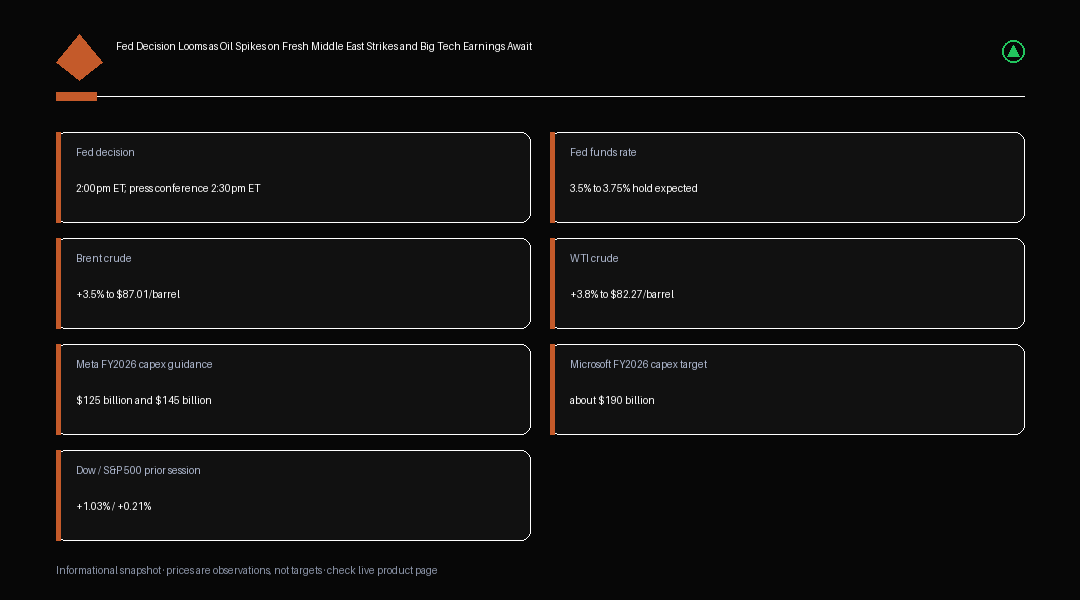
Attention now turns squarely to the Federal Reserve, whose policy decision is due later Wednesday at 2:00pm ET, with Chair Kevin Warsh's press conference to follow at 2:30pm ET, after the conclusion of the central bank's two-day meeting. Officials have spent the run-up to this meeting weighing the inflationary impact of recent oil-market volatility against the ongoing effects of heavy AI-related capital spending. June's consumer price data came in cooler than expected, offering some breathing room, but renewed fighting in the Middle East briefly pushed crude prices toward $100 a barrel last week, and there is little sign yet that big technology firms are scaling back their investment plans.
The US labor market, the other half of the Fed's dual mandate, has meanwhile settled into a period of low hiring paired with relatively few layoffs, a combination that gives policymakers less urgency to move aggressively in either direction. In theory, raising rates would help contain inflation, but doing so risks weighing further on employment and broader growth at a moment when the labor market is already cooling.
Much of the market's uncertainty centers on Warsh, who is overseeing only his second meeting at the helm of the central bank. Analysts have framed this decision as a genuine test of his approach: failing to raise rates could be read as a challenge to the Fed's inflation-fighting credibility, while hiking would cut against his own stated framework of looking through supply-driven price shocks such as an oil spike tied to a geopolitical event rather than underlying demand.
Heading into the announcement, market pricing implied roughly a 70% probability that the Fed holds its benchmark rate steady at 3.5% to 3.75%, consistent with what would be a fifth consecutive hold, with just under a one-in-three chance of a quarter-point hike. Traders should not expect much in the way of explicit forward guidance either; Warsh has been clear that he does not intend to offer markets a defined roadmap for the path of rates beyond the immediate decision.
Beyond the Fed, investors face a dense earnings calendar this week, beginning with Meta Platforms and Microsoft reporting after Wednesday's closing bell. For Meta, the results will offer the next test of whether its aggressive AI investment is beginning to pay off; the company lifted its full-year capital-spending forecast earlier this year to a range of $125 billion and $145 billion, up from a prior range of $115 billion to $135 billion, while also flagging potential legal and regulatory costs tied to scrutiny in Europe and the US.
Microsoft, for its part, has targeted record capital spending of roughly $190 billion in its current fiscal year, underscoring how central the AI buildout has become to its strategy. Investors will be watching closely for growth in the company's Azure cloud business, anticipated to have grown between 39% and 40% in constant currency, as well as any commentary addressing tepid uptake of its Copilot 365 assistant and its heavy reliance on AI partners such as OpenAI.
Oil markets, meanwhile, are telling their own story. Brent crude climbed 3.5% to $87.01 a barrel and West Texas Intermediate gained 3.8% to $82.27 a barrel, after the US and allied forces struck Iran-linked targets following the interception of a barrage of missiles aimed at US forces in the region. The renewed hostilities ended a multi-day pause in fighting that had briefly pulled crude prices lower, and a failed diplomatic proposal over shared control of a key shipping strait further clouded the outlook for a near-term de-escalation.
For traders, Wednesday brings a rare convergence: a live Fed decision, a jump in oil prices with direct inflation implications, and two of the most closely watched earnings reports of the season, all landing within a single trading day. Each of these threads feeds into the others, and the combined outcome is likely to set the tone for risk appetite heading into the final full week of the month.
Trading Insight
Oil's renewed spike gives the Fed a genuine complication: a supply-side price shock arriving just as it weighs whether to hold or nudge rates higher. A steady hold paired with a calm tone from Chair Warsh at the 2:30pm ET press conference would likely be read as the least disruptive outcome for risk assets, while any signal that the Fed views the oil-driven inflation risk as more persistent could pressure both equities and crude-sensitive currency pairs simultaneously.