


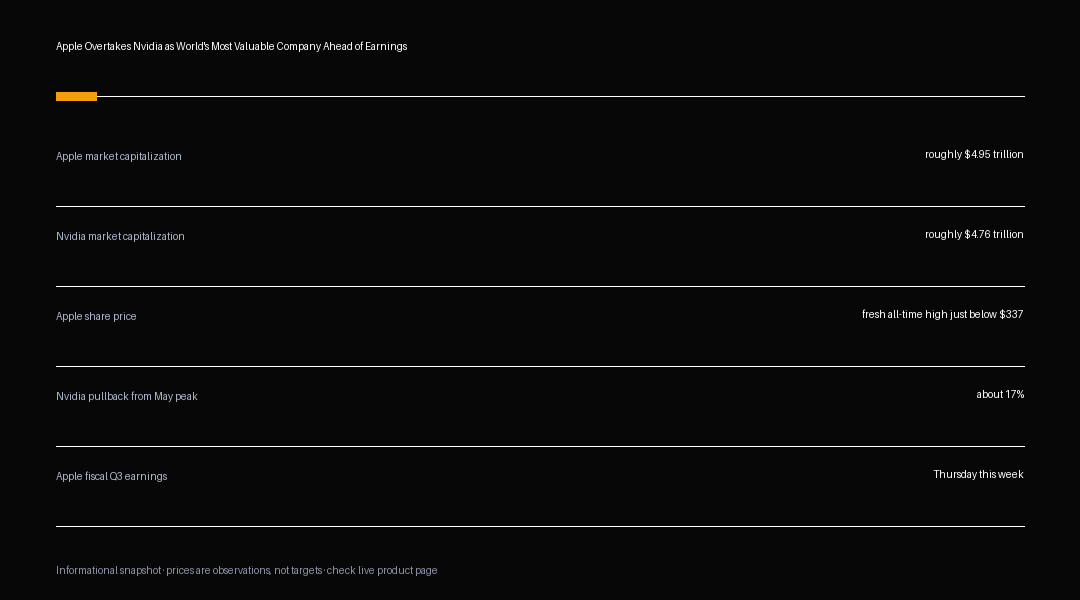
Apple closed Monday's session as the world's most valuable publicly traded company, edging past Nvidia for the first time since April 2025. A one percent gain lifted Apple's market capitalization to roughly $4.95 trillion, while a five percent slide left Nvidia at approximately $4.76 trillion. The flip caps a run of just over a year for Nvidia, which had claimed the top spot in June 2025 after overtaking Microsoft and briefly crossed the $5 trillion mark earlier this year. For a market that has spent the better part of two years fixated on artificial intelligence infrastructure spending, the reshuffling at the very top of the valuation table says as much about shifting investor priorities as it does about either company's fundamentals.
The numbers behind the flip are notable on their own. Apple shares climbed to a fresh all-time high just below $337 during the session, extending a rally that has quietly outpaced the broader technology sector in recent weeks. Nvidia, by contrast, has now retreated roughly seventeen percent from the peak it reached in May, as investors trim exposure to some of the AI sector's highest-profile names. Neither move happened in isolation; both reflect a market that is growing more selective about how it rewards AI exposure rather than a wholesale retreat from the theme.
What separates Apple from much of the AI trade is the company's approach to infrastructure. Rather than committing tens of billions of dollars to build proprietary data centers from scratch, Apple has largely rented computing capacity from cloud partners, a strategy that keeps its balance sheet lighter than peers pursuing their own build-outs. That distinction has become increasingly relevant to investors parsing capital expenditure, the spending on long-lived assets such as data centers, specialized chips and power infrastructure that has ballooned across the technology sector this cycle.
Capital expenditure matters because it is a direct trade-off against near-term cash flow. Heavier spending can support faster growth over a multi-year horizon, but it also compresses the free cash flow that investors use to value a business today. Alphabet's decision to lift its own capital spending outlook rattled some investors last week, a reminder that the market's patience with AI-driven capex increases is not unlimited. Apple's comparatively asset-light posture has, for now, allowed it to sidestep that specific source of investor anxiety.
That backdrop sets up a consequential earnings report. Apple is scheduled to report fiscal third-quarter results on Thursday, and the market's attention is likely to extend well beyond the iPhone unit that has traditionally anchored the print. Investors are looking for management's first substantive comments on how this year's global memory-chip shortage, and the price increases that followed in June, have affected component costs and margins across Apple's hardware lineup.
Commentary on Apple Intelligence, the company's artificial intelligence software initiative, is also likely to draw scrutiny. With the stock trading at record levels heading into the print, the bar for what counts as a reassuring update has risen accordingly. A merely solid quarter, without clear signs of AI-related momentum or margin resilience, risks being read by a market sitting near all-time highs as underwhelming rather than adequate.
The timing adds another layer of complexity. Apple's report lands in the middle of one of the busiest stretches of the earnings season, with several other megacap technology companies also scheduled to report results in the same window. That concentration of high-weight reporters means index-level volatility this week could be driven as much by the aggregate tone of Big Tech commentary as by any single company's numbers, Apple included.
For Apple specifically, the stakes of the earnings reaction are amplified by its newly reclaimed position at the top of the market-capitalization table. A disappointing print, particularly one that raises fresh questions about memory-chip cost pressure or a lack of visible AI monetization, could hand the valuation crown back to Nvidia or another AI-exposed peer just as quickly as Apple took it. Conversely, a reassuring update on margins and demand could cement the lead and validate the market's preference for Apple's lighter-touch AI strategy.
Nvidia's own path is worth watching alongside Apple's. A seventeen percent drawdown from a May peak is a meaningful correction for a company of Nvidia's size, and whether that pullback stabilizes or extends will depend heavily on how the broader AI capital spending narrative evolves through this earnings season. If hyperscaler capex commentary this week reassures investors that AI infrastructure spending remains disciplined and revenue-generative, Nvidia and its chip-sector peers could find a floor. If commentary disappoints, the pressure that has already knocked Nvidia from the top spot could deepen further.
The broader market implication is that the AI trade is entering a more discriminating phase. Investors appear increasingly willing to reward companies that can participate in AI-driven growth while limiting exposure to the heaviest infrastructure spending, exactly the positioning Apple has cultivated. That does not mean capital-intensive AI infrastructure plays are being abandoned outright, but it does suggest the market is now pricing execution and capital discipline more carefully than it did earlier in the AI investment cycle.
For traders, near-term positioning around Apple is likely to hinge on two related but distinct questions heading into Thursday: whether memory-chip cost inflation meaningfully dented hardware margins, and whether management can articulate a credible, monetizable AI roadmap without committing to the scale of capital spending that has pressured sentiment elsewhere in the sector. A clean answer to either question could extend Apple's rally; ambiguity on both risks a swift reversal given how far the stock has already run into the print.
It is also worth remembering that market-capitalization leadership, while a useful headline marker, is inherently a moving target driven by daily price action rather than a fixed structural advantage. Apple's lead over Nvidia as of Monday's close is a snapshot, not a settled outcome, and the gap between the two companies' valuations remains narrow enough that a single strong or weak earnings reaction from either side could flip the ranking again within days.
With Thursday's print now the market's central focus, the coming days are likely to test whether Apple's asset-light AI positioning can translate into the kind of earnings confidence that justifies its record valuation, or whether the same scrutiny currently being applied to Nvidia and other AI infrastructure spenders eventually catches up with Apple's own growth story. MC Markets does not cite exact source levels without independent market-data verification, and traders should treat this week's reported figures as subject to revision once official results are confirmed.
Trading Insight
Apple's asset-light AI strategy has helped it reclaim the market-cap lead from Nvidia, but Thursday's fiscal third-quarter earnings are the next real test. Watch for commentary on memory-chip cost pressure and any concrete AI monetization signal; a reassuring update could extend the rally toward fresh highs, while a cautious tone risks handing the valuation crown back to Nvidia just as quickly as Apple claimed it.