


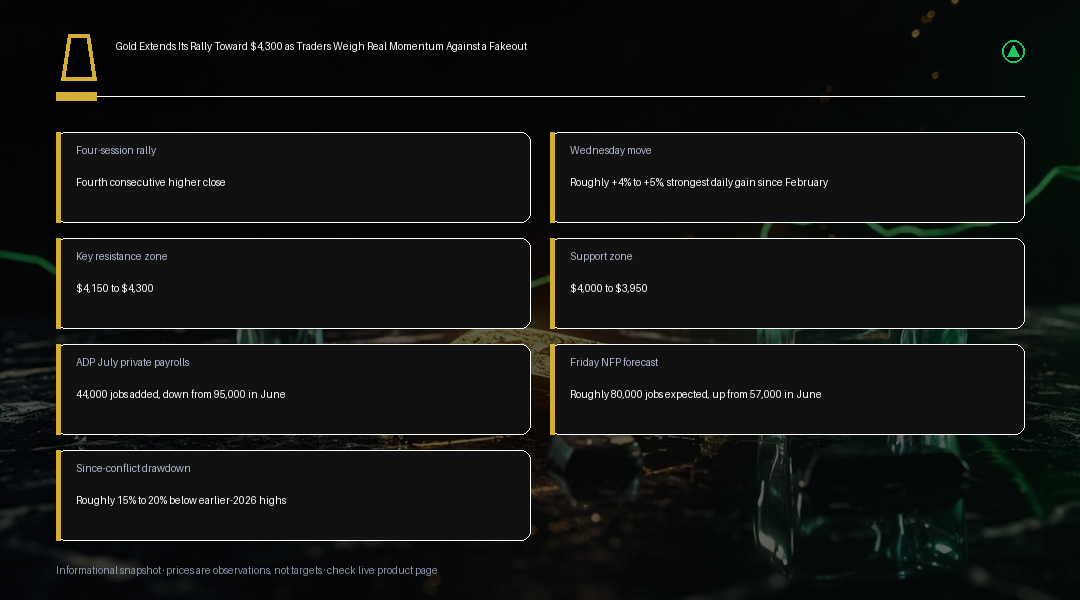
Gold extended its advance for a fourth consecutive session, pushing toward the closely watched $4,300 level and touching its highest mark since mid-June. The move followed a blowout session earlier in the week in which bullion jumped by roughly 4% to 5%, its strongest single-day performance since February, and it has left traders asking a familiar question after any fast, multi-day rally: is this the start of a genuine breakout, or another false alarm that fades before it can be confirmed.
The rally has been built on three reinforcing pillars rather than a single catalyst. The first is currency and rates. The US dollar has softened against a basket of major peers, and Treasury yields have eased alongside it. A weaker dollar makes gold cheaper for buyers transacting in other currencies, while lower yields reduce the opportunity cost of holding a non-yielding asset like bullion, which pays no interest and generates no cash flow while sitting in a vault. When both move in gold's favor at the same time, as they have this week, the metal tends to get a disproportionate lift.
The second pillar is easing geopolitical risk. Reports that talks could be progressing toward defusing tension around the Strait of Hormuz have pushed crude oil prices lower, which in turn eases some of the inflation anxiety that had been building in the market. Lower expected inflation matters for gold in two ways: it reduces the odds that central banks need to keep policy tighter for longer, and it lowers the real, inflation-adjusted return that investors would otherwise earn by holding cash or short-term bonds instead of bullion. Traders should treat this as a genuine but still-developing story rather than a finalized diplomatic outcome. Markets have reacted enthusiastically to reports of progress on this front before, only to see tensions resurface later, so confirmation through verified, durable de-escalation matters more than any single headline.
The third pillar is a shift in how the market is pricing the Federal Reserve's next move. Expectations for further policy tightening at the coming meeting have eased over the past several sessions, and less tightening generally supports gold because it lowers the relative appeal of interest-bearing alternatives. It is worth being precise here: the exact odds implied by short-term interest rate markets have moved quickly and have been reported inconsistently across different data providers this week, so traders should treat the shift as a genuine directional signal, easing bets on additional tightening, rather than anchoring to any single, precise percentage figure.
Layered on top of the rate story is a labor market signal that arrived earlier this week. Private payroll data showed employers added just 44,000 jobs in July, a meaningful slowdown from the prior month's revised total and below what economists had been expecting. A softer private-sector hiring print reinforces the idea that the labor market may not need additional restrictive policy to cool down, which is part of why yields and the dollar eased in its aftermath. The setup ties directly into Friday's more closely watched government employment report, where consensus estimates call for a moderate improvement from the prior month's soft reading, though still well below the pace of hiring investors had grown accustomed to earlier in the cycle.
That Friday report is arguably the single most important near-term catalyst for gold's next move. A weaker-than-expected outcome would likely reinforce the current narrative: cooling labor demand, reduced pressure on the Fed to tighten further, and a supportive backdrop for non-yielding assets. A stronger-than-expected print, on the other hand, could quickly reverse the recent move in yields and the dollar, testing whether the current gold buyers are prepared to hold their positions through a less favorable data surprise. Given how much of this week's rally rests on the assumption that the labor market is cooling in an orderly way, a surprise in either direction carries outsized potential to move price.
From a technical standpoint, the zone between roughly $4,150 and $4,300 has become the market's key battleground. A sustained close above the upper end of that range, ideally confirmed over more than a single session, would strengthen the case that this is a genuine trend extension rather than a short-covering bounce. Conversely, a rejection from current levels followed by a slide back toward the $4,000 to $3,950 area would support the more skeptical fakeout interpretation, particularly if it coincides with a reversal in the dollar or a jump in yields. Traders should also watch whether momentum indicators show the metal becoming stretched on a short-term basis, since four consecutive daily advances of this magnitude can leave a market vulnerable to a sharp, technical-driven pullback even if the underlying macro story remains intact.
It is also worth stepping back to note how far gold has traveled from its highs earlier in the year. The metal remains meaningfully below levels seen before a period of extended geopolitical and inflation-driven pressure earlier in 2026, and this week's advance, while notable, has only partially clawed back that drawdown. That context matters for position sizing: a four-session bounce inside a broader corrective structure is a different risk proposition than a fresh breakout to uncharted territory, even though both can look similar on a short-term chart.
For active traders, the practical takeaway is to treat this week's advance as constructive but not yet confirmed. The combination of a softer dollar, lower yields, cooling inflation expectations tied to easing oil prices, and reduced tightening bets has produced a coherent, multi-factor case for gold strength. But each of those pillars remains sensitive to fast-moving headlines and data surprises, particularly around Friday's employment report and any further developments regarding the Middle East diplomatic track. A disciplined approach means respecting the $4,150 to $4,300 zone as the line that will likely decide whether this becomes a durable move or another rally that fades once the immediate catalysts are digested.
Cross-asset signals support the same directional read for now. Real yields, the inflation-adjusted return on government bonds, have eased alongside nominal Treasury yields, which is typically the most direct read-through to gold demand from institutional and macro-driven investors. Silver has broadly tracked gold's advance over the same stretch, consistent with a genuine precious-metals bid rather than a narrow, gold-specific technical squeeze. Central-bank buying, which has been a persistent, multi-year source of demand for bullion, is another factor traders should keep on their radar even though its pace is not disclosed in real time; sustained official-sector demand would provide a structural floor beneath any near-term pullback, while a pause in that buying could remove one of the less headline-driven supports behind the broader 2026 uptrend.
MC Markets does not cite exact source levels without independent market-data verification. Traders should confirm current pricing and event timing through their own market-data feeds before acting on any of the levels discussed above.
Trading Insight
The rally's durability likely hinges on Friday's employment report and the follow-through in the dollar and Treasury yields over the coming sessions. A sustained close above the $4,150 to $4,300 resistance zone, ideally with confirmation from a softer payrolls surprise, would strengthen the case for a genuine trend extension toward the next technical objectives above $4,300. A rejection from current levels, especially if paired with a stronger-than-expected jobs print or a reversal in the dollar and yields, would support the fakeout interpretation and open the door to a retest of the $4,000 to $3,950 area. Given four consecutive sessions of gains, traders should also watch for signs of short-term exhaustion independent of the macro narrative, since sharp, momentum-driven pullbacks can occur even within an otherwise intact bullish structure. Position sizing should reflect the two-sided event risk around Friday's data and the still-developing, unconfirmed nature of the Middle East diplomatic track.