


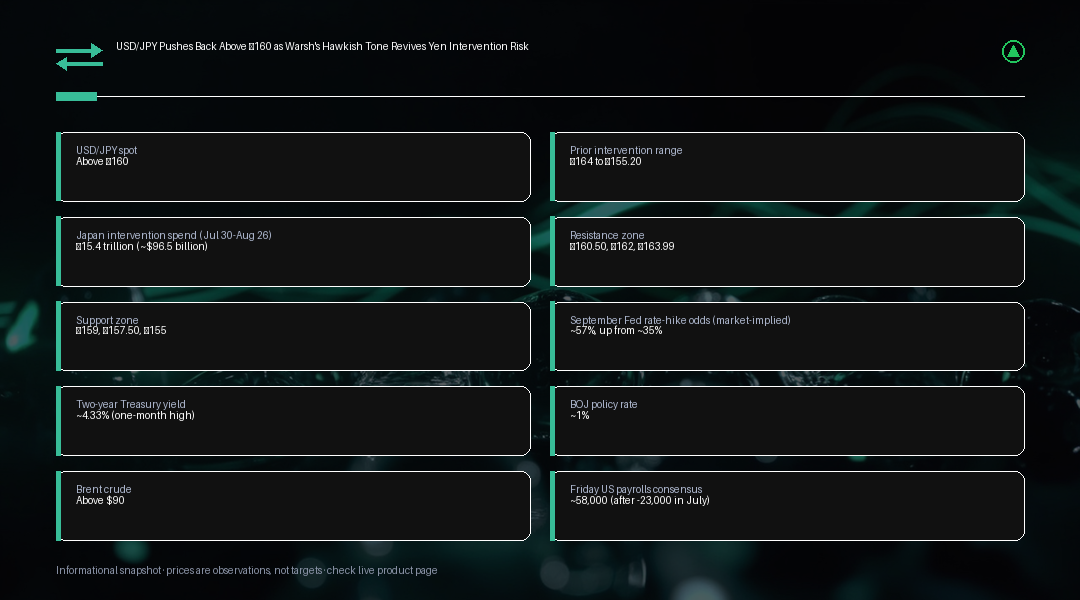
USD/JPY pushed back above the ¥160 threshold on Monday for the first time since Japan and the United States carried out a coordinated currency intervention, reviving talk that authorities in Tokyo and Washington could step back into the market to support the yen. The pair had previously climbed as high as roughly ¥164 before that official buying drove it down to around ¥155.20, so Monday's move effectively unwinds a meaningful share of the currency's hard-won recovery in just a few weeks.
Japan's Ministry of Finance data shows a record ¥15.4 trillion, equivalent to roughly $96.5 billion, was spent defending the currency between July 30 and August 26. The US Treasury also took part in that operation through its Exchange Stabilization Fund, which added credibility to the move even though Washington has not disclosed the exact size of its own purchases. One month on, most of that hard-purchased yen appreciation has already been given back, underscoring how quickly rate differentials can overwhelm a currency-market intervention once the underlying policy gap reasserts itself.
That policy gap is the heart of the story. Federal Reserve Chair Kevin Warsh told the Jackson Hole audience that policymakers still "have work to do" unless inflation moves convincingly back toward the 2% target. The remarks did not amount to a formal rate-hike announcement or a specific timetable, but interest-rate futures still moved to price a market-implied probability of roughly 57% for a September increase, up from about 35% beforehand, pushing the two-year Treasury yield toward a one-month high near 4.33%.
On the other side of the pair, the Bank of Japan's policy rate remains around 1%, leaving short-term US yields more than three percentage points higher. That gap is exactly the kind of setup that fuels the yen carry trade, in which investors borrow cheaply in yen to fund purchases of higher-yielding dollar assets. It can be a profitable trade for long stretches, right up until an intervention-driven candle rearranges the chart inside a single session.
The Bank of Japan could still raise rates at its September meeting, given persistent inflation and renewed currency weakness, and markets are treating that as a live possibility rather than a settled outcome. Any move higher in Japanese policy rates would need to be weighed against already-elevated Japanese government bond yields, which raise the cost of servicing Japan's enormous public debt and therefore limit how aggressively the central bank can tighten without creating separate problems in its own bond market.
Energy markets have added a fresh complication. Brent crude traded above $90 a barrel after US forces struck Iranian missile launchers on Larak Island, with Iran reportedly retaliating against American forces elsewhere in the region; those retaliation reports have not been independently confirmed and should be treated as developing rather than settled. Because Japan imports the vast majority of its energy needs, a sustained rise in oil prices tends to widen its trade deficit and increase demand for dollars to pay for those imports, adding another layer of pressure on the yen alongside the rate-differential story.
Despite the yen's slide back above ¥160, US Treasury Secretary Scott Bessent described the recent moves as orderly and "pretty well contained," language that lowers, without eliminating, the near-term probability of fresh coordinated intervention. Officials have historically stepped in to counter excessive volatility and disorderly moves rather than simply because a round number has been breached, so Bessent's tone matters as much as the ¥160 level itself when gauging how close authorities might be to acting again.
On the chart, resistance is layered at ¥160.50, then ¥162, with July's 40-year high near ¥163.99 as the more distant upside marker. Support sits at ¥159, then ¥157.50, with the intervention low near ¥155 as the deeper floor. As with any technical framework, these should be read as indicative levels from the current chart rather than fixed, independently verified thresholds, since intervention risk itself can override normal technical behaviour at short notice.
Friday's US employment report is the next scheduled catalyst that could move the pair meaningfully in either direction. Economists are looking for payrolls to rebound by roughly 58,000 jobs after July's surprise decline of 23,000, a data point that, if confirmed stronger than expected, would tend to reinforce the hawkish Fed narrative and could push USD/JPY back toward its previous highs. A softer print would work the other way, potentially lowering Fed hike expectations and doing some of Tokyo's currency-defense work without a single yen of official intervention.
For traders, the setup this week again comes down to sequencing two forces that are currently pulling in the same direction for the dollar: a hawkish Fed repricing and a genuine energy-driven inflation risk from the Middle East. Until one of those forces fades, whether through a softer jobs report, a de-escalation in the Iran-related conflict, or a fresh verbal or actual intervention from Tokyo and Washington, the path of least resistance for USD/JPY looks tilted higher, even though the pair remains within a level authorities have previously treated as a line worth defending.
Trading Insight
USD/JPY traders should treat ¥160 as a psychologically important zone rather than a hard ceiling, especially after Bessent's comment that recent moves have been orderly rather than disorderly. A push toward ¥160.50 and ¥162 on strong US data would keep the carry trade attractive, but positions built purely on the rate-differential story carry real intervention-headline risk: Japan has shown this year that it is willing to spend meaningfully to defend the currency once policymakers judge the move excessive. Traders leaning long into Friday's jobs report should watch for any verbal escalation from Japanese officials as an early warning sign, since intervention risk tends to build well before any actual market operation. On the downside, a break back below ¥159 and toward ¥157.50 would suggest the softer-payrolls scenario is playing out and that some of the post-Jackson Hole dollar strength is unwinding. MC Markets does not cite exact source levels without independent market-data verification, so confirm live pricing and the economic calendar before acting on any of the levels or probabilities discussed here. Above all, remember that the roughly 57% September hike probability and the Iran-related oil headlines are both fast-moving inputs that can shift materially within a single session.