


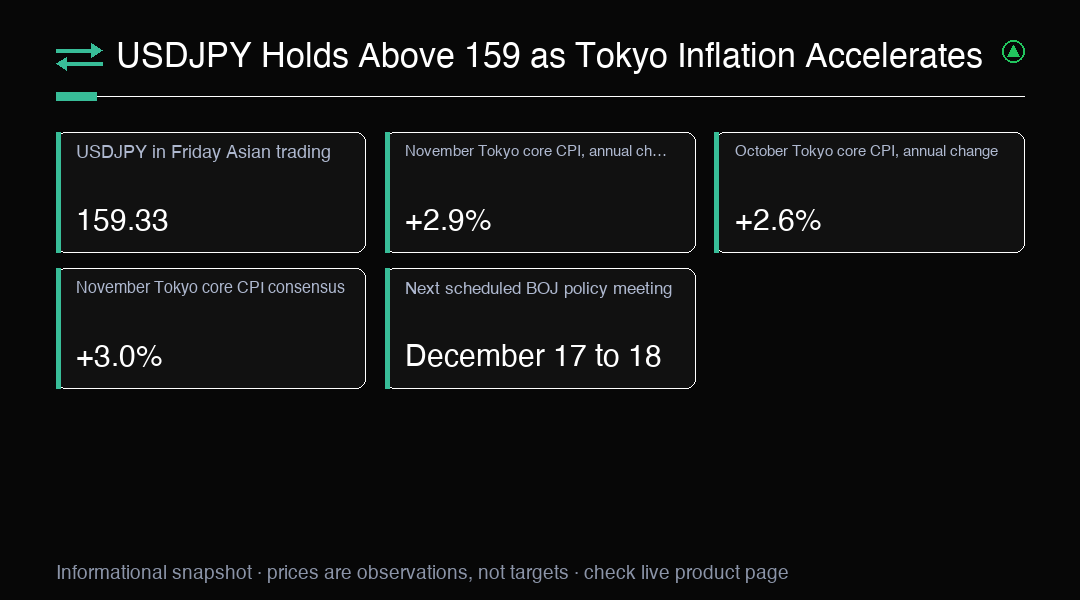
The US dollar traded at 159.33 yen in Friday’s Asian session as Tokyo’s core inflation accelerated in November and came in below expectations. USDJPY held above 159 in the available snapshots, leaving the yen on the weaker side of that round-number reference. The price data gave the Bank of Japan fresh evidence to weigh as it assesses the persistence of inflation. For the currency market, the release pointed in two directions. Faster price growth added to the case for tighter Japanese policy, while the smaller-than-expected increase limited how much the release strengthened that case relative to what markets already anticipated.
A separate Asian trading snapshot put USDJPY at about 159.28 at 09:04 JST. The pair measures how many yen are needed to buy one US dollar, so a rise in USDJPY means the yen has weakened against the dollar. Each quote captures pricing at a particular moment. Establishing the size and duration of any move following the inflation release would require comparable quotes taken before and after it. That timing matters in a market where both currencies can respond to developments elsewhere during the same session, including changes in expectations for US interest rates.
Tokyo’s core consumer price index rose 2.9% from a year earlier in November, compared with 2.6% in October and a consensus forecast of 3.0%. The index excludes fresh food and includes energy, so movements in energy costs can affect the core rate alongside changes elsewhere in the basket. The annual comparison measures how far the index stands above its level a year earlier. The rise in the annual rate can reflect price movements in the current period, the comparison period a year earlier, or both. Assessing the latest monthly momentum requires looking at the monthly figures separately.
October’s reading and the November consensus answer different questions. The first shows how the annual pace changed between releases. The second provides a benchmark for what the market expected heading into the data. A trader who already anticipated faster inflation could see the release as softer than expected even while the annual series shows an acceleration. The distinction matters because currency prices can reflect a widely held expectation ahead of a scheduled release. The November figure provided incremental information about the strength of the inflation pickup, and the forecast miss was the part that differed from the prevailing expectation.
The release covers Tokyo, where household spending patterns and changes in individual prices can differ from those elsewhere in Japan. It provides a timely reading of price pressures in the capital ahead of the December meeting. The nationwide figures will provide a broader basis for assessing whether similar pressures are present across the country. The breadth of any increase matters for policy. A rise spread across categories and regions can carry different implications for the persistence of inflation than an increase concentrated in a few items, even when both produce the same change in the aggregate index.
The Bank of Japan’s next scheduled policy meeting runs from December 17 to 18. The Tokyo release is one input into a decision that remains open. For the currency market, the meeting’s implications reach beyond the immediate policy rate. It can shape expectations for how long a given setting might last and what economic conditions could prompt a further change. A decision in line with expectations may leave the projected path largely intact. A shift in how officials assess persistent price pressure could change that path even if the current rate setting stays in place.
Inflation expectations also matter for how restrictive Japanese policy is at any given interest rate. If expected inflation rises while borrowing rates stay steady, the inflation-adjusted cost of borrowing falls. That can leave monetary conditions easier than the nominal rate alone suggests. A single Tokyo release gives limited evidence about that calculation because it measures past price changes, while households and businesses make decisions based on the prices and borrowing costs they expect to face. The distinction helps explain why policymakers need evidence about the likely persistence of inflation when deciding how much restraint the economy requires.
Interest rate differentials offer one way to understand why stronger Japanese inflation and a firm dollar can coexist. When US rates are expected to exceed Japanese rates over the same horizon, dollar assets can offer more interest income than comparable yen assets. All else equal, that gap can support demand for dollars from investors weighing returns in the two currencies. Investors who convert currencies to take those positions also face changes in the exchange rate. A rise in the yen against the dollar can erode or outweigh the interest advantage for a yen-based investor holding dollar assets.
The US side matters even when the main economic release comes from Japan. If expectations for Japanese and US rates rise by similar amounts over the same horizon, the projected gap can remain broadly steady. If Japanese rate expectations rise while US expectations hold steady, the gap can narrow. Timing matters as well. A change in expectations for the next policy meeting can leave the outlook further ahead largely intact, with different implications for short-term funding and longer-term holdings. Those scenarios explain how the rate differential can influence USDJPY, while the Asian quotes alone establish only where the pair traded.
The exchange rate can also feed back into inflation through the cost of imports. A weaker yen raises the yen cost of a dollar-priced import when its foreign price is unchanged and the buyer is exposed to the exchange rate. How much of that increase reaches households depends on contract terms, currency hedges and business pricing decisions. The effect can therefore show up at different times for importers and consumers. Tokyo’s core measure includes energy, making import costs a relevant channel, though the aggregate reading leaves open how much that channel contributed in November.
Above the observed Asian quotes, 160 is the next round-number reference. An approach toward it could bring the possibility of official intervention into the market discussion. Expectations of intervention can change how traders assess the risk of a sudden reversal, and the exchange rate alone offers little evidence about the likelihood or timing of official action. That distinction matters because expected interest rates and the perceived chance of intervention can affect the pair independently. The December BOJ meeting offers a scheduled point at which the policy outlook can become clearer, while any currency action remains a separate question.
Trading Insight
A narrowing expected US-Japan rate gap would reduce the dollar’s relative interest advantage. A simultaneous decline in USDJPY would show yen strength in the exchange rate, while a steady gap would give the Tokyo inflation surprise less scope to affect the pair through relative rates.