


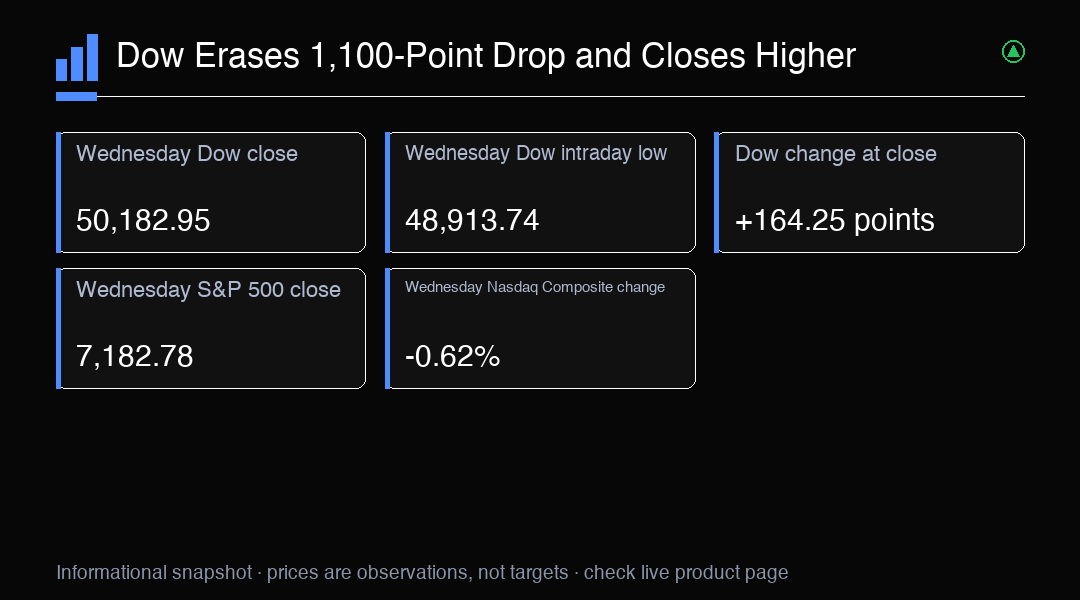
The Dow Jones Industrial Average erased a drop of about 1,100 points on Wednesday and closed at 50,182.95, up 164.25 points, or 0.33%. The blue-chip index recovered about 1,269 points from its intraday low of 48,913.74 as US stocks pared steep losses ahead of Thanksgiving. The S&P 500 and Nasdaq Composite still finished lower, while small caps advanced. Buyers stepped in after a deep selloff, leaving Friday's shortened session to test whether the recovery can carry beyond the blue-chip and small-cap shares that finished higher.
The size of the comeback depends on where the measurement starts. The closing level and point gain imply a prior close of 50,018.70, the base for measuring Wednesday's result. The Dow first fell well below that level, then recovered all of the loss and added a modest gain. The distance from the low to the close shows how much trading risk a daily percentage change can conceal when prices move sharply in both directions. A position marked at the previous close would have shown a sizable loss during the day before ending modestly higher. The close-to-close measure is also the cleaner comparison across benchmarks, since each can reach its intraday low at a different time.
IBM, Sherwin-Williams, Salesforce, Nike and Home Depot helped the Dow recover. That group spans software, paints, apparel and home improvement, showing how buying spread across industries. The Dow's construction helps explain why those moves mattered. It weights its constituents by share price, so a given percentage gain in a higher-priced stock adds more index points than the same gain in a lower-priced stock. The size of each stock's contribution matters alongside the number of gainers in explaining how the blue-chip average reclaimed its losses while other large-cap benchmarks remained below their previous closes.
The S&P 500 fell 0.25% to 7,182.78, and the Nasdaq Composite lost 0.62% after falling more than 4% intraday. Nvidia ended down 3.9% and Amazon fell 3.1%. The S&P 500 gives greater weight to companies with more market value in publicly tradable shares, so declines in those two stocks can offset gains across a much longer list of companies. The Nasdaq Composite is also weighted by market capitalization. Its recovery from the lows showed how much selling pressure eased over the session, even as some of its biggest names continued to weigh on the close.
Small caps held up better than the broad large-cap market. The Russell 2000 rose about 0.7%, showing that gains extended beyond the Dow's blue-chip constituents. A majority of S&P 500 members also rose, even as declines in some of its largest stocks pulled the index lower. Company results produced further differences among individual shares. HP rose 11.5% following its earnings, a gain specific to the PC and printer maker during a session when several large technology stocks fell. The day's split among benchmarks therefore reflected both where buying took place and how much weight those stocks carried.
The reversal came amid an inflation backdrop that remains relevant to equity valuations. The personal consumption expenditures price index rose 3.8% in October from a year earlier, while core PCE inflation, which excludes food and energy, was 3.3% on the same basis. Treasury yields fell on Wednesday. Those developments can coexist because bond prices reflect expectations for growth and policy as well as demand for safety during a selloff. Persistently elevated inflation can limit the Federal Reserve's room to lower borrowing costs, and a renewed rise in yields would put pressure on stocks whose valuations depend heavily on earnings far in the future.
The same inflation backdrop has different implications for the companies that helped lift the Dow. For retailers and consumer brands such as Home Depot and Nike, higher prices for essentials can leave households with less to spend on other purchases. Higher financing costs can also make it harder for households to take on big renovation projects. For companies that sell technology to businesses, a different question is how much corporate customers are willing to commit to new software and services. Wednesday's gains across these businesses brought the Dow back above its prior close, while their earnings remain exposed to different spending decisions.
Asian shares rebounded on Thursday, with technology stocks helping lift markets in Japan and South Korea. The recovery came in a separate cash session after Wednesday's turnaround on Wall Street. Asian markets had sold off before US stocks recovered, and Thursday gave investors in the region their first chance to respond in regular trading. The rebound showed that buyers were willing to return to parts of the technology sector overseas. With US cash trading paused for Thanksgiving, the next indication of whether that demand extends to American chipmakers and other large technology stocks will come when those shares reopen on Friday.
NYSE cash equities are closed Thursday for Thanksgiving, and Friday's regular session is scheduled to end at 1 p.m. ET. The early finish compresses the time for cash-market orders to be executed and for prices to respond to news accumulated over the holiday. When liquidity is thin, an order that would normally move a stock only slightly can have a larger effect, particularly near the open or close. Friday will provide the first cash-market test of the recovery, with the next full session offering a longer window to assess whether demand can absorb renewed selling.
Wednesday's close gives the Dow an immediate reference when regular trading resumes. Holding near or above it through the opening swings would suggest some of the demand behind the recovery has carried over. A retreat below Tuesday's implied close would give back the net gain, while a move toward Wednesday's intraday low would bring the depth of the original selloff back into focus. The path between those levels matters. A brief move through a reference price in a shortened session carries less information about sustained demand than repeated buying or selling around it as the session progresses.
A wider recovery would draw support from the large technology shares that held back the S&P 500 and Nasdaq, alongside continued participation from smaller companies. The Dow could still gain with support from a handful of influential blue chips while the broader benchmarks lag. If the small-cap advance fades as well, there would be fewer areas of strength supporting US equities. That comparison gives Friday's index moves more meaning than the direction of any single benchmark on its own. The count of advancing and declining shares would add context if a handful of large companies account for much of the move in either direction.
Trading Insight
Wednesday's Dow cash close and intraday low frame Friday's test. An opening gain that fades toward the prior close would bring the durability of Wednesday's rebound into question. Holding above Wednesday's close through the shortened session would provide an early sign that demand has carried over.