


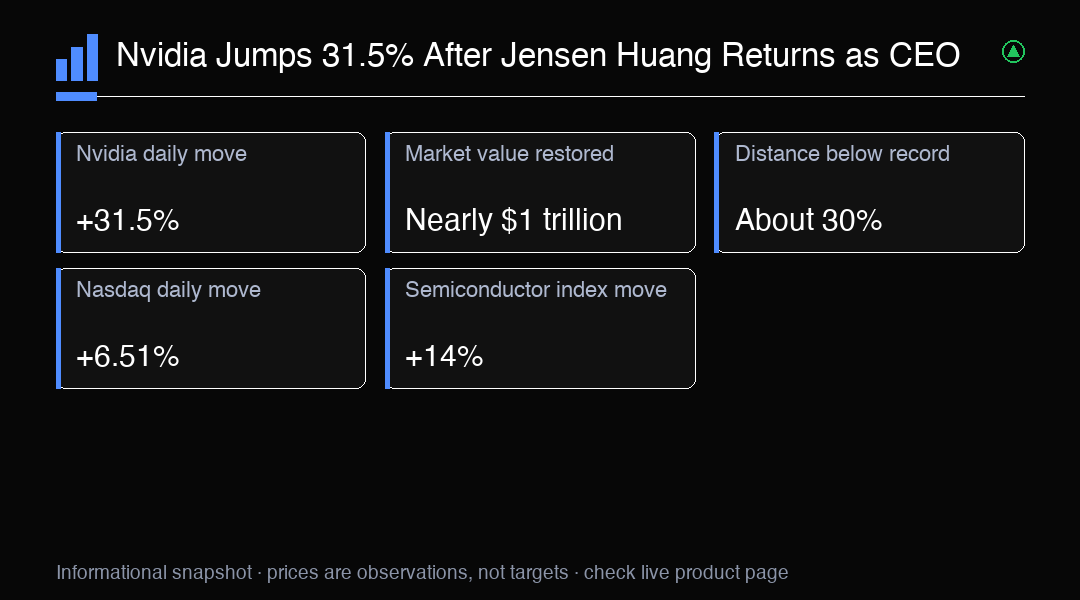
Nvidia shares jumped 31.5% Monday, their strongest session since 2003, after the board reinstated Jensen Huang as president, chief executive and director. The rally added nearly $1 trillion to the chipmaker’s market value and returned it to second place behind Apple among the world’s largest listed companies. Huang’s return gave investors a clear answer to who would lead the company through its next phase of expansion. The market reaction reached beyond Nvidia as investors returned to semiconductor stocks and other shares tied to spending on artificial intelligence.
Even after the surge, Nvidia remained about 30% below its record high and had recovered only part of the losses since Huang’s departure. A daily gain is measured from the previous session’s price, while the distance from a record is measured from the peak. The different starting points explain how a gain of this scale can still leave a substantial gap to the high. The market value restored on Monday reflects the higher price investors placed on Nvidia’s outstanding shares. The change in rank shows how sharply that repricing shifted Nvidia’s position relative to other large companies.
The unanimous vote reversed the board’s position less than a week after it ruled out Huang’s return. Colette Kress stayed on as chief financial officer, and Harvey Jones remained board chair. The decision restored a familiar executive structure at a company whose product plans take years to develop and depend on coordination with suppliers and customers. For those businesses, continuity at the top matters when decisions involve committing to product schedules, reserving manufacturing capacity or negotiating long-term supply agreements.
Nvidia said input from senior US government officials helped directors conclude that reinstating Huang posed no national security risk. President Donald Trump later said he had persuaded the company to bring Huang back. The board settled who would lead Nvidia, while political and legal scrutiny of its export practices continued. Lawmakers from both parties criticized the reinstatement and called for tighter controls on advanced chips reaching China. Their response kept the focus on how restrictions are enforced, a question with commercial implications for Nvidia and for customers that source its chips through distributors or other intermediaries.
Nvidia’s advance helped lift the Nasdaq Composite 6.51% and the S&P 500 4.73% Monday, while semiconductor shares gained 14%. The company’s size gave it considerable influence on the headline benchmarks. The jump in chip shares also showed renewed enthusiasm for businesses linked to AI spending. Those moves capture different parts of the session. A headline index can rise sharply on the strength of a few heavily weighted companies, while the performance of individual chipmakers and suppliers shows how far buying extends within the industry. The sector’s gains made that distinction especially relevant on Monday.
The case for sustained AI investment depends in part on what customers earn from the computing capacity they install. A chip order can support a supplier’s revenue well before the buyer knows how much of that capacity it can sell. For a cloud provider, returns depend partly on utilization, or how much of its available computing capacity customers pay to use. The price of that computing time matters too. Higher utilization can help spread fixed costs over more workloads, while lower prices can limit how much additional revenue comes from keeping more servers busy.
Financing adds a different constraint. Data centers require spending on buildings, power and networking as well as chips, with bills coming due before the facilities reach full use. Funding terms can affect when a project starts and how much equipment it orders at each stage. A customer with flexible financing can expand in phases as demand develops. A buyer with more pressing funding needs may have less room to absorb a delay in securing power or signing tenants. For chip suppliers, the timing of actual deployments can matter as much as the size of announced projects.
Export rules affect a different part of Nvidia’s order pipeline. When a sale requires a license, the customer’s location, intended use and access to approved versions of a chip can shape the order before any hardware ships. Tighter rules could change which products Nvidia offers in a market or how it allocates supply across customers. The revenue effect would depend on the scope of any measure and the demand available elsewhere. For Nvidia’s customers, a change in product availability can also affect how they plan data center capacity and when they commit to purchases.
Nvidia created a national security and export control committee made up of independent directors and was seeking a chief compliance officer. The committee gives independent directors a formal role in overseeing trade compliance as Nvidia looks for an executive to lead that work. The practical questions include how the company vets customers and intermediaries, how staff escalate concerns about where chips may end up, and what information reaches directors when a sale warrants closer review. Those details matter in a distribution chain where the immediate purchaser and the operator that ultimately installs the hardware may be different businesses.
Huang was scheduled to appear before the Senate on December 3, giving lawmakers a public forum to question how Nvidia applies export safeguards and where they see gaps in the rules. For markets, the commercial significance of the hearing will depend on what lawmakers and regulators do with the issues it raises. Specific proposals could reveal which products, customers or channels would face closer scrutiny. Until any changes take effect, the existing requirements govern sales, and Nvidia’s handling of orders under those rules remains the immediate commercial issue for customers planning new computing capacity.
Over the next few sessions, the market will get a clearer view of how much of Monday’s gain Nvidia retains and whether chip stocks keep pace. Share prices can adjust to an executive decision in a single session, while chip purchases move through budgets, deployment schedules and procurement. Nvidia’s updates on orders and shipments can help show whether customers are turning planned computing capacity into purchases. Across the chip industry, the pace of those commitments will offer a more direct measure of demand than a rise in valuations driven by the immediate reaction to Huang’s return.
Trading Insight
Compare Nvidia’s follow-through with the semiconductor index. If Nvidia holds Monday’s gains while chip shares give ground, the rebound would look more company-specific. Gains that persist across chipmakers would signal broader participation.