


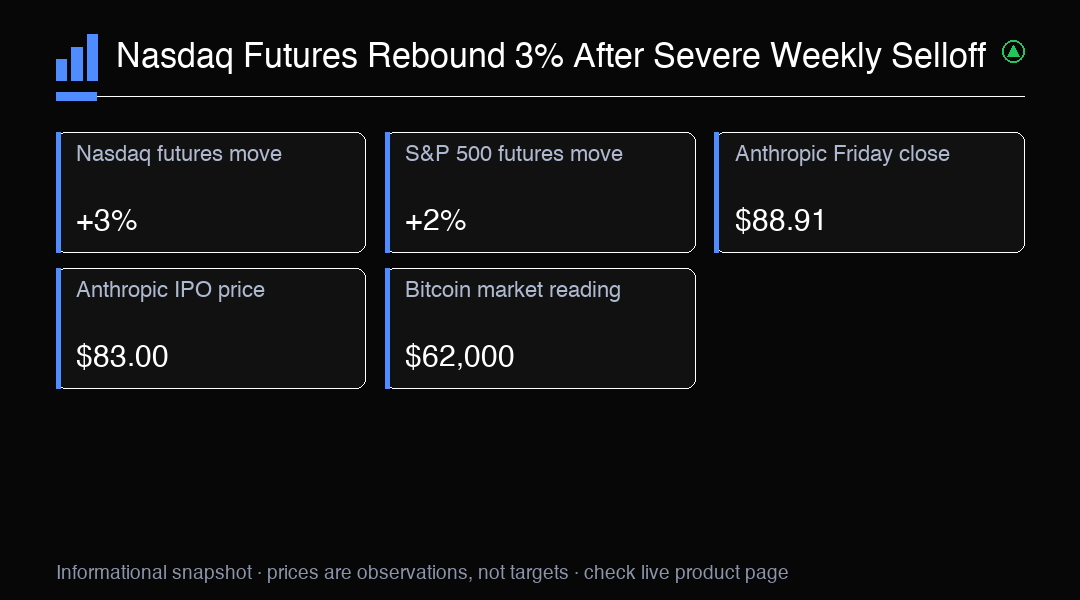
Nasdaq-100 futures rose about 3% in Asian trading on Monday, November 23, while S&P 500 futures gained around 2%. The advance offered an early recovery after a punishing week for US equities, with the larger gain in Nasdaq-100 futures putting technology shares back in focus. The rebound came before US cash trading, leaving the broader decline unresolved. The size of the move was striking, but so was the backdrop. Friday’s losses had extended well beyond technology, and the week ended with two major benchmarks more than 10% below their record closing highs.
The Nasdaq Composite fell 5.3% on Friday, the S&P 500 lost 3.7% and the Dow declined 1.9%. The Nasdaq recorded its weakest week since March 2020. The S&P 500 and Dow had crossed the threshold commonly used to define a correction, a decline of at least 10% from a recent peak. Those measures tell different parts of the story. The daily losses show how sharply prices moved in a single session, while the distance from record closes shows the cumulative damage. Both matter when judging how much ground the market can recover in a bounce.
The Nasdaq figures also refer to different benchmarks. Friday’s decline was in the broader Nasdaq Composite, while Monday’s futures gain tracked the Nasdaq-100, which is made up of large nonfinancial companies listed on the exchange. Many prominent technology shares influence both indices, but their membership and weights differ. A handful of heavily weighted stocks can lift the Nasdaq-100 even when gains are modest across the rest of the market. That makes the gap between the two futures moves an early sign of where buying was strongest at the index level, with individual stock participation still to be seen.
Anthropic offered a closer look at the swings within technology. Its shares, trading as ANT, closed Friday at $88.91, down 8.5%, after touching $83.05 intraday. That low brought the stock close to its $83 initial public offering price. The offer price gives traders a reference for how much of the premium since listing remains. Friday’s close also showed how quickly that premium could widen again from the session low. With only a short trading history, ANT has few established price references, so the offer price carries particular visibility during its volatile first sessions.
The debate over AI infrastructure spending reaches beyond any one listing. Companies funding computing capacity face costs before they can see the full return from putting that capacity to work. Financing terms affect the cost of carrying those investments, while customer demand and pricing help determine how quickly the revenue arrives. Investors can agree about the long-term potential of AI and still reach very different conclusions about what today’s spending is worth. That tension helps explain why expectations for future cash flows can have an outsized effect on technology valuations during periods of market stress.
Asian cash markets gave a mixed reading alongside the rise in US futures. Taiwan’s benchmark recovered about 2%, while South Korea’s Kospi pared deeper losses and remained around 2.5% lower. Japan was closed for a holiday, and European futures were broadly steady during the same Asian session. The distinction between recovering from an intraday low and turning positive was particularly clear in South Korea. The Kospi’s climb from its lows showed that some selling pressure had eased, while its loss for the session showed that buyers had recovered only part of the ground lost.
Policy responses varied across the region. Taiwan tightened short-selling rules, Chinese exchanges eased margin-financing requirements and South Korea reiterated that officials were prepared to stabilize markets. The measures work through different channels. Short-selling restrictions change the conditions for taking bearish positions, while easier margin requirements can affect how readily investors finance purchases. South Korea’s statement concerned its readiness to act. These steps can influence trading conditions and positioning in the near term. The economics of AI investment still depend on funding costs, how much customers use the new capacity and the revenue that usage generates.
The dollar and government bonds largely retained their defensive gains from Friday. The euro remained below $1.10, and USD/JPY briefly traded above 159, putting the yen under pressure against the dollar at that point in the session. A stronger showing in equity futures can coexist with demand for assets used to manage risk. Currency and bond prices also reflect expectations about interest rates, and those expectations can move on a different timetable from technology shares. The brief move above 159 describes where the pair traded during the session. It leaves the closing direction open.
Precious metals recovered some of the ground lost in the previous week. Gold rose 2.4% to about $3,615 after losing around 9% the week before, while silver gained roughly 3% to $42.41. Gold’s move illustrates how far a rebound can fall short of a full recovery. A gain measured from the lower price starts from a smaller base, so even a substantial rally can leave much of the earlier loss in place. That distinction matters after a week when large percentage moves made it easy to lose sight of the distance between current prices and their earlier levels.
Bitcoin traded near $62,000 after falling to around $55,000 during thin weekend trading. Its rebound unfolded while US cash equities were closed, giving it a different starting point from Monday’s rise in equity futures. With fewer orders available near the prevailing price, even a modest trade can move a thin market farther than it would during busier hours. The weekend range therefore offers a measure of how far Bitcoin moved under those conditions. The reading near $62,000 captures the subsequent recovery, while trading in the more liquid hours gives that move a different test.
The US cash session will show how widely the rebound reaches beyond the largest technology names. Gains spread across sectors would point to broader participation after Friday’s losses. A rise driven mainly by a handful of large stocks would tell a narrower story, even if the index move were sizable. Anthropic’s trading near its offer price and the diverging performances in Taiwan and South Korea already illustrate how much an index headline can leave out. For this rebound, the distribution of gains across stocks and sectors will help put the headline percentage in perspective.
Trading Insight
Friday’s cash close provides a baseline for measuring the US equity rebound. Comparing the opening move with performance later in the regular session shows how much of the initial advance holds as more stocks trade.