


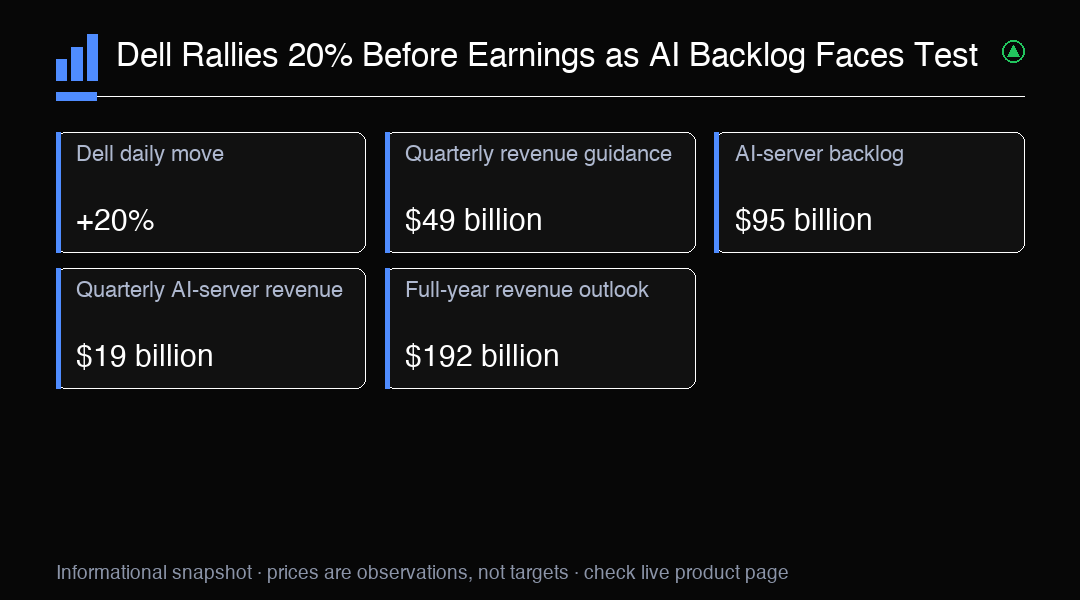
Dell shares rose 20% Monday alongside a rally led by Nvidia following Jensen Huang's return. Dell was due to report fiscal third-quarter results after Tuesday's US close, giving investors a chance to assess how much of the demand for AI infrastructure was turning into sales. The advance raised the stakes for a company whose order book already pointed to substantial demand. With the stock trading at a much higher price heading into the release, the focus was on how quickly Dell was getting systems into customers' hands and how much it was earning on those deliveries.
Management had guided for quarterly revenue of $49 billion, plus or minus $500 million, and adjusted earnings of $6.50 a share, plus or minus $0.10. Some analyst surveys had moved above the company's targets. That left investors with two benchmarks for the release. Management's guidance would show how the quarter measured up against Dell's own plan, while those surveys pointed to higher expectations among some analysts. Results at the center of Dell's guidance could therefore be in line with management's expectations and still fall short of what some investors were looking for after Monday's advance.
Dell entered the quarter with a $95 billion AI-server backlog after securing $60.9 billion in orders in the preceding quarter. Orders measure the commitments booked during a period. The backlog represents the business still to be fulfilled at a given point. Dell recognizes revenue as it fulfills its obligations under customer contracts. That makes the order book a measure of potential future sales, with the timing of those sales spread across individual contracts. For investors assessing the current quarter, the immediate question was how much of that business had reached the point where Dell could record it as revenue.
Dell projected $19 billion in quarterly AI-server revenue, up from $16.4 billion in the preceding period. Its previous guidance also called for strong infrastructure growth. The server projection gave investors a specific target for assessing how well Dell managed its shipments. An order can be booked well before the necessary components arrive, and completed systems can still be waiting on a customer's deployment schedule. A shift in the timing of a large delivery could move sales between quarters. Management's account of where systems were in that process would help explain any gap between the reported figure and the projection.
The movement in the backlog can be as revealing as its size. New orders add to the total while deliveries draw it down, so a single headline balance can obscure changes in both. A growing backlog can accompany strong shipments when customers place orders faster than Dell can fill them. A declining balance can reflect successful execution if deliveries accelerate while order intake remains firm. Commentary on orders and completed shipments would help investors tell those situations apart. It would also give them a clearer sense of whether the sales pace could carry forward once the quarter's largest deliveries were complete.
Profitability depends in part on which systems Dell ships. AI servers carry a high sales price partly because of the components they contain. If those components account for a large share of what the customer pays, additional revenue may translate into a smaller increase in gross profit. The mix of systems delivered in a given quarter can matter as much as the aggregate sales figure. A quarter with more revenue from hardware-heavy configurations could produce strong infrastructure growth while putting pressure on margins. Margin commentary would show how much of the incremental revenue Dell was keeping after the direct costs of those sales.
Adjusted earnings per share would show how much profit Dell reported on a per-share basis after its adjustments. The rest of the income statement would help explain that figure. Gross profit reflects what Dell has left after the direct cost of sales, while operating profit also accounts for the cost of running the business. Taxes and the share count can affect earnings per share as well. Reading those figures together would help investors judge whether growth in the server business was improving operating profitability and identify any other factors that contributed to the change in adjusted earnings.
Operating cash flow shows when the server business generates cash. Dell can pay for components and carry inventory before it delivers a system, then wait for the customer to pay. A quarter with rising shipments can still tie up cash if Dell is buying parts for future orders or carrying more receivables. Cash committed to an upcoming delivery may come back once the customer pays, while a longer payment cycle can keep cash tied up even after shipments accelerate. Changes in inventory and receivables would help explain any gap between reported profit and cash generated by operations.
Dell's existing full-year outlook called for $192 billion in revenue, $74 billion in AI-server sales and adjusted earnings of $25.50 a share. Investors would have to consider any revisions together. A higher server sales outlook paired with a steady earnings projection would raise questions about the margin on those additional sales or the cost of getting systems out the door. If the company left the outlook intact, attention would shift to the performance needed over the remainder of the fiscal year to reach those targets. The annual figures would give investors a way to gauge how much the quarter changed the broader earnings outlook.
Dell also offers a view of AI investment from a different point in the supply chain. A chip supplier can record a sale before the customer who ordered a finished system is ready to put it to work. Dell sits between those steps, assembling servers and getting them to customers that may have their own installation schedules. The pace of accepted deliveries gives investors a closer look at when that investment is reaching the facilities that will use it. The distinction matters for other suppliers whose sales also depend on those deployments.
After a move as large as Monday's, the market reaction could turn on where Dell finished relative to expectations and what management said about the next quarter. Strong sales and margins would carry more weight if the accompanying outlook suggested that level of performance could hold. A quarter buoyed by a few large projects would put more emphasis on which deliveries were scheduled to follow. The report would give investors a company-specific basis for judging how much of Monday's enthusiasm could carry forward as Dell works through its order book.
Trading Insight
Read Dell's AI-server sales alongside margins and operating cash flow. Together, they show how much shipment growth translated into profit and cash. Management's delivery timetable can help explain any change in the full-year outlook.