

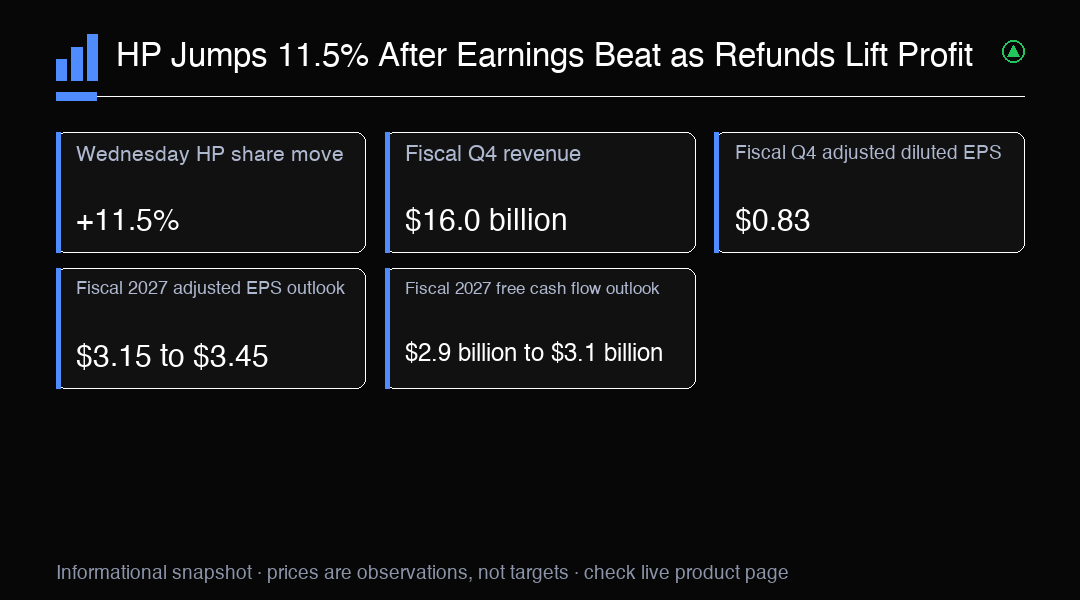
HP Inc. shares rose 11.5% in the regular US trading session on Wednesday, November 25, after the company reported fiscal fourth-quarter results late Tuesday, November 24. The gain came as the Nasdaq Composite and Nvidia shares fell. HP's fiscal 2026 fourth-quarter revenue rose 9.3% from a year earlier to $16.0 billion, and adjusted diluted earnings of $0.83 per share exceeded the $0.75 analyst consensus. Tariff refunds lifted reported profit, helping HP clear that estimate even as adjusted earnings fell from a year earlier. For fiscal 2027, how much of HP's sales growth reaches the bottom line will depend in part on its ability to manage higher component costs.
Adjusted diluted earnings fell from $0.93 a year earlier, while diluted earnings under generally accepted accounting principles, or GAAP, were steady at $0.84. Those measures describe a business that brought in more revenue without a corresponding increase in earnings per share. The market comparison is different. An earnings beat can prompt investors to revisit what they had priced in before a release, even when earnings are still below year-earlier levels. Wednesday's rally followed a clear upside surprise against the consensus, with the makeup of the beat particularly important to the outlook.
Tariff refunds contributed $0.15 per diluted share to both GAAP and adjusted earnings for the quarter, compared with the $0.08 benefit HP had built into its earlier guidance. The difference helps explain the strength of the headline result. The refunds lifted fiscal 2026 earnings by $0.26 per diluted share on both measures. Analysts questioned how much of that benefit could recur. A refund recovers money HP previously paid in duties, and the timing of its recognition can make profits bumpier from quarter to quarter. That makes the refund contribution particularly important when comparing earnings across periods.
Revenue growth puts more emphasis on the cost of delivering those sales. Memory and storage remain a source of margin pressure for HP, and higher component costs can eat into the profit on each machine even when revenue is rising. Raising prices could offset some of that pressure, with the outcome depending on how customers respond. Some can defer a purchase or choose a cheaper configuration, leaving HP to weigh the benefit of a higher price against the risk of losing volume. Product mix offers another lever. Higher-priced devices can lift profit per device when the added revenue exceeds the extra cost of making and selling them.
Timing matters for that margin test. A rise in component costs can raise the cost of new supplier orders while some finished products still reflect earlier input costs. HP may also have commitments to customers that limit when it can change prices. The gap between a cost increase and a pricing response can leave a hardware business with higher sales and less profit on each dollar of revenue. If costs ease, the same lag can slow the improvement as HP sells through inventory it bought at higher prices. That makes the path of margins across several quarters more informative than any single quarter's change.
HP projects fiscal 2027 adjusted diluted earnings of $3.15 to $3.45 per share. Beginning in the first quarter of that fiscal year, the company will exclude stock-based compensation from its non-GAAP measures. HP estimated that applying the policy to fiscal 2026 would have raised adjusted diluted earnings by $0.38 per share. That figure is an estimate of the effect under the new definition for comparison purposes. Fiscal 2026's originally reported figures stand, and the policy leaves GAAP results unchanged. Measuring growth against the earlier year therefore requires putting both periods on the same accounting basis.
Stock-based compensation also matters to shareholders beyond its treatment in the earnings release. Equity awards pay employees without an equivalent cash outlay at issuance, and they can dilute existing shareholders over time. Buybacks can offset dilution while using cash that could otherwise fund investment or dividends. As HP changes how it presents adjusted earnings, GAAP results and the diluted share count provide different views of what shareholders earn per share. Those measures help distinguish the effect of the new definition from changes in the underlying business and in the number of shares over which profits are spread.
The cash outlook gives investors a separate measure of HP's performance. The company forecasts fiscal 2027 free cash flow of $2.9 billion to $3.1 billion, below the $3.3 billion it generated in fiscal 2026. Cash generation depends on when customers pay, when HP pays suppliers and how much the company spends on capital investment. Higher component costs can tie up more cash in inventory before HP collects proceeds from sales. As the year progresses, cash flow will help show whether sales are supporting the funds available for investment and shareholder distributions while the business absorbs those costs.
HP announced an increase in its quarterly dividend to $0.31 per share and returned $2.3 billion to shareholders through dividends and repurchases in fiscal 2026. The dividend increase comes alongside a forecast for lower free cash flow, so the pace of repurchases is a separate question from the size of the quarterly payout. Repurchases are generally easier to vary with cash generation than a regular dividend. If cash comes in toward the lower end of HP's forecast, the company would have less room to sustain buybacks alongside its other spending priorities. An improvement in cash generation would give HP more flexibility over how much it returns.
US cash equity markets are closed Thursday for Thanksgiving and reopen for a shortened Friday session. That leaves less trading time before the week ends for investors to respond to Wednesday's move. In a shortened session, a small number of large orders can have an outsized effect if fewer buyers and sellers are present. Wednesday provided the first regular session for the stock to absorb the results. The first full session after the holiday will offer a longer window to gauge whether the buying interest that emerged after the release is still there once normal trading hours resume.
HP's next results will give investors a chance to see where the sales growth is contributing to profit. Segment margins can show how much of each business's revenue remains after operating costs. If sales hold up and those margins begin to recover, HP would have firmer evidence that its response to rising costs is working. Another period of stronger sales and weaker margins would extend the pattern from the latest quarter and leave more of the burden on future cost relief. That operating comparison will help put the earnings surprise and Wednesday's share move in perspective.
Trading Insight
A margin recovery accompanied by stronger cash generation would carry more weight than a rise in adjusted earnings alone. If operating margins improve while free cash flow lags, inventory and payment timing can help explain the gap.