


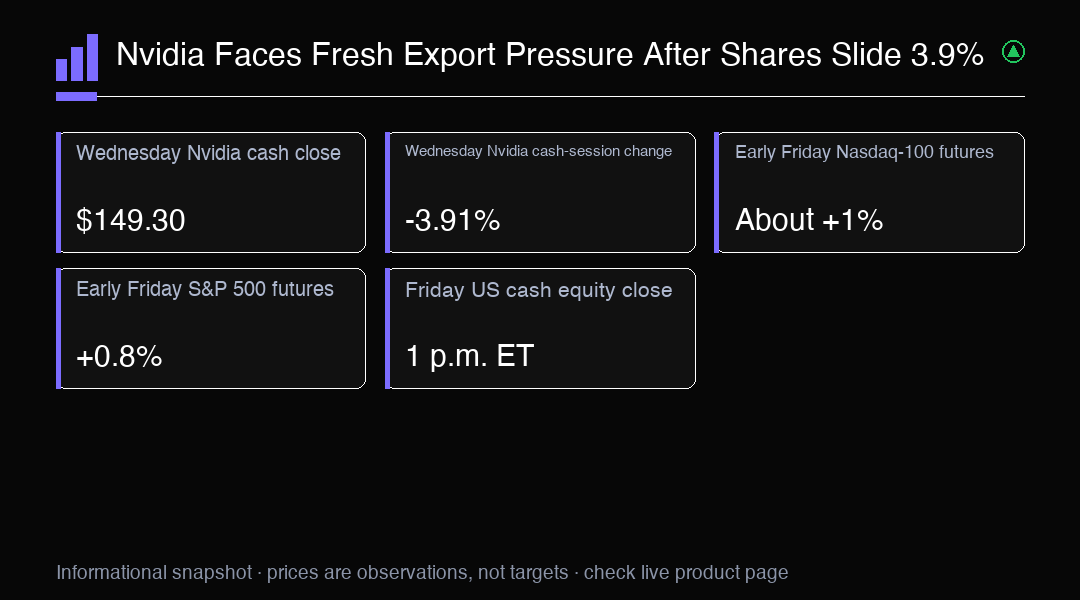
Nvidia shares fell 3.91% on Wednesday, November 25, closing at $149.30. Partners have reportedly paused shipments of servers containing Nvidia chips to Malaysia, Singapore, Thailand and Indonesia, raising questions about when affected orders can be delivered. S&P also placed Nvidia’s AA long-term issuer credit rating on CreditWatch Negative. The reported shipment pause puts delivery schedules in focus, while the credit watch raises the possibility that S&P could revise its assessment of Nvidia’s ability to meet its financial obligations. Both developments are in focus heading into Friday’s shortened US equity session.
Wednesday’s cash close provides the reference price for Friday’s regular session. Comparing Nvidia’s return with those of other large technology stocks can help put the move in context. If Nvidia falls while its peers hold steady, the underperformance would show that selling was more concentrated in the shares. A decline shared across the group would point to a broader move in technology stocks. Either pattern would leave open the question of what drove individual trades, but the comparison can show whether Nvidia’s performance stands out from the rest of the sector.
The reported interruption concerns servers shipped by partners. A finished server can combine Nvidia chips with other components, and several businesses can be involved between the sale of a chip and the delivery of a working system. A pause at the shipment stage can therefore leave a partner with equipment ready to dispatch and a customer waiting to install it. The four destinations define the reported geographic scope. The duration of the pause, the number of servers involved and the share of orders affected remain unclear, limiting any estimate of the immediate commercial impact.
Broader US licensing requirements govern whether covered exports can proceed and under what conditions. The reported pause concerns the handling of particular shipments. For a server partner, the practical question is whether an order can proceed under the rules that apply to its hardware, destination and customer. Where authorization is required, the time needed to obtain it can affect the delivery schedule. A customer can also face a planning problem before the final outcome is known. Even if the order ultimately goes through, uncertainty over the delivery date can complicate preparations to put the equipment into service.
The financial effect on Nvidia depends in part on where affected orders sit in the supply chain. A partner may already have bought the chips that go into a delayed server. In that case, the immediate disruption is to delivery of the finished system, and the effect on Nvidia could come later if the partner changes its component orders. Other systems may still require chips to be bought or allocated. The value of a finished server can also include hardware and services beyond the chips, so the value of delayed server orders alone would give an incomplete picture of Nvidia’s exposure.
S&P’s decision leaves Nvidia’s AA long-term issuer credit rating in force. CreditWatch Negative flags a possible downgrade, and any rating change would require a separate decision. For lenders and bondholders, the rating speaks to the company’s capacity to meet its financial obligations. Bond prices can respond to the prospect of a downgrade ahead of a formal decision, alongside changes in interest rates and the broader credit market. The next S&P assessment will carry more information about the outcome of the review and the factors the agency considers material to its rating.
Moody’s maintained its Aa1 rating and stable outlook. The two agencies use separate rating scales and issue their own judgments, so each signal has meaning within the framework of the agency that issued it. Moody’s stable outlook indicates the direction it expects for its rating, while S&P’s watch identifies the possibility of a nearer-term action on its assessment. For creditors who follow both, the timing of any updates matters because one agency can revise its assessment while the other’s stays in force. The rationale accompanying an update can help explain where the agencies’ judgments differ.
For shareholders, shipment developments matter through their potential effect on sales, margins and the timing of cash flows. Creditors look at cash generation in relation to the obligations the company must meet. A delivery delay could change expectations for when some sales occur while leaving the company’s capacity to service its debt intact. A more lasting interruption could matter for future sales if partners reduce orders or customers change their plans. The size of the affected business is therefore important when assessing how much weight to give the shipment news in either the equity or credit market.
US cash equities close at 1 p.m. ET on Friday. The early close brings forward the point at which the market records Nvidia’s regular-session closing price and gives investors fewer hours to respond to developments during the session. It also affects how trading volume can be read. A shorter session gives shares less time to change hands, so total turnover can be lower even when trading is active during the available hours. Comparing activity over equivalent trading windows can help show whether Nvidia attracted unusually heavy trading as investors assessed the day’s developments.
Nvidia can influence the broader Nasdaq index through its weight among the constituents. NAS100 provides exposure to that broad index, with its performance reflecting moves across a basket of stocks. When Nvidia and other large constituents rise or fall together, their contributions can reinforce one another. When they move in different directions, gains elsewhere in the basket can offset weakness in Nvidia, and declines elsewhere can dilute a gain in the shares. Direct exposure to Nvidia comes through an instrument tied specifically to Nvidia shares. Its contribution to NAS100 is one part of the index’s overall move.
If shipments resume, the scope of that resumption will help show how much business can move. An update covering one server configuration or destination would answer a narrower question than confirmation that partners can start clearing orders across the affected markets. Customer decisions offer another measure of the impact. Orders that remain in place can still translate into deliveries once the necessary steps are complete. Cancellations, if they occur, would indicate a more lasting impact on those orders. The number and value of pending, delivered and canceled orders would help establish the financial significance of the pause.
Trading Insight
Nvidia’s Friday close relative to its intraday range can show whether an early move held. A close near the session high after an early decline would show that buyers recovered most of the day’s range. A close near the low after an early rally would show that sellers erased most of the advance.