


US stock futures rose on Sunday evening after President Donald Trump said he would hold off on new strikes against Iran while a possible agreement was pursued. Oil fell at the same time as markets priced a better chance that disruption around the Strait of Hormuz could ease.
The useful signal is not “peace headline equals lasting rally.” It is a sequence: less supply risk lowers oil’s conflict premium, softer oil reduces near-term inflation pressure, and rate-sensitive growth shares receive the clearest initial relief. That is why Nasdaq 100 futures led the three major US index contracts in the first snapshot.
Key takeaways
- Nasdaq 100 futures led early gains while WTI and Brent fell sharply.
- Lower oil matters through inflation expectations and the interest-rate path, not just sentiment.
- A stronger signal needs oil, index breadth and crypto participation to confirm in that order.
Why did US stock futures rise?
Futures rose because the announcement removed part of the market’s immediate energy-supply risk. The Associated Press reported on August 2 that Trump had agreed to pause new US strikes while an agreement was explored. The proposed parameters included reopening the Strait of Hormuz, the key detail for markets because restricted shipping had kept a large premium in crude prices.
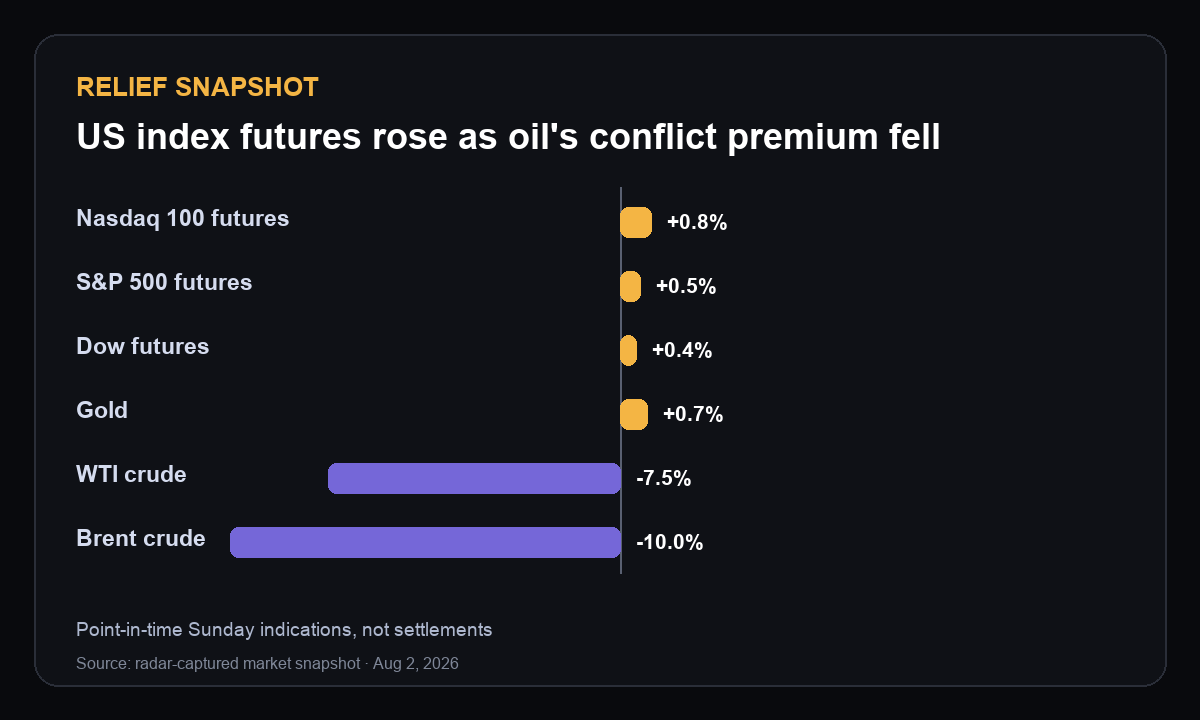
A radar-captured Sunday snapshot posted by David Gokhshtein showed S&P 500 futures up about 0.5%, Nasdaq 100 futures up 0.8% and Dow futures up 0.4%. The same snapshot had WTI crude down 7.5%, Brent down 10.0% and gold up 0.7%. These were point-in-time indications, not closing returns.
AP recorded a different Sunday-night oil window: US crude down 5% to $80.79 a barrel and Brent down 5% to $83.87. The gap between those percentages is not a contradiction. Fast markets moved between observations, which is why the contract, timestamp and timezone matter more than a single headline number.
Why did Nasdaq 100 futures lead?
Nasdaq led because lower oil can relax the inflation-and-rates pressure that weighs most heavily on long-duration growth valuations. Technology companies do not benefit simply because crude is cheaper. The transmission runs through the discount rate investors apply to future earnings.
When oil’s supply premium rises, markets can price stickier inflation and a firmer policy path. That tends to pressure high-multiple technology shares more than the broader market. When the premium falls, the same chain can run in reverse. Reuters described that pattern during an earlier June de-escalation session, when technology shares led as falling crude eased inflation concerns.
The Sunday hierarchy was consistent with that mechanism: Nasdaq 100 futures gained more than S&P 500 and Dow futures. It does not prove the mechanism will persist into the cash session, but it gives traders a testable first read. Live product information is available on the NAS100 page.
What does falling oil actually change?
Falling oil changes the inflation impulse first; it does not by itself confirm that geopolitical risk has disappeared. If crude holds most of its decline, the immediate pressure on transport, fuel and other energy-sensitive costs becomes less severe. That can reduce the chance that an energy shock forces a more restrictive rates outlook.
The physical-market question remains the Strait of Hormuz. A political statement can move futures in seconds, while shipping access, insurance costs and damaged infrastructure take longer to normalize. Earlier Reuters coverage of similar peace hopes repeatedly identified reopening and restoring energy flows as the market’s harder confirmation.
That creates a clean distinction. A headline-driven oil drop is the first move. A sustained decline accompanied by improving shipping conditions is a broader repricing. If oil rebounds before those conditions improve, the inflation relief embedded in Nasdaq futures can fade quickly. Traders can compare the index response with current product information on the USOIL page.
How can crypto traders read the signal?
Crypto is most useful here as the third confirmation, not the first. The approved radar evidence highlighted growing sensitivity between crypto and equities. That link is strongest when the move is genuinely about broad risk appetite rather than a crypto-specific catalyst.
The sequence matters. First, oil should retain enough of its decline to show that the supply premium is compressing. Second, Nasdaq strength should broaden beyond an overnight futures reaction when deeper US liquidity arrives. Only then does participation from Bitcoin and other liquid crypto assets add evidence that risk appetite is spreading across markets.
If crypto remains weak while Nasdaq futures rise, the divergence may reflect crypto-specific positioning, leverage or flows. It does not automatically invalidate the equity move. Equally, a brief crypto bounce is weak confirmation if oil and equity futures are already reversing. Cross-asset agreement is more informative than forcing every market to move at the same speed.
What could reverse the relief move?
The relief move is most vulnerable to a renewed oil spike, weaker index breadth or evidence that the proposed agreement is not advancing. AP noted that Iran had not offered an immediate public response when the announcement was reported. The statement also came after repeated shifts in the conflict, so markets still need evidence beyond the initial pause.
Three observations keep the framework honest:
- Oil: a sharp rebound would show that supply or shipping risk is returning.
- US indices: Nasdaq giving back its relative lead while broader futures weaken would reduce the rates-relief signal.
- Crypto: failure to participate matters more if oil and equities are also losing momentum.
None of these is a forecast. They are conditions that distinguish an overnight headline reaction from a more durable cross-asset repricing.
How do the Sunday snapshots fit together?
| Market | Observed move | What it indicated |
|---|---|---|
| Nasdaq 100 futures | +0.8% in the radar-captured snapshot | Strongest early US index response |
| S&P 500 futures | +0.5% in the same snapshot | Broad large-cap relief |
| Dow futures | +0.4% in the same snapshot | Positive, but behind Nasdaq |
| WTI crude | −7.5% in the snapshot; later/other AP window −5% to $80.79 | Conflict premium compressed, with timing sensitivity |
| Brent crude | −10.0% in the snapshot; later/other AP window −5% to $83.87 | Global benchmark carried the larger initial reaction |
| Gold | +0.7% in the snapshot | Relief in equities did not erase every hedge bid |
All percentages are observations from Sunday, August 2, 2026, and may differ from later prices or settlements.
Final thoughts
The first market message was coherent: oil’s conflict premium fell, US stock futures rose and the rate-sensitive Nasdaq led. The more important question is whether that relationship survives beyond thin Sunday trading.
Oil provides the first confirmation, the US cash session tests the second, and crypto can supply the third. Keeping that order prevents a political headline from becoming a market conclusion before the underlying prices agree.