


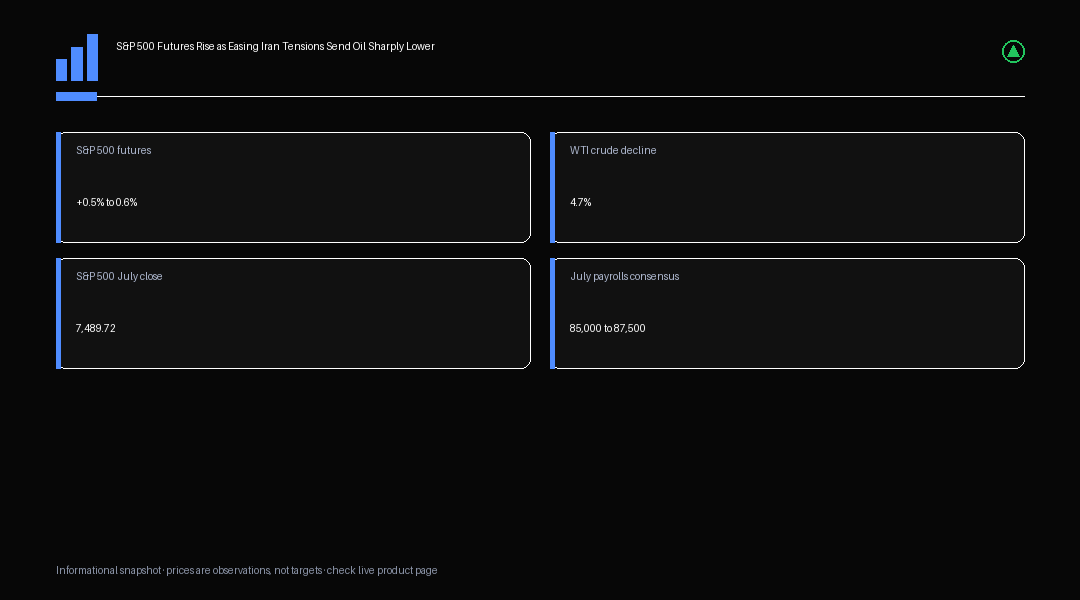
US stock futures opened the new month on a firmer footing, advancing in early Monday trade as oil prices fell sharply after President Donald Trump said he had called off a planned strike on Iran. S&P 500 futures rose roughly 0.5% to 0.6%, Nasdaq-100 futures added about 0.8%, and Dow futures climbed around 0.4%, a broadly risk-on tone after a choppy end to July.
The driver behind the move was unmistakably geopolitical. Oil prices tumbled after reports that Washington had been preparing another wave of strikes as diplomatic hopes faded and disruption risk around the Strait of Hormuz had been pushing energy prices higher. Trump said Iran and other Middle Eastern countries had asked the US to hold fire and that the broad outlines of a deal had been agreed. Brent crude fell by roughly 4.6% to 4.7% and WTI dropped about 4.7% in early trading, a sizable reversal that removed a chunk of the risk premium that had built into energy markets over recent sessions.
The equity backdrop heading into this move was more of a consolidation than a collapse. The S&P 500 closed July at 7,489.72, down only about 0.13% for the month, a far cry from the dramatic 'weakest two-month stretch' framing that circulated in early commentary. The index has still climbed a meaningful amount so far this year, and last week's gain snapped a short losing streak, reinforcing the sense that July was a pause rather than a genuine breakdown.
Not every regional market shared in Monday's brighter mood. Asian equities were mixed, with several major indices trading lower even as US futures pointed higher, a reminder that the risk-on tone driven by the Iran de-escalation and lower oil prices has not been universally embraced across markets just yet.
Attention now turns to this week's economic calendar, headlined by Friday's US jobs report. Economists' estimates cluster in the roughly 85,000 to 87,500 range for July payroll additions, up from 57,000 in June. A weak print could revive concerns about a slowing labor market, while a stronger-than-expected number may reignite debate over how much room the Federal Reserve has to keep cutting rates, given the resilience that would imply in the broader economy.
Earnings season adds another layer to the week. Consumer bellwethers McDonald's, Kraft Heinz, Costco and Walt Disney are all scheduled to report, offering a read on the state of household spending heading into the back half of the year. Palantir and Advanced Micro Devices round out the calendar with another temperature check on artificial intelligence demand, following a July in which AI-linked technology names delivered an unusually wide range of outcomes for investors.
SpaceX is also due to post its first earnings report as a public company this week, a milestone event for a stock that has pulled back sharply from its June highs. While that story sits outside the S&P 500 itself for now, the market's reaction to it will likely feed into the broader risk appetite for high-valuation growth names that has been a recurring theme across the index this year.
That AI and growth-stock undercurrent is worth watching closely alongside the more traditional macro catalysts this week. Technology names carried an outsized share of both the gains and the losses across major indices in July, and how AI-linked reporters such as Palantir and AMD frame near-term spending and demand could set the tone for whether growth stocks resume leadership or continue ceding ground to more defensive, consumer-facing names reporting the same week.
Taken together, the week sets up as a test of whether the calmer geopolitical backdrop and softer oil prices can translate into sustained equity strength, or whether Friday's jobs data and the earnings slate end up dominating the conversation instead. With the S&P 500 essentially flat over the past two months rather than in obvious distress, the bar for a genuinely bullish breakout likely depends on this week's data confirming rather than undermining the calmer tone that opened August.
The energy angle deserves its own attention beyond the immediate equity reaction. A sustained pullback in oil prices, if it holds, would ease one of the inflation risks that has periodically complicated the Federal Reserve's policy calculus this year. Lower energy costs feed through to headline inflation readings with a lag, and a durable de-escalation around Iran would remove a source of upside price risk that had been building as tensions around the Strait of Hormuz intensified in recent weeks. That dynamic gives Friday's jobs report added importance, since a labor market that cools without an accompanying energy-driven inflation shock is the kind of combination that tends to support the case for continued policy easing.
Equity positioning heading into the report also matters. After a July defined more by rotation and consolidation than outright weakness, many desks entered August without a strong directional conviction, which can amplify moves once a clear catalyst, in this case oil prices and de-escalating geopolitical risk, gives the market a reason to lean one way. That backdrop leaves plenty of room for volatility to pick up quickly if either Friday's jobs number or this week's earnings slate delivers a surprise, in either direction, relative to the calmer tone with which the month has opened.
Trading Insight
The combination of easing Middle East tensions, a sharp pullback in oil prices, and a S&P 500 that is essentially flat over the past two months rather than in a genuine downtrend argues for a more constructive near-term tone, but this week's data flow is likely to be the deciding factor. A weaker-than-expected jobs report on Friday could reinforce the current risk-on move by keeping rate-cut expectations alive, while a stronger print risks reviving the same higher-for-longer concerns that weighed on markets earlier in the summer. Earnings from consumer bellwethers and AI-linked names add event risk on both sides, meaning traders may want to treat Monday's futures strength as a starting point for the week rather than a settled outcome, particularly given how quickly the oil-driven risk premium could reprice if the Iran de-escalation proves fragile.