


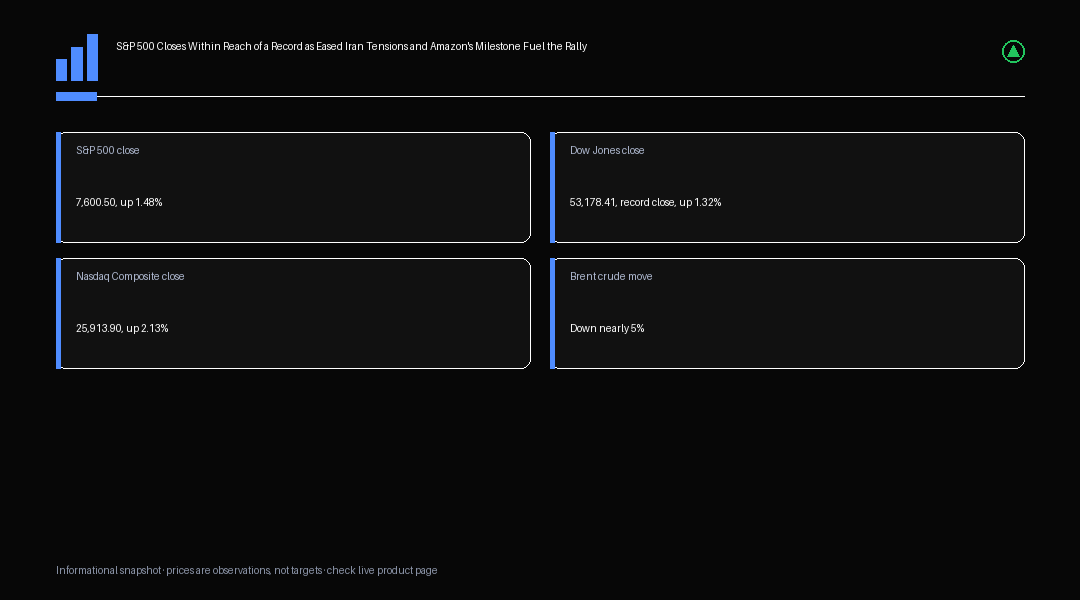
The S&P 500 surged 1.48 percent, or roughly 111 points, to close at 7,600.50, leaving the benchmark index only narrowly below its own record close and reigniting talk of a fresh all-time high in the sessions ahead. The Dow Jones Industrial Average outpaced it in points terms, rallying 693 points, or about 1.3 percent, to a record close of 53,178.41, while the Nasdaq Composite led all three major benchmarks with a 2.13 percent jump, adding 540 points to close at 25,913.90.
Two distinct catalysts combined to drive the rally. The first was geopolitical: renewed diplomacy around Iran's nuclear program and the Strait of Hormuz saw planned strikes paused in favor of negotiations, easing fears of a broader regional escalation. That de-escalation knocked nearly 5 percent off Brent crude in a single session, reducing one of the more persistent inflation and rate-hike risks that had been weighing on sentiment.
The second catalyst was corporate rather than geopolitical. Amazon's shares gained roughly 4.6 percent after Friday's outsized post-earnings surge, pushing the company's market value above $3 trillion for the first time and placing it alongside Apple, Microsoft, Alphabet, and Nvidia as only the fifth company ever to reach that level. Nvidia and Meta Platforms also advanced strongly, and Alphabet and Microsoft added to the mega-cap technology leadership, though Apple was a notable holdout, falling for a fourth consecutive session as investors continued digesting a softer outlook and ongoing supply-chain pressure.
Lower oil prices and falling bond yields reinforced each other in a way that particularly benefited growth and technology stocks. Declining energy costs reduce a key driver of inflationary pressure, which in turn lowers the perceived urgency for the Federal Reserve to keep policy tighter for longer, a dynamic that tends to disproportionately support longer-duration growth names whose valuations are more sensitive to the path of interest rates than shorter-duration value stocks.
The rally was broad in scope but not uniform beneath the surface. Sectors tied to lower energy prices and technology led gains, while energy producers and consumer-staples names lagged behind, a pattern consistent with markets rotating away from defensive positioning and back toward risk assets rather than every sector participating equally.
Stock futures were still edging modestly higher into the next session, up roughly 0.2 percent, suggesting traders were not finished digesting the rally but had scaled back the pace of buying after such a strong single-day move. Attention is now turning to a dense earnings calendar, with SpaceX delivering its first report as a listed company, alongside Advanced Micro Devices, McDonald's, and Pfizer, providing the next set of catalysts that could either extend or interrupt the current momentum.
For context, the index's push above 7,600 sits within roughly 0.1 percent of its prior record close, meaning the psychological question of a fresh all-time high is now less about whether the broader trend supports it and more about whether the specific catalysts driving this session, eased geopolitical risk and strong mega-cap earnings, can be sustained into the next few sessions without a fresh shock.
It is worth unpacking why an easing of Middle East tensions moves equity markets as much as it does. Elevated geopolitical risk around a major oil-producing region tends to raise the probability that traders assign to supply disruptions, which pushes energy prices higher and complicates the inflation outlook at a time when central banks are already balancing growth and price stability. When that risk premium comes out of the market quickly, as it did in this session, the reaction can be outsized relative to the news itself, because markets are unwinding hedges and repricing risk at the same time.
The corporate side of the rally tells a complementary story about where investors currently see the most durable growth. Amazon's milestone was not an isolated event; it arrived in the same week as strong results across other mega-cap technology names, reinforcing a market view that AI infrastructure spending and cloud computing demand remain the dominant growth theme in this earnings season, even as more traditional consumer and industrial names post a more mixed set of results.
That divergence, strength concentrated in a relatively narrow group of mega-cap technology and AI-linked names against a more mixed picture elsewhere, is itself a signal traders should not ignore. Broad index gains driven by a small number of very large constituents can mask more uneven performance underneath, meaning the health of the rally may look different depending on whether it is measured by the cap-weighted S&P 500 or by the performance of the median stock within it.
None of this changes the near-term technical picture much: the index remains close enough to its record close that a modest continuation of Tuesday's momentum would be enough to set a fresh high, while a reversal driven by a resurgence in oil prices or a disappointing print from this week's earnings slate could just as easily send the benchmark back toward the middle of its recent range. Traders should treat the current setup as finely balanced rather than a one-way move.
Trading Insight
With the S&P 500 sitting only fractionally below its record close, the near-term path likely hinges on whether this week's earnings calendar, headlined by SpaceX's debut report alongside AMD, McDonald's, and Pfizer, reinforces or undercuts the mega-cap-led leadership seen in this session. A durable push to a fresh record would typically want confirmation from continued strength in technology and AI-linked names rather than a narrow rally concentrated in just one or two mega-cap stocks. On the risk side, the rally's reliance on easing Iran-related tensions means any renewed escalation could quickly reverse the drop in oil prices and reintroduce the inflation and rate-hike concerns that this session's move helped push aside, making cross-asset signals in energy and Treasury yields worth watching alongside the index itself. Because a meaningful share of this session's gain was concentrated in a handful of mega-cap names, traders should also track breadth measures, such as the proportion of index constituents trading above their moving averages, to judge whether strength is broadening out or remaining narrowly concentrated, since narrow rallies have historically proven more vulnerable to sharp reversals than broad-based advances.