


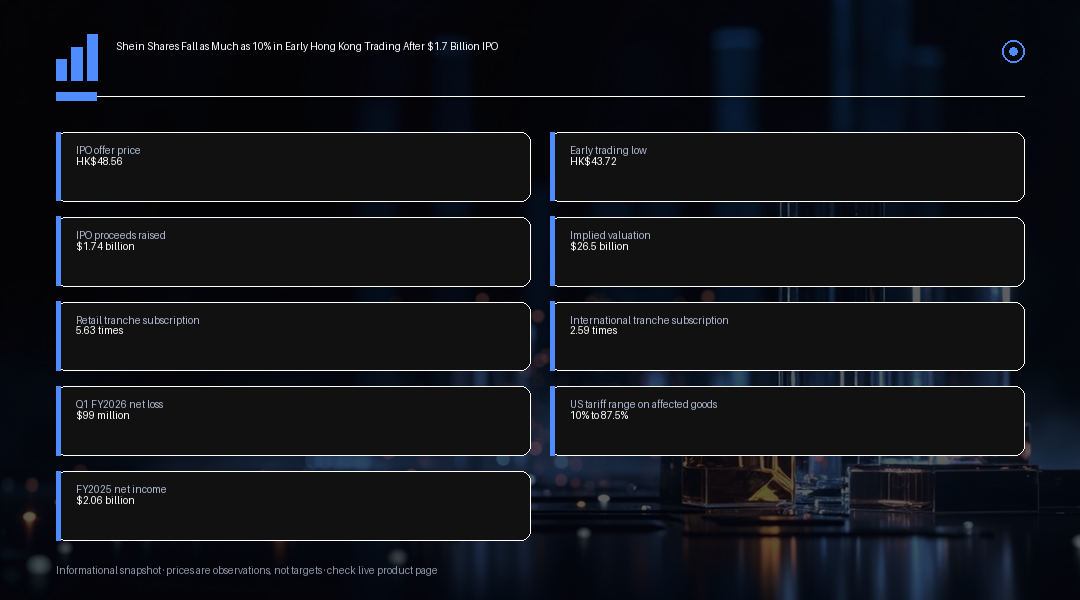
Shein finally completed its long-delayed transition to a public company this week, pricing its Hong Kong initial public offering at HK$48.56 a share and raising approximately HK$13.60 billion, or about $1.74 billion, from a sale of 280 million shares. It ranks among the largest listings in Hong Kong this year. Rather than opening the celebration organizers might have hoped for, the stock fell as much as approximately 10% in early trading, touching a low near HK$43.72 to HK$43.80 before stabilizing, and pushing the company's implied market value down toward roughly $26.5 billion.
The soft debut is notable because demand looked strong heading into the listing. The retail portion of the offering was subscribed 5.63 times, while the international institutional tranche was subscribed 2.59 times, meaning far more investors wanted shares than were available. That kind of oversubscription often produces exactly this pattern: investors who win an allocation in a hot IPO frequently sell into the opening session to lock in a quick profit or simply to free up capital, and when enough of them do it at once, the stock can fall sharply even though underlying demand for the company's story was genuinely high just days earlier.
The valuation math tells its own story. Shein's roughly $26.5 billion market value at listing represents a discount of close to three-quarters versus the approximately $100 billion figure investors assigned the company in a private funding round back in 2022, when pandemic-era online shopping growth was near its peak. That earlier valuation reflected a very different environment for e-commerce, one with fewer tariff barriers, less regulatory scrutiny and considerably more investor enthusiasm for fast-growing direct-to-consumer retail. The gap between the two numbers is a useful reminder of how quickly private-market valuations can become disconnected from what public investors are ultimately willing to pay.
Financially, Shein reported a net loss of $99 million for the quarter ended March 31, 2026, compared with net income of $395 million in the same quarter a year earlier. A meaningful share of that swing reflected a $328 million fair value loss tied to the company's convertible redeemable preferred shares, an accounting item rather than a sign of deteriorating day-to-day operations, though the underlying business also softened during the period, with US revenue falling 14.3% year over year. For the full 2025 year, net income fell 38.7% to approximately $2.06 billion, underscoring that the pressure on profitability extends beyond a single quarter.
Tariff policy is a central part of the story. The United States eliminated the so-called de minimis exemption that had allowed Shein to ship low-value parcels directly from Chinese factories to American consumers without paying import duties, a change that pushed applicable tariffs on some Chinese-origin goods into a range of roughly 10% to 87.5% depending on the product category. Europe has moved in a similar direction: starting July 1, 2026, the European Union introduced a temporary charge of EUR3 per customs classification on qualifying low-value e-commerce imports and ended the previous duty-free treatment for parcels valued under EUR150. Together, these two policy shifts strike directly at the low-cost, direct-shipping model that helped Shein undercut established retailers on price.
Competitively, Shein continues to face pressure from Temu, AliExpress, H&M and Zara, all of which are adjusting their own logistics and pricing to the same tightening tariff environment. At the same time, investor appetite in the region has increasingly rotated toward other fast-growing themes such as artificial intelligence, robotics and memory-chip manufacturers, leaving less room for enthusiasm around a fast-fashion retailer facing structurally higher costs. Shein has said it plans to direct IPO proceeds largely toward two priorities: roughly 40% toward technology capabilities and roughly 40% toward brand awareness and global expansion, with the remainder allocated to smaller corporate uses. The company is also working to grow a third-party marketplace business and expand its portfolio of owned and acquired brands, an attempt to diversify beyond the direct-to-consumer fast fashion model that made it famous but that regulators in multiple markets are now making more expensive to run.
For active traders, Shein's Hong Kong debut sets up two clear reference points. The HK$48.56 offer price marks the level company insiders and early backers effectively priced as fair value ahead of listing; a sustained recovery back above it would suggest the early selling reflected short-term profit-taking from an oversubscribed allocation rather than a deeper reassessment of the business. On the downside, the session low near HK$43.72 to HK$43.80 is the level to watch for signs of further capitulation, and a decisive break below it would open the door to additional markdown as the market continues to digest the tariff-driven margin pressure and the swing to a quarterly net loss. Because IPO debuts often see outsized volatility from investors flipping oversubscribed allocations, the next several trading sessions should offer a cleaner read on where fair value actually sits than the first day's price action alone. Longer term, the stock's direction is likely to hinge on whether Shein's technology and brand investments, together with its push into third-party marketplace sales, can offset the structural hit from the loss of duty-free shipping in both the United States and Europe.
Trading Insight
For active traders, Shein's Hong Kong debut sets up two clear reference points. The HK$48.56 offer price marks the level company insiders and early backers effectively priced as fair value ahead of listing; a sustained recovery back above it would suggest the early selling reflected short-term profit-taking from an oversubscribed allocation rather than a deeper reassessment of the business. On the downside, the session low near HK$43.72 to HK$43.80 is the level to watch for signs of further capitulation, and a decisive break below it would open the door to additional markdown as the market continues to digest the tariff-driven margin pressure and the swing to a quarterly net loss. Longer term, the stock's direction is likely to hinge on whether Shein's technology and brand investments can offset the structural hit from the loss of duty-free shipping in both the United States and Europe.