


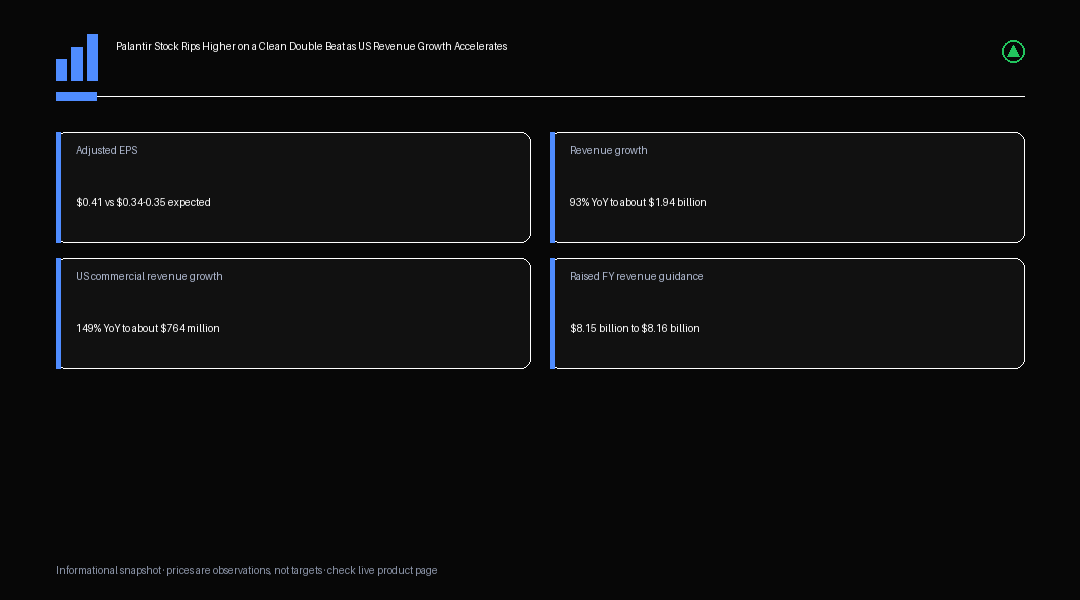
Palantir shares jumped more than 15 percent in premarket trading after the AI-focused software company delivered a clean double beat on profit and revenue, giving traders a fresh reason to revisit one of this year's most debated growth stories. Adjusted earnings came in at $0.41 per share, comfortably ahead of the roughly $0.34 to $0.35 that Wall Street had penciled in, and well above the $0.16 per share the company reported a year earlier.
Revenue told a similar story. Sales climbed about 93 percent year over year to roughly $1.94 billion, beating consensus estimates near $1.81 billion and extending a run of accelerating growth that has defined Palantir's shift from a niche government contractor toward a broader enterprise AI platform. Adjusted operating margin expanded into the low 60 percent range from the mid 40s a year earlier, a sign that the company is scaling its software business rather than simply buying growth with higher costs.
The most striking numbers came from Palantir's US commercial segment, where revenue rocketed roughly 149 percent year over year to about $764 million, part of a compounding expansion of close to 380 percent since 2024. US government revenue was not far behind, rising about 90 percent to roughly $809 million. Combined, Palantir's American operations generated about $1.57 billion in the quarter, evidence that commercial adoption of the company's AI and data platforms is now catching up with the defense and intelligence contracts that originally built the business.
Management used the print to raise its own expectations. Full-year revenue guidance moved up to a range of roughly $8.15 billion to $8.16 billion, a meaningful step up from the prior outlook near $7.65 billion to $7.66 billion, and executives pointed to next-quarter revenue running comfortably ahead of Wall Street's own estimates. That is a rare combination for a company of this size: beating current expectations while simultaneously raising the bar for what comes next.
For traders, the results push back on a narrative that had been building for months, that generative AI adoption might eventually erode demand for specialized enterprise software rather than expand it. Palantir's own numbers argue the opposite. Companies appear to need platforms like Palantir's precisely because they want to connect large language models securely to their own proprietary data and operational workflows, rather than replace that layer altogether.
Even so, the reaction is unlikely to fully settle the valuation debate around the stock. Even with the premarket bounce factored in, Palantir shares remain well below their record high, underscoring how far sentiment swung during the stock's earlier pullback. That gap between an accelerating fundamental story and a share price still working to reclaim prior highs is exactly the tension active traders will be watching in the sessions ahead.
What could change the picture from here: the current strength is heavily concentrated in US commercial momentum, so any sign that quarter-over-quarter growth in that segment decelerates, or that government contract renewals slow, would quickly reopen the valuation debate that has followed Palantir for much of the past year. Broader sentiment toward AI-linked software spending, not just Palantir's own numbers, is also likely to keep swinging the stock beyond what fundamentals alone would justify.
That combination of a re-accelerating growth story, expanding profitability, and a stock still trading below its highs is the setup traders are now weighing heading into the next few sessions, alongside a broader market backdrop where mega-cap technology and AI-linked names have been driving much of the recent upside.
It helps to understand what a double beat actually means for a stock like this. Wall Street analysts build models estimating both how much profit a company will report and how much revenue it will generate; when a company clears both bars at once, it removes one of the more common excuses bears use to dismiss a rally, that strong headline growth is being bought with unsustainable spending or thinning margins. Here, margin expansion alongside revenue growth is the detail that matters most, because it suggests Palantir's software is becoming more efficient to deliver at scale rather than requiring proportionally more headcount and infrastructure as it grows.
The move also lands inside a broader session where mega-cap technology and AI-linked names have been a dominant theme, with several large index constituents extending recent strength. Palantir's premarket surge is best read as a high-beta expression of that same theme rather than an isolated, company-specific event, which is part of why the stock can move so sharply on a single earnings print. Traders positioning around index-level AI exposure will likely watch how durable this move is once regular trading begins and broader market flows, not just Palantir-specific buyers, have had a chance to weigh in.
Looking ahead, the next real tests for the story are less about today's premarket reaction and more about whether Palantir can keep compounding its US commercial book at anywhere close to its recent pace. Renewal cycles for large commercial contracts, the rate at which new customers move from pilot programs to full deployments, and management commentary on demand visibility into next year are the practical signposts traders should watch, rather than any single quarter's percentage change taken in isolation.
Trading Insight
For active traders, the key tension is between an unambiguously strong quarter and a stock that, even after the premarket pop, remains meaningfully below its record high. A push back toward that prior peak would likely require confirmation that US commercial growth is durable rather than a single standout quarter, alongside continued execution on the raised full-year guidance. On the downside, any signal that the US commercial growth rate is decelerating from its current pace, or that broader AI-software sentiment cools, would raise the risk of the stock giving back part of today's gain. Traders should also watch how peer AI and software names react in the same session, since Palantir's move is unfolding alongside a broader mega-cap technology rally rather than in isolation. Because the stock has a history of large single-session swings around earnings, position sizing and clear invalidation levels matter more here than in lower-volatility index constituents; traders should treat the premarket move as an opening signal to confirm during regular trading hours rather than a guaranteed intraday trend.