


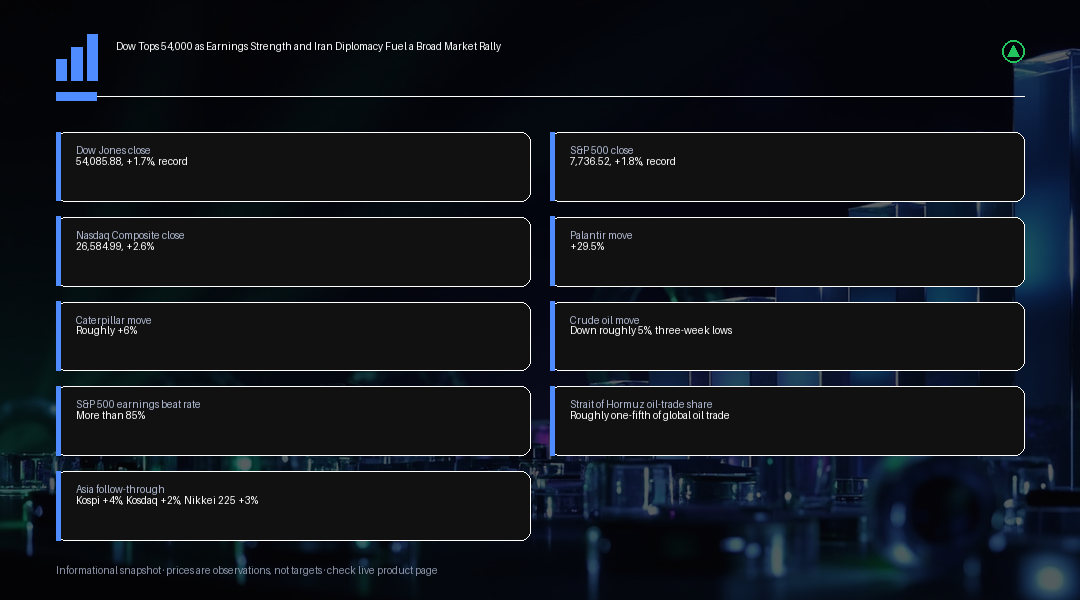
US stocks staged a broad, record-setting rally, with the Dow Jones Industrial Average surging 907 points, or about 1.7%, to close at a record 54,085.88. The S&P 500 gained 1.8% to a fresh record of 7,736.52, its first new high since June, while the Nasdaq Composite outpaced both benchmarks, jumping 671 points, or roughly 2.6%, to 26,584.99. The move reflected what traders have taken to calling a return of animal spirits: a broad willingness to add risk after a stretch of choppier trading.
Two distinct catalysts combined to drive the session. The first was corporate: Palantir shares jumped roughly 29.5% after the company nearly doubled quarterly revenue and raised its annual forecast, while Caterpillar added roughly 6% as AI-linked infrastructure demand strengthened its outlook, a reminder that the AI trade now extends well beyond chipmakers and software companies into heavy machinery and industrial capacity.
The second catalyst was geopolitical. Crude oil futures sank roughly 5% to three-week lows after Treasury Secretary Scott Bessent said the United States could be close to an agreement with Iran to reopen the Strait of Hormuz, a waterway that handles roughly one-fifth of global oil trade. Qatar separately reported progress in related diplomatic efforts. Reopening the strait would ease fears of a supply disruption along one of the world's most consequential shipping routes, with knock-on benefits for inflation, corporate input costs and interest-rate expectations all at once.
Markets have celebrated potential Iran agreements before that ultimately did not fully materialize, so a measure of caution remains appropriate even as Tuesday's session treated the latest diplomatic signal as meaningfully positive. Whether this specific round of talks produces a finalized deal, rather than another round of paused tension, is a genuinely open question rather than a settled outcome.
Earnings strength gave the rally real substance beneath the optimism. More than 85% of reporting S&P 500 companies have beaten expectations this season, a breadth of beats broad enough to support a genuinely wide rally rather than one concentrated in a handful of mega-cap names.
Not every earnings report fed into Tuesday's optimism, however. AMD and SpaceX both fell after their own results the same day, a reminder that even a record-setting index session does not mean every individual earnings print was well received. Index-level strength and single-stock disappointment can coexist within the same trading day, and Tuesday's session is a clear example of that dynamic.
The rally also traveled well beyond US markets. South Korea's Kospi jumped more than 4%, the smaller-cap Kosdaq gained around 2%, and Japan's Nikkei 225 rallied more than 3%, suggesting the risk-on mood extended across Asian trading hours rather than staying confined to Wall Street.
US stock futures were edging higher again early Wednesday, extending the record-setting momentum into the next session. That follow-through suggests traders were not immediately looking to fade Tuesday's move, though a single day of gains, however broad, is rarely enough on its own to confirm a durable shift in market direction.
For traders, the combination of genuinely broad earnings strength and an improving, if still unconfirmed, geopolitical backdrop is a constructive setup, but one that depends on both legs holding. A stall in Iran diplomacy or a reversal in oil prices would remove one of the two supports behind Tuesday's move, while a run of disappointing earnings from the dense calendar still ahead this week could undercut the other.
The rally also arrives inside a dense stretch of the earnings calendar. SpaceX and AMD both reported the same day as this record-setting index session, and their after-hours declines are a useful reminder that a strong tape at the index level does not guarantee a uniformly positive reaction beneath the surface. Traders positioning around this week's remaining reports should expect a similar pattern: broad index strength driven by earnings beats and macro relief, layered against pockets of stock-specific disappointment where guidance or competitive news falls short of a rich valuation.
The oil-price angle deserves particular attention given how quickly sentiment can reverse on geopolitical headlines. A confirmed reopening of the Strait of Hormuz would be a genuinely disinflationary development, easing one of the more persistent cost pressures still facing central banks. But because markets have reacted enthusiastically to similar diplomatic signals before without a finalized agreement following through, traders should watch for concrete confirmation, such as a signed agreement or a verified resumption of shipping traffic, rather than treating Tuesday's commentary alone as the end of the story.
Breadth statistics such as the more-than-85% earnings beat rate and the specific Asian-market percentage moves referenced above are best treated as supporting context rather than independently reverified hard figures in this fast-moving news cycle, though they remain consistent with the broad, earnings-driven character of Tuesday's advance.
None of this diminishes the significance of three major indices closing at or within a whisker of record levels on the same day. It does mean traders should distinguish between the confirmed, already-priced facts, the record closes themselves, and the more forward-looking, still-developing pieces of the story, particularly the Iran diplomatic track, when sizing new positions into the rest of the week.
Trading Insight
With all three major indices closing at or near records, the near-term path likely depends on whether this week's dense earnings calendar and the Iran diplomatic track both continue to cooperate. A durable extension of the rally would typically want confirmation from continued broad participation, not just a handful of mega-cap or AI-linked names, alongside further clarity on the Strait of Hormuz talks. On the risk side, any renewed escalation around Iran could quickly reverse Tuesday's drop in oil prices and reintroduce the inflation and rate concerns the session helped push aside, making crude and Treasury yields worth watching alongside the index levels themselves. The same-day declines in AMD and SpaceX are also a useful reminder that record index closes can mask sharper moves underneath the surface; traders should track breadth measures, such as the share of S&P 500 constituents trading above their moving averages, to judge whether Tuesday's strength is broadening out or concentrating in a narrower set of names, since narrow advances have historically proven more vulnerable to sharp reversals than genuinely broad ones.