


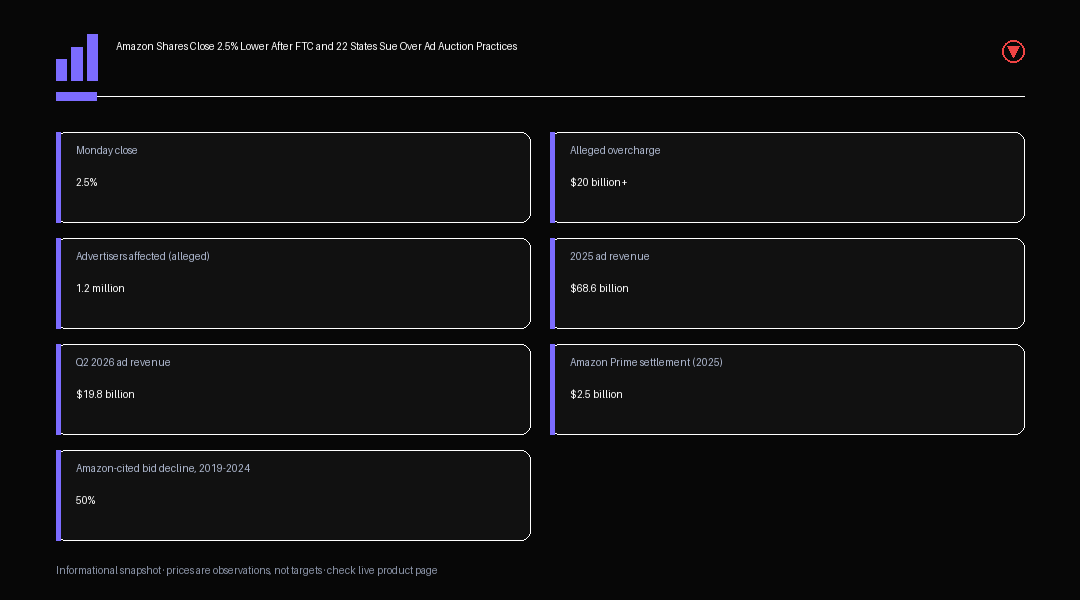
Amazon shares closed about 2.5% lower on Monday, August 31, after the Federal Trade Commission and 22 state attorneys general filed a lawsuit in federal court in Washington state alleging the company secretly manipulated its advertising auctions. Intraday declines were reported to have exceeded 3% before the stock pared some of its losses into the close, a reminder that first reactions to major litigation headlines can overshoot before the market settles on a more measured read.
The complaint alleges that Amazon represented its Sponsored Products, Sponsored Brands and Sponsored Display placements as competitive, second-price auctions, in which the winning advertiser should pay only slightly more than the next-highest bid, while secretly overriding those results with higher, undisclosed prices or hidden surcharges. Regulators say the alleged conduct began as early as 2018, with certain surcharges applied to at least one advertising product from 2019 onward, and claim it affected approximately 1.2 million advertising customers, including more than 500,000 small and medium-sized businesses. It is important to stress that these are allegations contained in the complaint rather than findings by a court, and Amazon has not been found to have acted unlawfully.
On the dollar figures, the plaintiffs allege the conduct generated more than $20 billion in overcharges, which they argue advertisers ultimately passed through to consumers in the form of higher prices for goods sold on the platform. The FTC has indicated it will seek damages, refunds and penalties running into the tens of billions of dollars, though the final amount, if any, will depend on how the litigation unfolds and has not been determined by any court.
Amazon has firmly denied the allegations and says the FTC misunderstands how its advertising system actually works. The company points to figures showing that average winning bids in its search-ad auctions fell by roughly 50% between 2019 and 2024, and it argues that its pricing adjustments saved advertisers more than $8 billion between 2021 and 2025. Those figures come from Amazon itself rather than an outside party, so they are best read as the company's defense in the case rather than as independently confirmed facts, but they give a sense of the numbers the two sides will likely argue over as the case proceeds.
The case lands squarely on one of Amazon's most important growth engines. The company reported $68.6 billion in advertising services revenue for 2025 and approximately $19.8 billion in the second quarter of 2026 alone, up 26% year over year, comfortably outpacing growth in its core online store business. Advertising is generally viewed as a higher margin, more asset-light revenue stream than storing, packing and shipping physical goods, which is one reason investors are watching this case closely: any court-ordered changes to how Amazon prices or structures its ad auctions could weigh on a business line that has become an increasingly important contributor to overall profitability, even if the near-term refund exposure ultimately proves manageable relative to the company's overall size.
This is not Amazon's first encounter with the FTC in recent years. In September 2025, the company agreed to a $2.5 billion settlement over allegations that it used deceptive practices to enroll and retain customers in its Prime subscription service, a deal that included a $1 billion civil penalty and roughly $1.5 billion set aside for customer refunds. Amazon also continues to face a separate FTC-led lawsuit alleging monopolization of its online marketplace business, with a trial in that case tentatively expected in early 2027. The new advertising complaint is best understood as its own distinct consumer protection matter rather than an extension of the marketplace antitrust case, even though both add to a broader pattern of regulatory scrutiny facing the company.
Legal observers note that consumer-protection cases like this one, brought jointly by a federal regulator and a large coalition of states, often move more slowly than headlines suggest, with discovery, expert testimony on auction mechanics, and potential settlement talks all playing out over a period of months or years rather than weeks. Amazon has a large legal team and a track record of contesting FTC actions vigorously, including in the ongoing marketplace antitrust litigation, so investors should not assume the case resolves quickly in either direction. The complaint's emphasis on small and medium-sized businesses, which make up the bulk of the roughly 1.2 million advertisers named, also raises the stakes given how central small-business advertisers are to Amazon's marketplace ecosystem.
Investors should treat both the $20 billion overcharge figure and the 1.2 million-advertiser estimate as allegations that still need to survive discovery and, potentially, a trial, rather than as confirmed financial exposure. The more immediate market question is whether the stock can hold the technical support it built up since its last earnings report, now being tested by both the size of the lawsuit and its potential to reshape how Amazon structures future ad pricing. A further factor to watch is whether the FTC action encourages private advertiser lawsuits, which could extend the timeline and cost of resolving the matter well beyond the current case. Because Amazon's advertising segment has become a larger share of overall company profitability, any eventual court-ordered changes to auction transparency, even well short of the full damages sought, could matter more for the long-term earnings outlook than the size of the initial share price reaction suggests.
Trading Insight
Investors should treat both the $20 billion overcharge figure and the 1.2 million-advertiser estimate as allegations that still need to survive discovery and, potentially, a trial, rather than as confirmed financial exposure. The more immediate market question is whether the stock can hold the technical support it built up since its last earnings report, now being tested by both the size of the lawsuit and its potential to reshape how Amazon structures future ad pricing. Because Amazon's advertising segment has become a larger share of overall company profitability, any eventual court-ordered changes to auction transparency could matter more for the long-term earnings outlook than the size of the initial share price reaction suggests.