


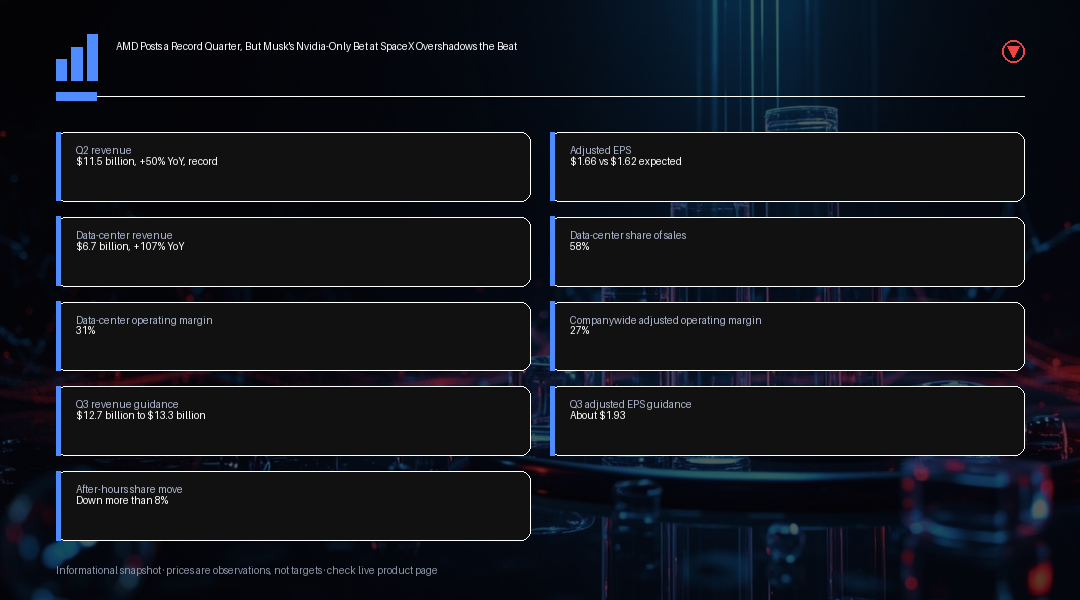
AMD delivered a record second quarter, with revenue climbing 50% year over year to $11.5 billion, beating Wall Street's $11.3 billion estimate. Non-GAAP earnings per share reached $1.66, up sharply from $0.48 a year earlier and slightly ahead of the $1.62 analysts expected. By almost any conventional measure, this was a clean double beat. Shares still fell sharply in after-hours trading, at one point down by more than 8%, as investors focused less on the beat itself and more on a comment made elsewhere, on a different company's earnings call, about who will not be buying more AMD chips going forward.
Data-center revenue, the segment most closely tied to AI demand, surged 107% year over year to $6.7 billion, topping a consensus estimate in the roughly $6.3 billion to $6.5 billion range and accounting for about 58% of total company sales. The segment carried a 31% operating margin, meaning AMD kept 31 cents of operating profit for every dollar of data-center revenue it generated.
Companywide, adjusted operating income reached $3.1 billion, a 27% margin that narrowly beat consensus. Put simply, AMD is not just growing its AI-linked revenue, it is converting that growth into profit at an improving rate, which is typically the combination that removes the more common bearish argument against a rally: that fast headline growth is being bought with unsustainable spending or thinning margins.
Guidance for the third quarter came in at $12.7 billion to $13.3 billion in revenue, implying roughly 41% year-over-year growth and sitting above a consensus estimate near $12.5 billion. Adjusted earnings per share are guided to about $1.93 at the midpoint. The outlook was genuinely upbeat, but for a stock already pricing in rapid AI-driven acceleration, guidance that lands only slightly ahead of expectations can read as underwhelming rather than reassuring.
The sharper catalyst for the after-hours move came from outside AMD's own earnings call. During SpaceX's simultaneous quarterly report the same day, Elon Musk said the rocket and satellite company would build its future AI infrastructure exclusively around Nvidia's Blackwell platform, calling it the best architecture available. The comment represented a notable shift: as recently as May, Musk had indicated that both Tesla and SpaceX would likely keep buying chips from Nvidia and AMD.
It is worth being precise about causation here. AMD's after-hours decline is best read as the product of two factors landing on the same day: a rich AI-growth valuation that had already priced in a strong quarter, and a competitive-positioning headline from a major potential AI infrastructure customer choosing a rival supplier exclusively. Independent coverage most consistently describes the after-hours move as a decline of more than 8%, rather than the sharper 10% figure that circulated in some headlines, and the precise percentage is sensitive to the exact timestamp used.
Losing SpaceX as a prospective AI infrastructure customer does not undo AMD's existing data-center business. The company's customer base still includes Meta, Microsoft, OpenAI, Oracle and Anthropic, a group broad enough that a single vendor decision, even a symbolically important one, is unlikely to change the underlying trajectory of AMD's data-center revenue on its own.
Zooming out, this sits inside a broader theme running through the same trading session: SpaceX's own shares also fell after its earnings call, even as the S&P 500, Dow Jones and Nasdaq all closed at fresh records the same day. That combination shows how a strong headline earnings season and AI-capex anxiety can coexist within the same trading day, with index-level strength masking sharper single-stock reactions underneath.
For a stock that has already priced in a significant amount of AI-driven growth, the market's message appears to be that beating current expectations is necessary but no longer sufficient on its own. Traders are now demanding evidence that demand from the largest prospective AI infrastructure buyers remains diversified across multiple chip vendors, rather than concentrating around a single supplier as capital-spending decisions get made.
It is also worth noting what has and has not been independently reconfirmed here. The direct link between Musk's Nvidia-exclusivity comment and the timing of AMD's after-hours slide is plausible and consistent with widely reported Musk commentary patterns, but it was not independently reconfirmed against a second wire-service source in the hours after both calls. AMD's own guidance commentary and its already-rich AI-growth valuation are equally plausible contributors to the move, so traders should treat the Musk narrative as a contributing sentiment factor rather than a fully proven single cause.
For active traders, the practical question is less about assigning blame for a single session's decline and more about what would change the picture from here. A stabilization in the stock following the initial after-hours reaction, without confirmed defections from AMD's larger hyperscaler customers, would support the case that this was a sentiment-driven wobble rather than a structural setback. Conversely, any sign that Meta, Microsoft, OpenAI, Oracle or Anthropic are shifting toward single-vendor AI infrastructure commitments of their own would be a considerably more serious signal than one comment from a single, high-profile customer prospect, and would warrant a more cautious near-term stance on the stock.
Trading Insight
The record quarter itself, a 50% revenue increase, a clean EPS beat and an above-consensus Q3 outlook, remains fundamentally constructive for AMD's data-center franchise. The near-term risk traders should watch is not this quarter's results but whether other large AI infrastructure buyers follow SpaceX's lead toward single-vendor commitments, which would meaningfully narrow AMD's addressable AI opportunity. A stabilization in the stock after the after-hours decline, without a further leg lower on confirmed customer losses, would suggest the market is treating the SpaceX comment as sentiment noise rather than a fundamental shift. Conversely, any signal that Meta, Microsoft, OpenAI, Oracle or Anthropic are reconsidering multi-vendor chip strategies would be a far more serious development than a single comment from Elon Musk. Given the stock's history of sharp single-session swings around both its own earnings and sector-wide AI headlines, traders should treat guidance quality and vendor-diversification commentary as the key signals to track into the next quarter, rather than reacting to headline percentage moves alone.