


USD/JPY fell to a five-week low near 156.10 yen before recovering toward 156.90 yen early Friday, extending a three-session advance in the Japanese currency and putting the exchange rate at its weakest level since early September. A falling pair means a strengthening yen, because each dollar now buys fewer Japanese currency units. That arithmetic is the whole story: the dollar is retreating against a currency that spent much of the year under pressure. The shift also carries consequences for the global carry trade, the strategy that has quietly shaped currency markets for years. It matters beyond the chart too. A stronger yen compresses the overseas earnings that Japanese exporters repatriate, changes the cost base of the country's manufacturers, and alters the appeal of Japan as a destination for foreign capital.
Lower US yields removed an important source of dollar support. The 10-year Treasury yield hovered around 4.95% after Thursday's sharp bond rally, and that decline reduced the relative attractiveness of holding dollars at a moment when investors were already cutting exposure to American technology stocks. When returns on US debt fall, the dollar's yield advantage becomes less compelling. What makes this episode notable is the sequence: yields are falling not because growth is collapsing but because investors are repricing the path of American monetary policy.
The yen can also benefit when investors unwind carry trades. These involve borrowing in a lower-interest-rate currency to purchase higher-yielding assets elsewhere, and closing those positions can require buying back yen, potentially amplifying its gains. That mechanism is one reason yen moves can be abrupt and self-reinforcing rather than gradual. Japan spent decades as the world's funding currency, and that status leaves a large stock of outstanding positions that can be unwound in a hurry when conditions change.
Japan's September core inflation accelerated to 2.1% from 1.7%, exceeding the Bank of Japan's target for the first time in nine months. This measure excludes fresh food but includes energy, which makes it a broad gauge of underlying price pressure rather than a snapshot of one category. The acceleration strengthens the argument that the central bank has further work to do, and it raises the cost of delaying the normalization of policy that began earlier this year. For a central bank that spent years fighting deflation, a reading above target is a delicate achievement, because it validates the tightening already delivered while creating an obligation to keep going.
The Bank of Japan is expected to hold its policy rate at 1.25% on October 30, following September's increase. December remains the next likely opportunity for a quarter-point rise to 1.5%, and that timing is now the central question for traders positioning in the yen. The decision itself has become almost mechanical in market expectations, which means the real information will come from the details. Traders should examine the updated inflation forecasts and Governor Kazuo Ueda's guidance alongside the headline decision.
The dollar still has a substantial interest-rate advantage. The Fed's target range is 3.75% to 4%, and markets continue to price a high probability of another increase in December. That differential is the fundamental reason the dollar remains strong over the medium term, and it limits how far the yen can rally without a significant shift in US monetary expectations. Any sustained yen strength therefore requires either a US slowdown or a much more aggressive Bank of Japan.
Yen strength could face resistance if US yields rebound or the Bank of Japan signals a slower tightening path than investors currently expect. The exchange rate has already moved sharply over three sessions, and some consolidation is natural after such a run, because positions become crowded and profit-taking tends to follow. Traders will be watching whether the breakout below the recent range holds or whether the market fades the move and rebuilds dollar positions.
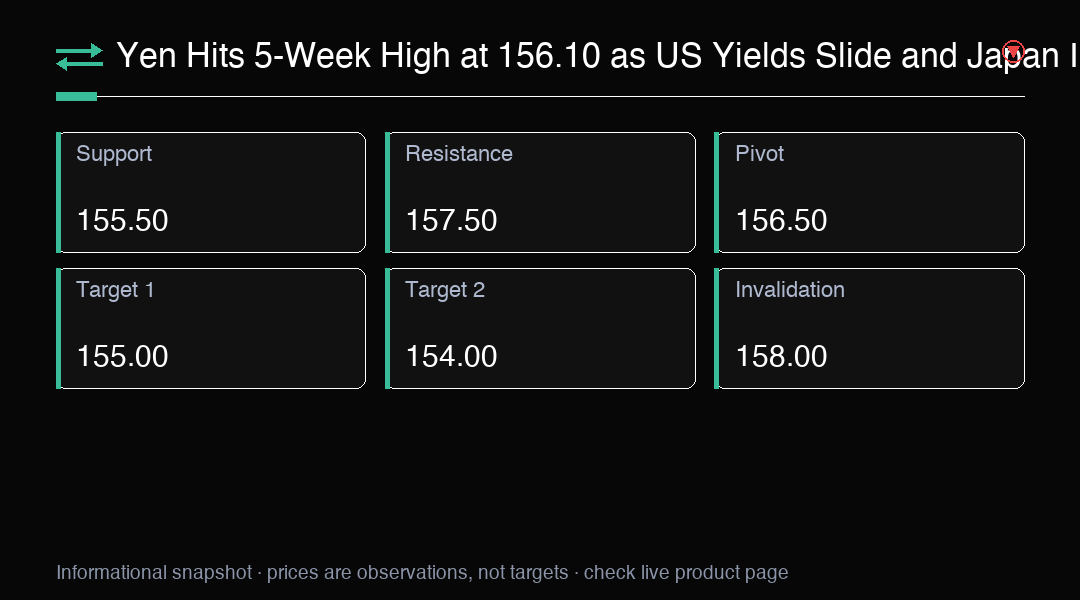
The 156.10 yen to 156.25 yen area is the immediate downside reference. Sustained trading below that zone would strengthen the bearish case for the dollar, with 155.50 yen and the psychological 155.00 yen level becoming the areas to monitor. Those levels represent both technical support and psychological thresholds that have influenced the market in previous episodes, and a break below them would signal that the yen's advance has further to run.
A recovery faces potential resistance around 157.50 yen and 158.00 yen, following the loss of those levels during the decline. Beyond them, recent peaks around 158.94 yen to 159.02 yen remain important. Those zones are where sellers have previously emerged, and reclaiming them would require a clear shift in either US yield expectations or Bank of Japan rhetoric, neither of which appears imminent at present.
Oil remains a complication for Japan. Brent traded above $114 as Middle East supply concerns intensified, and as an energy importer Japan faces higher import costs when crude rises. That dynamic creates a tension in the yen: rising oil prices widen Japan's trade deficit and weigh on the currency, even while global market anxiety encourages investors to seek its defensive qualities. The net effect depends on which force dominates. Japan imports nearly all of its crude, so a sustained rise in energy prices directly worsens the terms of trade and drains yen demand from the commercial sector.
From a technical perspective, USD/JPY has broken below its recent range and is testing the 156.10 yen area. A decisive close below 155.50 yen could attract further selling, while a recovery above 157.50 yen might signal that the decline has run its course. The options market is likely to price elevated volatility around the Bank of Japan meeting on October 30, which could create sharp moves in either direction.
Overall, the yen hit a five-week high as falling US Treasury yields and firmer Japanese inflation strengthened the case for further Bank of Japan tightening. The central bank is expected to hold at 1.25% on October 30, with December the next likely window for a rise to 1.5%, while the dollar retains a substantial interest-rate advantage. The coming weeks will test whether the yen's advance can extend beyond the 156 yen area or whether a rebound in US yields caps the move. Much will depend on how quickly the market adjusts its expectations for American policy, because the interest-rate differential remains the anchor that has kept the dollar supported through previous yen recoveries.
Trading Insight
USD/JPY fell to a five-week low near 156.10 yen as US yields slid and Japanese inflation hit 2.1%. Key support at 155.50 yen. Watch the Bank of Japan decision on October 30.