


Bitcoin traded near $81,700 early Friday, recovering from Thursday's low around $80,700 as the cryptocurrency absorbed another bout of risk aversion. The decline had taken the original coin more than 4.5% below Wednesday's peak above $84,800, reversing much of its recent recovery. Ether also steadied near $2,410 after suffering a sharper pullback during the selloff, and the two largest digital assets remain tightly correlated in the current environment, which means weakness in one tends to drag the other lower regardless of the individual narrative around either.
The immediate pressure came from the retreat in technology stocks. The Nasdaq Composite fell 2.6% on Thursday as earnings updates renewed doubts about AI spending and financing, and that weakness spilled directly into the cryptocurrency market. Bitcoin has traded as a high-beta expression of technology sentiment for much of this cycle, so a sharp move in the Nasdaq tends to produce an amplified reaction in digital assets. The correlation has been remarkably consistent over recent months, which is why the magnitude of the technology selloff mattered more than any Bitcoin-specific news.
Falling Treasury yields provided little immediate protection. The US 10-year yield returned below 5%, but investors seeking safety favored government bonds and the yen rather than Bitcoin. That preference matters because it suggests the market is treating the cryptocurrency as a risk asset rather than a store of value during this particular episode of stress. The pattern is consistent with previous technology-led drawdowns, when capital rotated toward the most defensive parts of the market and away from anything perceived as carrying elevated volatility.
US spot Bitcoin ETFs recorded $635.6 million in net outflows on Thursday. BlackRock's IBIT accounted for $254.1 million, Fidelity's FBTC lost $217.5 million and Ark's ARKB shed $109.4 million. The reversal is significant because institutional flows through these products have been one of the main drivers of demand since their launch, and a sustained turn to outflows removes a reliable buyer from the market. The concentration of withdrawals across the three largest products suggests the selling was broad-based rather than driven by a single fund's specific circumstances.
The week's buying has been reduced substantially, although it remains positive. Monday through Wednesday attracted $1.075 billion combined. Subtracting Thursday's withdrawals leaves roughly $439 million in net inflows through four sessions, which means the cumulative picture is still constructive but far weaker than it appeared midweek. Investors will be watching whether Friday's session restores the inflow trend or extends the reversal, because two consecutive days of outflows would shift the narrative from profit-taking to something more sustained.
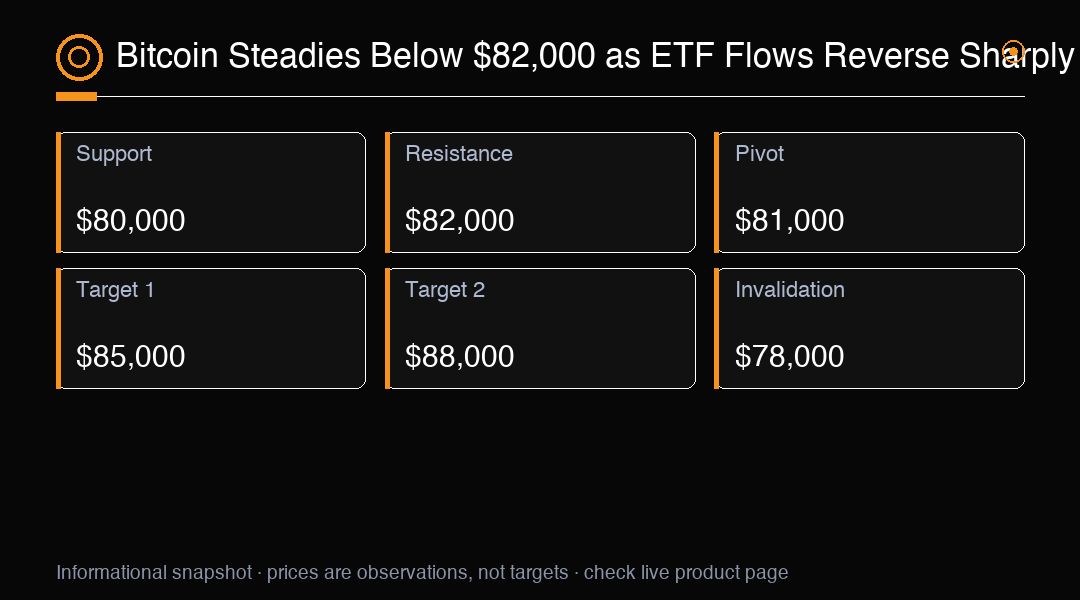
About $1.3 billion in Bitcoin options are scheduled to expire on Friday at 8 a.m. UTC. The reported max pain level is $82,000, which is the settlement price that would minimize the outstanding options' aggregate intrinsic value. Expiry events can pin price action near such levels in the hours beforehand, and the large notional involved means market makers' hedging activity can amplify short-term moves in either direction. Traders often watch the relationship between spot price and the max pain level to gauge where dealer positioning might concentrate.
Thursday's low near $80,790 is the immediate downside reference, followed by the psychological $80,000 level. Sustained trading beneath that area would strengthen the case that the latest recovery has failed and that the market is retesting the support built during the earlier advance. A break below $80,000 would also likely trigger additional selling from traders who entered positions on the assumption that the level would hold, and it would force a reassessment of the broader recovery thesis that has guided much of the recent positioning.
Recovering $82,000 would be an initial improvement, but buyers face further work around $85,000. That region combines a level highlighted by Bitfinex with the latest failed advance, making it the zone where the market would need to prove that the recovery is genuine rather than a temporary bounce. Volume and ETF flow data will be the clearest signals of whether buyers are willing to absorb supply at those prices, and a move through $85,000 on strong participation would do more to restore confidence than a quiet drift higher.
Positions funded with borrowed money can make either direction more abrupt. Traders using borrowed funds can face automatic position closures when collateral becomes insufficient, adding selling during a drop and amplifying rallies when prices recover. That mechanical dynamic is one reason Bitcoin moves can appear exaggerated relative to the underlying news flow, and it is worth keeping in mind when interpreting sharp intraday swings. The effect is amplified during periods of thin liquidity, when even modest flows can produce outsized price changes.
Keep in mind that Bitcoin trades throughout the weekend, although at lower volumes. That leaves it exposed to headlines while US ETF trading is closed, which can produce gaps and thin liquidity that exaggerate price moves. Traders who hold positions over the weekend face a different risk profile from those who close before the traditional market week ends, and the reduced depth can make stops harder to execute at expected prices. The combination of weekend trading and event risk from the options expiry makes the coming sessions particularly unpredictable.
From a technical perspective, Bitcoin is holding above the $80,000 area but has failed to reclaim the $82,000 expiry reference. A decisive close above $82,500 could attract momentum buying, while a break below $80,000 might open the door to a retest of the year's lows. The options market is likely to price elevated volatility around Friday's expiry, which could create sharp moves in either direction depending on where settlement occurs. Traders should also watch the funding rates in the perpetual futures market, since extreme readings often precede a squeeze in the opposite direction.
Overall, Bitcoin steadied below $82,000 after a sharp reversal in ETF demand and a technology-led risk pullback, leaving the market focused on whether buyers can defend $80,000. The combination of falling Treasury yields, a stronger yen and renewed doubt about AI spending has shifted the macro backdrop against risk assets, and the coming week's flow data will be critical. Investors will be watching whether the ETF inflows recover or whether the reversal marks the start of a deeper correction, and the answer will likely set the tone for the remainder of the quarter.
Trading Insight
Bitcoin steadied near $81,700 after ETF outflows of $635.6 million reversed the week's inflows. Key support at $80,000. Watch Friday's $1.3 billion options expiry and the $82,000 max pain level.