


Tesla shares fell 3.2% after hours on Wednesday, reversing much of the optimism that had lifted the stock 3.4% to $386.50 during regular trading. Investors initially cheered better-than-expected adjusted earnings, but the question-and-answer session that followed raised fresh doubts about how quickly the company can turn its AI, robotics and autonomous-driving ambitions into durable revenue. The reversal left the shares in a familiar position, gaining ground through the day only to give much of it back once management began taking questions. For a stock valued on future technology rather than current car sales, the episode showed how fast the narrative can swing when the near-term numbers disappoint.
Adjusted earnings reached 48 cents per share versus 45 cents expected, while revenue was broadly flat at $28.05 billion. The figures describe a business that can still exceed modest expectations, although it has yet to restore the sustained sales growth that once defined the company. Revenue that barely moves year over year is a concern for a stock trading at a premium to much of the automotive sector, because investors are paying for expansion the top line has not delivered. The gap between a small earnings beat and a durable re-rating of the shares was the central tension of the session.
Reported net income fell 43% to $787 million, while operating profit declined 56% to $718 million. Operating profitability was 2.6%, compared with 5.8% a year earlier, which leaves a significant profitability challenge even as the underlying automotive business improved. The contrast between a shrinking bottom line and a stronger gross profitability on vehicles shows how much of the current earnings base depends on items outside the core car business, including regulatory credits, energy storage and services. Those adjacent businesses are meant to carry more weight over time, but the numbers suggest they are not yet large enough to offset pressure on the main automotive operation. The squeeze also raises a question about pricing, since Tesla has used aggressive price cuts to defend volume and those cuts have weighed on the income statement.
Automotive gross profitability excluding regulatory credits improved to 18.1% from 15.4%, offering one of the clearest signs of operational progress in the report. Deliveries reached 486,532 vehicles against production of 464,391, a gap that suggests the company is working through inventory accumulated in earlier quarters. The improvement in vehicle economics gives management more room to absorb pricing pressure, though it has not yet translated into higher overall profitability. The delivery and production figures cut both ways, because delivering more vehicles than the company built indicates that it is clearing stock rather than producing to meet new demand.
Management cut its annual capital-expenditure forecast to $20 billion from more than $25 billion, a reduction that lowers the immediate funding requirement but also raises questions about investment timing. Tesla did not specify which projects would account for the reduction, leaving investors to guess whether the cut reflects discipline or a slower pace of development. Lower spending is generally welcomed by investors who worry about cash consumption, but Tesla has built its investment case on being the most aggressive spender in its industries, particularly in AI compute and robotaxi infrastructure.
Free cash flow returned to positive territory at $1.53 billion, as operating cash flow of $6.26 billion exceeded capital expenditure of $4.73 billion. Spending nevertheless more than doubled from a year earlier, which means the company is still investing at a rate that consumes a large share of its cash generation. The return to positive free cash flow is encouraging, but its durability depends on whether the lower capital-expenditure plan holds. A single positive quarter is not yet a trend, and spending that has more than doubled shows how far the company still is from self-funding its full investment programme.
Tesla aims to sell Cybercab robotaxis to the public by year-end, with an expansion of its ride service to Dallas planned for November. Federal regulators are examining the steering-wheel-free vehicle's compliance with existing safety standards, making regulatory progress central to the commercial rollout. The robotaxi programme is central to the bullish case for the stock, because it represents the clearest path to monetising the company's autonomous-driving software at scale. A public launch would also mark a symbolic milestone, but a vehicle without a traditional steering wheel must satisfy standards written for conventional cars.
Commercial Optimus deliveries to other companies are targeted for around the end of 2027, Musk said. He expects roughly a year to reach production of approximately 20,000 robots weekly, while acknowledging supply-chain difficulties and required design changes. The robotics programme remains the most speculative part of the investment case, and the market is being asked to value it long before it generates meaningful revenue. The timeline places the first real commercial deliveries well beyond the current fiscal year, which means investors will not see revenue from the programme for some time.
A potential SpaceX merger remains under evaluation by independent committees, with no agreed terms and shareholder approval still required. The proposal adds an additional layer of uncertainty to the Tesla story, because any combination would reshape the capital structure and the strategic focus of both companies. Investors will want clarity on timing and governance before assigning much value to the possibility. The fact that independent committees are reviewing the idea is a necessary safeguard, since a transaction of this kind would raise obvious questions about related-party interests and the fair treatment of Tesla shareholders.
The earnings report illustrated a company that is simultaneously improving its vehicle economics and struggling to grow its bottom line. Lower spending supports cash flow in the near term, but it also raises questions about whether the company is slowing investments that were intended to drive future growth. On one side, Tesla is becoming more efficient at building and selling cars, with gross profitabilitys that have recovered meaningfully. On the other, the company is earning less overall and cutting the investment budget that was supposed to fund its next phase.
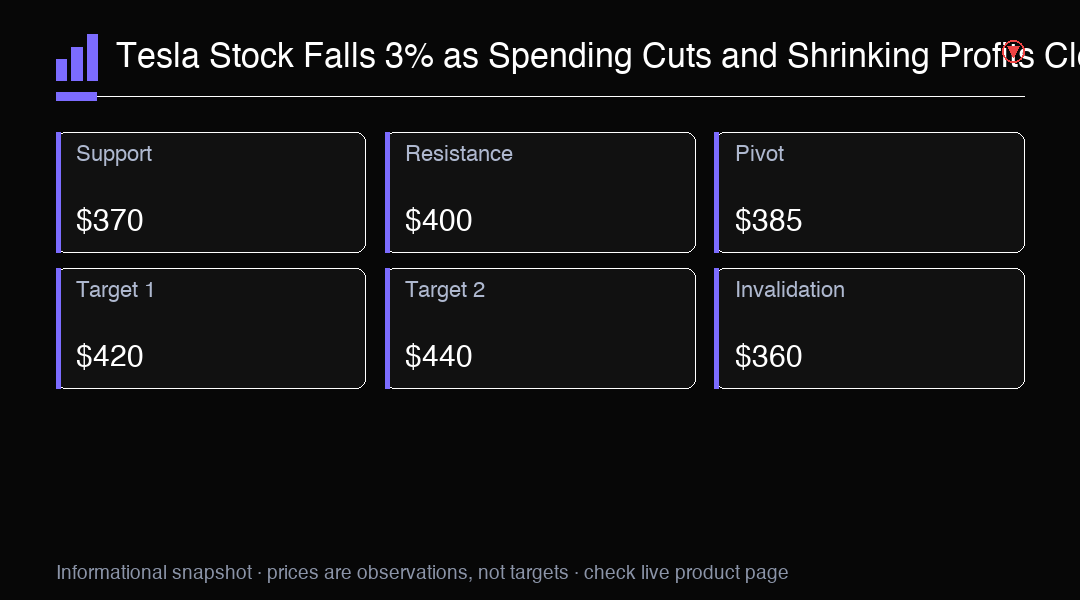
From a technical perspective, Tesla is holding above its recent lows but remains vulnerable to a break lower if the broader technology sector comes under pressure. A decisive move above $400 could signal that the selling pressure has been exhausted, while a break below $370 might open the door to a retest of the year's lows. The options market is likely to price elevated volatility around any update on robotaxi or Optimus progress. The stock has spent much of the year trading in a wide range, and the $400 level has acted as resistance on several occasions.
Overall, Tesla delivered a modest earnings beat but a weaker profit trend, and the market chose to focus on the latter. Positive cash flow and stronger automotive margins offer encouragement, but lower investment plans and a distant Optimus timetable kept investors away from the shares. The coming quarters will test whether the company can convert its autonomous-driving and robotics ambitions into revenue growth that justifies the current valuation. What Tesla lacks, for now, is a clear path to the growth that would justify the premium the market has historically assigned to the name.
Trading Insight
Tesla fell 3.2% after hours despite an earnings beat, as operating profitability fell to 2.6% and capex guidance was cut to $20 billion. Key support at $370. Watch robotaxi and Optimus progress.