


Bitcoin traded at $82,673 on Monday, up 1.3% over the past 24 hours as the cryptocurrency market stabilized following last week's bout of volatility. The gain since Sunday's daily close of roughly $81,900 represents a near 0.9% advance, extending a recovery that began after the market tested the recent low of $80,000. The move confirms that buyers are still willing to step in on weakness, and it places the largest digital asset firmly back within the broad trading range that has defined price action for the past several weeks. Market participants described the session as orderly, with volumes in line with the recent average and no signs of the forced selling that characterized the sharp declines earlier in the month.
The recovery comes as institutional inflows continue to provide support beneath the market. US spot Bitcoin ETFs recorded $220 million in net inflows over the weekend, marking a continuation of the positive trend that has been building since last week. Cumulative inflows since launch now stand at $18.6 billion, a figure that underscores how much demand has been channeled through regulated vehicles rather than direct custody. Analysts note that the steady accumulation through these products has changed the structure of the market, because the shares are bought during US trading hours and the underlying coins are taken off the open market. That dynamic has reduced the float available to traders and has given the price a more durable base than was present in earlier cycles.
Ethereum traded at $2,480, up 4.2% over 24 hours, outperforming Bitcoin for the second consecutive day and reinforcing the view that capital is rotating toward higher-beta assets within the sector. The broader crypto market capitalization rose 2.1% to $2.95 trillion, with most altcoins posting gains across the board. Solana gained 5.6% to $138.20 and XRP rose 3.1% to $0.55, both outperforming the market leader. The pattern suggests that traders are becoming more comfortable adding risk after last week's turbulence, and that liquidity is improving across the board. When altcoins lead while Bitcoin consolidates, analysts often read the tape as a sign of broad participation rather than a narrow, defensive bid.
Analysts note that Bitcoin's correlation with US equities has stabilized in recent sessions, suggesting the cryptocurrency is gradually developing its own independent drivers rather than simply tracking the risk appetite of traditional markets. The ETF flows and the pace of institutional adoption are providing a floor under the price that was not present in previous cycles, and the recent price action indicates that buyers are stepping in at each level of support. That does not mean Bitcoin is immune to macroeconomic shocks, but it does suggest the market is discounting a steadier supply backdrop. Correlation has eased rather than collapsed, which traders generally interpret as a healthy development for an asset that is still establishing its long-term valuation framework.
The options market shows increased demand for call protection, with the 25-delta skew shifting positive as traders pay more for upside exposure. Implied volatility has declined to 52%, down from 68% last week, suggesting reduced uncertainty and a more stable market environment after the violent swings that followed the break lower. The decline in implied volatility is significant because it signals that the premium market participants demand to hold protection has fallen, which typically accompanies a period of consolidation. Dealers reported balanced two-way flow, with demand for calls matched by steady interest in puts as investors look to hedge rather than speculate. That combination points to a market that is rebuilding confidence without becoming complacent.
On-chain data shows that long-term holders continue to accumulate, with wallets that have held Bitcoin for over a year adding to positions rather than distributing into strength. Exchange outflows have increased for four consecutive weeks, suggesting investors are moving coins to cold storage rather than preparing to sell. This pattern is consistent with a maturing market in which participants are increasingly treating Bitcoin as a long-term store of value. The behavior contrasts with previous cycles, when long-term holders tended to take profits aggressively during rallies. This time the balance on exchanges has continued to fall even as the price recovered, which reduces the immediate supply overhang and gives rallies a better chance of holding.
From a technical perspective, Bitcoin is now testing a key resistance zone between $82,500 and $83,000. A decisive break above $83,000 could open the door to a retest of $85,000, a level that would mark a clear extension of the recovery and potentially attract further buying interest from momentum accounts. Conversely, a pullback below $81,000 would signal a return to the recent trading range and could attract further selling toward the $80,000 area. The $83,000 level is watched closely because it caps the upper end of the range and has repeatedly rejected advances over recent sessions. Traders are using the zone as a trigger: a confirmed close above it is treated as a buy signal, while a failure is treated as a cue to reduce exposure.
The derivatives market shows a healthy balance, with funding rates positive but not excessive and open interest having declined from last week's peak. The reduction in open interest suggests that speculative positions were flushed out during the recent selloff, which typically precedes more sustainable price movements because the market becomes less vulnerable to forced liquidations. Traders noted that the cleanup has left the market in better shape, with fewer overextended positions that could amplify a move in either direction. Positive funding indicates that longs are still paying a modest premium to maintain exposure, but the level is far from the extremes that have historically marked blow-off tops. Overall, the derivatives backdrop is neutral to constructive.
Looking ahead, the busy earnings week could provide a catalyst for Bitcoin. If technology companies demonstrate that AI investments are generating returns, it could boost risk sentiment and lift cryptocurrencies along with other growth-sensitive assets. Conversely, disappointing results could push Bitcoin back toward the $80,000 support level, where buyers have so far been willing to absorb supply. The macro backdrop matters as well: softer inflation readings and a more measured outlook for interest rates tend to support risk assets, while a reacceleration in price pressures would work against them. Traders are therefore watching both corporate results and the tone of the data, since either can shift the near-term path of the market.
Macroeconomic conditions also appear supportive, with the dollar softening and Treasury yields easing after recent economic data pointed to a gradual cooling in price pressures. A weaker dollar tends to lift assets denominated in the US currency, and Bitcoin has historically benefited when real yields decline and liquidity conditions improve. Central bank policy expectations have shifted toward a more patient stance, which reduces the headwind that higher borrowing costs pose for speculative assets. Analysts caution that the macro picture remains fragile and that a single hot inflation print could quickly reverse the current mood. For now, however, the combination of a softer dollar and calmer rates markets is giving Bitcoin room to consolidate.
Overall, Bitcoin appears to be consolidating in a broad range between $80,000 and $87,000. The ETF inflows and declining volatility suggest the market is maturing, with institutional investors providing more stable support than in previous cycles. The recent price action suggests the market is finding a floor, and the steady grind higher indicates that sellers are being absorbed rather than overwhelmed. Volume has been sufficient to confirm the recovery but not so heavy that it signals exhaustion. The next direction is likely to be decided by whether the market can hold above the $82,000 area or whether the broader risk environment forces another test of the lower end of the range.
Some analysts are now targeting $90,000 as the next major resistance level, arguing that the combination of ETF demand and macroeconomic uncertainty could drive Bitcoin to new highs by year-end. Such a move would require a sustained break above $87,000 and a period of calm in traditional markets, conditions that are plausible but not yet confirmed. The earnings week will likely determine the near-term direction, and traders are approaching the market with a mixture of optimism and caution. If the $83,000 resistance can be cleared, the path toward $85,000 and eventually $87,000 opens up, while a failure could keep the market range-bound for longer than expected.
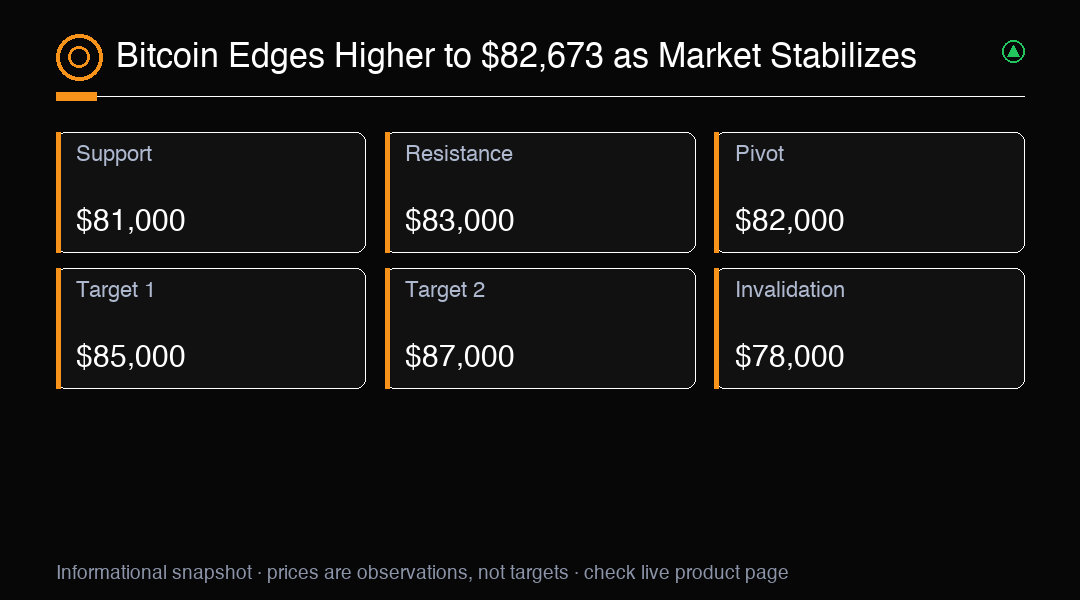
Trading Insight
Bitcoin is stabilizing above $82,000 with ETF inflows providing support. Watch $83,000 resistance and $81,000 support. Range remains $80,000 to $87,000.