


The Nasdaq Composite dropped 2.6% to 26,008.86 on Thursday, its steepest decline since early June, as technology stocks retreated on renewed questions about the cost of AI expansion. The S&P 500 fell 1.21% to 7,663.43, while the Dow edged up 0.02% to 52,867.98. Most US stocks actually advanced, which shows how losses in heavyweight technology companies can overwhelm gains elsewhere when the largest weights in the index move sharply. The divergence between the headline indices and the broader market is a reminder that index-level moves can obscure a much more constructive picture beneath the surface.
Semiconductors led the retreat, with the Philadelphia chip index losing 6.7%. Nvidia fell 4.4%, while Intel, AMD, Sandisk and Marvell each lost more than 8%. Meta dropped 7% and Tesla shed 3.1% as their earnings updates renewed scrutiny of AI spending and its eventual returns. The concentration of losses in the semiconductor sector is notable because those stocks have been the primary beneficiaries of the AI investment cycle, making them especially vulnerable to any shift in sentiment about the pace of spending. The speed of the reversal also caught many traders off guard, since the group had been among the strongest performers heading into the earnings season.
Earnings produced some substantial winners, which is the most encouraging part of the session. Procter & Gamble gained 5.6% after beating estimates, Blackstone rose 8.4% and Spotify jumped 11.1% on an upbeat profit outlook. The contrast suggests investors are becoming more selective about which growth stories and spending plans they will reward, rather than applying a blanket premium to anything associated with technology. That dispersion is healthier for the market than a uniform rally would be, because it means capital is being allocated on the basis of individual fundamentals rather than a single thematic trade.
SpaceX's wireless ambitions shook telecom stocks after hours. Reports of talks to secure at least 80,000 US cell sites sent Crown Castle up roughly 9%, American Tower up 4% and SBA Communications up 7%. Verizon, AT&T and T-Mobile fell around 3% to 4% as investors assessed potential competition from another nationwide carrier. The reaction showed how quickly capital can rotate between sectors when a credible new entrant changes the competitive landscape, and it illustrated that the market remains willing to reward companies that stand to benefit from disruption even as it punishes those that might be displaced by it.
Asia retreated as bonds and currencies drew attention. South Korea's Kospi fell about 2.5% in Friday trading, with Samsung among the stocks under pressure. Japan's Topix lost 1.8% and the Shanghai Composite declined 1.6%, while Hong Kong's Hang Seng edged higher. The weakness in Asian markets reinforced the cautious tone, and it suggested that the negative reaction to US technology earnings was spreading beyond American trading hours. The regional divergence also reflected the different exposures each market has to semiconductor demand and to the AI supply chain.
US equity futures offered a quieter early indication. S&P 500 futures were little changed, while Euro Stoxx 50 futures slipped around 0.2%. In currencies, the euro traded near $1.1210 and USD/JPY hovered around 156.90 yen following the yen's gains over the previous three sessions. The relative calm in futures suggested that the worst of the technology selloff may have been absorbed, though the mood remained fragile ahead of the weekend. Traders were also mindful that the futures market can be a poor guide to the cash open after a session as volatile as Thursday's.
The US 10-year Treasury yield returned below 5%, trading around 4.96%. Thursday's sharp bond rally reflected demand for safety, while France's benchmark yield climbed above 5.06% amid fiscal concerns. December Fed hike odds eased to roughly 85%, which is still substantial despite the shift toward caution. The combination of falling yields and rising risk premiums in parts of Europe illustrates how uneven the global backdrop remains, even as US technology earnings have been strong. That unevenness is likely to keep volatility elevated across asset classes in the coming weeks.
Japan supplied another reason to watch the yen. September core inflation accelerated to 2.1% from 1.7%, returning above the Bank of Japan's target. That supports the case for further tightening, although it does not settle the timing. The central bank's next policy meeting ends October 30, and traders will be parsing the updated forecasts for any hint that a December move is being prepared. The yen's strength is itself a factor that could complicate the inflation outlook, since a stronger currency tends to dampen import prices and therefore the measured rate of price increases.
Brent approached $114 a barrel and US crude moved above $100 early Friday, extending Thursday's rally after attacks in Saudi Arabia heightened supply concerns. Expensive energy complicates the outlook: it raises costs for businesses and consumers while keeping inflation pressure alive as investors question growth. The result is a difficult combination for central banks, which must weigh the risk of persistent price pressure against the possibility that higher energy costs will eventually dampen demand. That tension is one of the main reasons the market has struggled to sustain a rally in recent weeks.
Gold hovered around $4,000 after Thursday's roughly 3% decline, failing to attract the same haven demand as bonds. Bitcoin recovered about 0.7% to $81,700 from near $80,000 and Ether rose 1.2% to $2,410. The divergence between bonds and other assets showed that investors are discriminating carefully about where they seek safety, favoring the deepest and most liquid markets over alternatives that might offer a hedge in a more traditional risk-off scenario. The pattern suggests that the traditional relationship between gold and risk assets has become less reliable in an environment where real yields and the dollar are moving in ways that complicate the safe-haven calculus.
Friday's US flash PMIs arrive at 9:45 a.m. ET, followed by final Michigan consumer sentiment and inflation expectations at 10 a.m. American Express and SLB also report before the open. The data could influence the Fed's decision on Wednesday, particularly if the surveys point to a weakening labor market or a further rise in inflation expectations. Traders will be watching whether the numbers support the recent shift toward caution in rate expectations, and any surprise could produce a sharp reaction in both bonds and equities given how sensitive the market has become to macro data.
Next week brings another demanding test for markets: Microsoft, Amazon and Alphabet earnings alongside the Fed decision on Wednesday and the ECB on Thursday. Traders will be assessing both the returns from AI investment and the borrowing costs needed to finance its expansion. With the Nasdaq already down 2.6% and semiconductor stocks under heavy pressure, those results will determine whether the selloff is a pause or the start of a deeper reassessment of technology valuations. The concentration of the upcoming earnings in the very companies that lead the AI trade means the stakes are unusually high for a single week of reports.
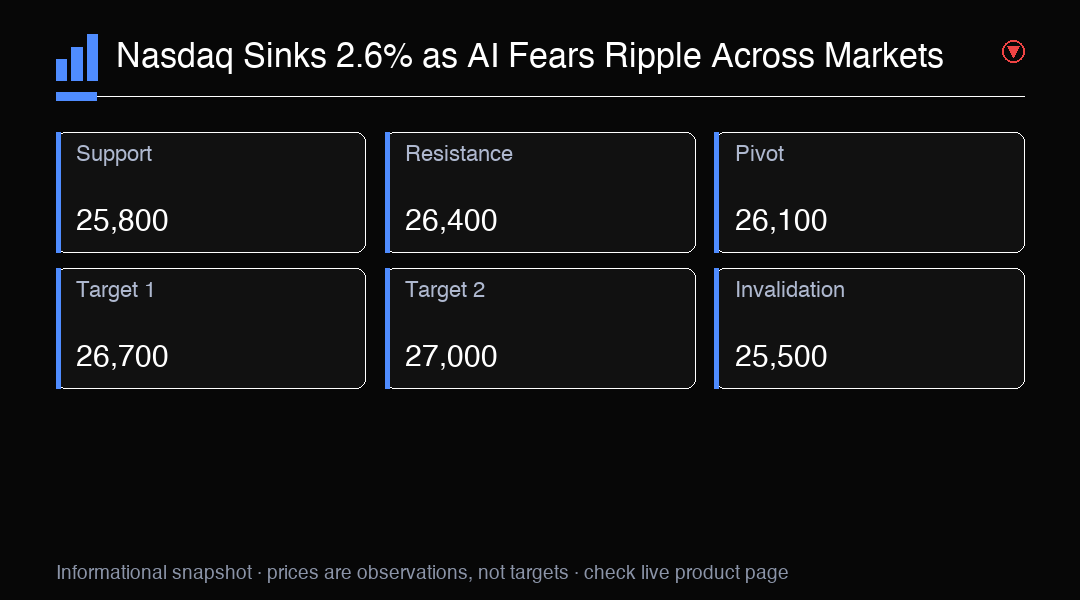
Trading Insight
The Nasdaq dropped 2.6% to 26,008.86 as AI fears hit semiconductors and mega-cap technology. Key support at 25,800. Watch Microsoft, Amazon and Alphabet earnings next week.