


US equity futures were little changed to modestly higher heading into a week packed with catalysts, with S&P 500 futures edging slightly higher, Nasdaq contracts gaining roughly 0.3%, while Dow futures slipped about 0.1%. The muted open follows a choppy end to last week, when the S&P 500 and Nasdaq Composite each posted a third consecutive weekly gain even after dipping slightly on Friday, leaving major indexes still within reach of record territory heading into a week that will test whether recent economic softness is being read as good news or bad news for stocks.
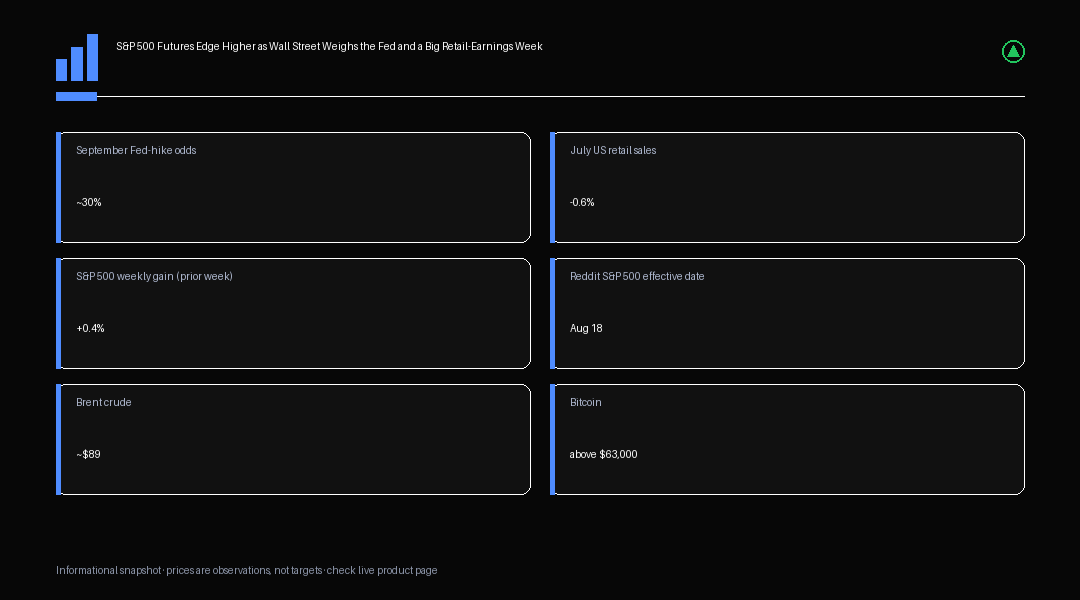
That tension over how to interpret weak data sits at the center of this week's setup. July retail sales unexpectedly fell 0.6%, the first monthly decline in nine months, with core sales down 0.4% as well, and both figures missed forecasts. The soft print pushed market pricing for a September Federal Reserve rate increase down toward 30%, a meaningful drop from where odds stood roughly a month earlier. Traders are effectively deciding whether that combination of weaker consumer spending and reduced hike risk nets out as a positive or a negative for equity valuations, and the market's current, cautiously higher tone suggests the reduced-rate-risk side of that equation is winning out for now.
Retail earnings will offer a more direct read on the health of the American consumer than any single data release. Home Depot reports Tuesday, followed by Target and Lowe's on Wednesday and Walmart on Thursday, giving traders a near-complete picture of how households are spending across home improvement, general merchandise and everyday essentials within a single week. Comparable sales, customer traffic trends and forward guidance will matter more than headline earnings-per-share figures, since the retail sales miss has already primed the market to focus on demand signals rather than backward-looking profitability.
Index mechanics add a second, unrelated catalyst to Tuesday's session. Reddit is set to join the S&P 500 before the opening bell that day, replacing AvalonBay Communities, which is being absorbed into the index through its acquisition by fellow member Equity Residential. The change forces every fund that tracks the S&P 500 to buy Reddit shares to stay aligned with the benchmark, a mechanical flow that can generate outsized volume around the effective date independent of any fresh view on the company's underlying business, and traders should treat any resulting price action in Reddit shares as being driven partly by that forced buying rather than pure fundamentals.
The Federal Reserve's own calendar looms over the back half of the week as well. Minutes from the Fed's late-July meeting are due for release, and because that meeting predates the recent run of soft employment, inflation and retail-sales data, the minutes will mainly reveal how divided officials were at the time rather than offer a real-time read on the current data flow. UK inflation figures are scheduled for release the same day and carry their own potential to move global bond yields and currency markets, adding another cross-current for US traders to monitor even though the release itself sits outside the domestic calendar.
Currency and commodity markets are telling a broadly consistent story of a softer US dollar amid fading Fed-hike bets. The dollar has eased against both the euro and the yen, helping explain some of the recent strength in gold, which has climbed well above its earlier-August levels into the $4,400-plus area, while Bitcoin has held above the $63,000 mark after a roughly 3% weekly decline the prior week. Oil remains the more unsettled corner of the market, with Brent crude near $89 a barrel and West Texas Intermediate near $83 after both benchmarks rallied more than 5% the previous week as talks between the United States and Iran stayed stalled and tanker traffic through the Strait of Hormuz slowed sharply.
Asian markets offered a mixed handoff into the new week, with Japan's Nikkei gaining modestly and Australia slipping, while South Korea's markets were closed for a holiday. That split performance, alongside the ongoing standoff over oil supply risk in the Middle East, is a reminder that the constructive mood in US futures is playing out against a global backdrop that is not uniformly calm, and any escalation in the Iran situation could quickly reprice both energy markets and the broader risk-asset complex that has otherwise been grinding higher.
Taken as a whole, this week's setup leaves US equities balanced between a consumer-spending story that just turned softer, a Federal Reserve that markets believe has largely finished tightening, and a retail-earnings calendar dense enough to move the narrative in either direction by Thursday's close. Nvidia and the broader artificial-intelligence infrastructure theme remain the market's dominant long-term leaders, but this week's real test comes from consumer-facing companies rather than technology heavyweights, making Walmart's Thursday report arguably the single most closely watched print of the week for gauging whether the broader economic softness seen in the retail-sales data is starting to show up in corporate results as well.
Trading Insight
For traders, this week's setup requires weighing a softer consumer-spending signal against a retail-earnings calendar dense enough to confirm or contradict it within days. A strong round of results from Home Depot, Target, Lowe's and Walmart would suggest the July retail sales miss was a one-off rather than the start of a genuine slowdown, supporting the market's current willingness to treat fading Fed-hike odds as a net positive for equities. Weak guidance across that group, particularly from Walmart on Thursday given its role as a bellwether for value-conscious consumers, would raise the risk that softer spending is becoming a trend rather than a blip, a scenario that could pressure index-level valuations even as lower rate expectations argue the other way. Reddit's mechanical entry into the S&P 500 on Tuesday is a separate, time-boxed event that traders should treat as index-flow noise rather than a market-wide signal, though it may add short-term volatility to broader index futures around the open. Fed minutes due later in the week describe a meeting that predates the recent data softness, so any market reaction to them should be weighed against the more current data already in hand. Cross-asset signals, including a firmer gold price and an unsettled oil market tied to the Iran standoff, suggest traders are hedging against downside risk even as headline index levels hold near records, arguing for disciplined risk management heading into a data- and earnings-heavy week.