


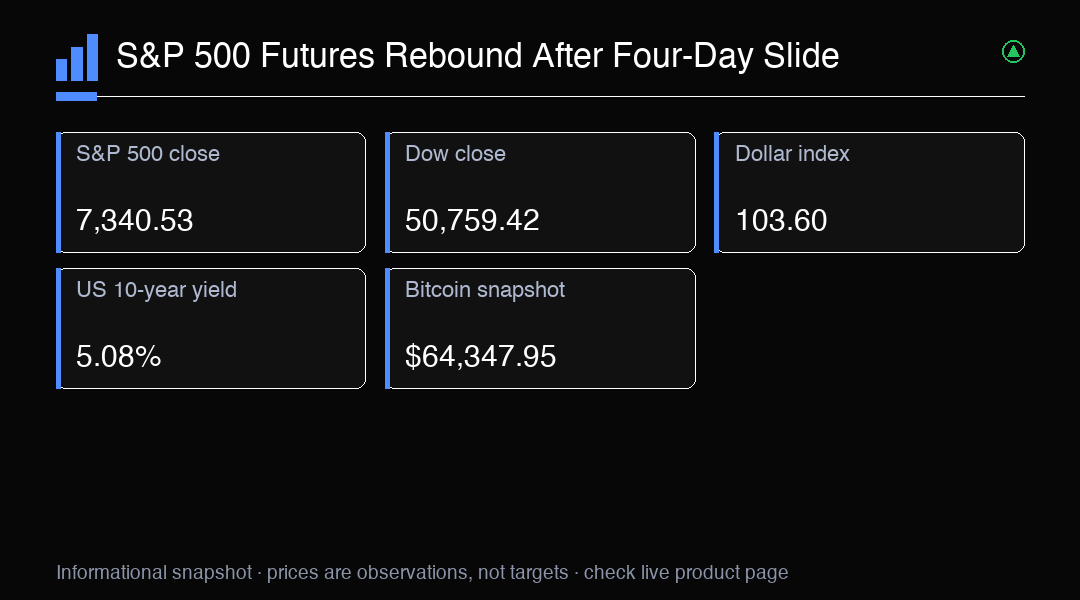
S&P 500 e-mini futures rose about 0.3% in Asian trading on November 18, offering a tentative rebound after the cash index’s four-session slide. The move arrived as investors weighed Nvidia’s revenue outlook, interest-rate pressure and weakness across several global markets. It marks a change in near-term tone, but the central question is whether buyers can extend the advance into later trading. For now, futures have interrupted the decline without erasing its context: the S&P 500 ended November 17 down 1.03% at 7,340.53, while the Dow fell 1.6% to 50,759.42.
That sequence matters because a single positive futures session can coexist with a weakening broader trend. The four-day loss has put the latest bounce in a recovery test: does demand return as prices stabilize, or does early strength fade when more participants enter? Futures move ahead of the US cash open and continue to reprice as new information arrives. The November 17 closes provide a fixed reference for the previous session, while the Asian futures gain captures sentiment at that point in time. Follow-through, breadth and the cash market’s response will give the rebound more meaning than its opening percentage alone.
Nvidia’s results and guidance supplied a key catalyst for technology sentiment. Fiscal third-quarter revenue reached $115.8 billion, and the company projected fourth-quarter revenue of $130 billion, plus or minus 3%. The outlook assumes no data-center compute revenue from China and includes an extra week. Those details shape the comparison investors make between the headline forecast and underlying demand. A stronger outlook can support expectations for AI-related spending across suppliers and customers, yet the S&P 500 reflects many industries and earnings cycles. Nvidia may influence the index through its size and reach, but its guidance cannot by itself establish that a broad-market recovery is underway.
Investors also have to weigh Nvidia’s unsettled leadership question. The board said it did not intend to reinstate Jensen Huang, adding governance and execution uncertainty alongside the company’s operating outlook. Revenue growth and forward guidance speak to demand and business performance; leadership continuity concerns how the company will direct and deliver that growth. Keeping those threads separate helps explain why strong financial figures can coexist with questions about confidence and valuation. For the index, Nvidia’s influence comes through its market weight and its role in the AI investment theme, while the wider market still depends on how other large companies and sectors trade.
Anthropic added a smaller but timely signal for AI-market appetite. The company was reportedly expected to price above $80 ahead of a planned Thursday Nasdaq debut under the symbol ANT, versus an earlier range of $70 to $78. The expected price remained provisional at the cited time. A higher anticipated IPO price may draw attention to demand for private AI companies entering public markets, but one offering is a narrow indicator rather than a verdict on broad equity risk appetite. Its relevance here is as part of the technology backdrop surrounding Nvidia, not as a substitute for evidence from the S&P 500 itself.
Cross-asset trading showed that the futures bounce was developing amid mixed pressure. The dollar index stood at 103.60 and the US 10-year Treasury yield at 5.08%. Spot gold fell 1.6% to $3,787.65 by 04:28 GMT, while silver declined 3.1% to $45.94. Bitcoin was quoted at $64,347.95 and Ether at $1,804.06. These markets respond to different drivers, but together they offer a read on rates, currency demand and investor positioning. The yield level is especially relevant to equity valuations because higher long-term borrowing costs can weigh on growth-sensitive shares, including companies whose expected returns sit further in the future.
Asia’s equity benchmarks were also modestly lower during the cited session. MSCI’s Asia ex-Japan index slipped 0.1%, and Japan’s Nikkei 225 fell 0.3%. The declines were limited, yet they underline that the US futures advance was not part of a uniform regional rally. Local earnings, currency moves and market composition affect each benchmark differently, so the comparison is useful as context rather than a direct signal for US equities. A recovery in S&P 500 futures will need to show its own durability as US trading approaches, rather than relying on a broad global risk-on move that was not visible in these readings.
The market is therefore balancing two forces: a four-day cash-index decline that leaves investors cautious, and an early futures advance supported in part by Nvidia’s forward outlook. Rates and the dollar remain part of the valuation backdrop, while the AI theme can lift sentiment without guaranteeing participation across the full index. The Dow’s larger November 17 loss than the S&P 500 also shows that the pullback was not identical across major benchmarks. Traders will learn more from whether gains broaden across sectors and hold through the US session than from headline enthusiasm around one company or one planned listing.
The first follow-through test is whether futures can retain their gain as liquidity builds and the cash market opens. A firm move above the prior S&P 500 close of 7,340.53 would indicate that buyers are willing to reclaim ground after the losing streak; a fade would leave the rebound looking more like a pause. Neither outcome is established by the Asian session. Price behavior through subsequent trading, alongside participation from other major stocks, can clarify whether sellers are losing control or simply taking a brief step back. This is a monitoring framework, not a forecast, and conditions can change as fresh data and company news arrive.
Nvidia’s guidance may remain a focal point, but a sustainable index advance would require the wider market to absorb rate pressure and demonstrate demand beyond the largest AI names. The reported Anthropic pricing expectation may keep attention on technology issuance, while its provisional status means it should be treated as a developing event. Meanwhile, the dollar, Treasury yield and metals readings frame the current macro backdrop rather than dictate a single direction for equities. The key is how these separate signals interact with actual cash-market prices once US investors return.
For traders tracking the broad S&P 500, the practical focus is whether the November 18 futures rebound develops into steadier cash-market demand after four declining sessions. Compare the move with the previous close, watch whether strength spreads beyond a handful of large technology shares, and note whether rates continue to challenge valuations. US500 follows a broad S&P 500 mapping, giving traders a way to monitor the benchmark’s general movement. It does not represent direct exposure to Nvidia or Anthropic, so company-specific views remain distinct from an index view.
Trading Insight
Watch whether the Asian-session futures gain holds into US trading and whether cash-market strength broadens beyond large technology shares. Compare price action with the prior S&P 500 close of 7,340.53.