


Nasdaq futures rose about 0.35% in early Asian trading on November 17, while S&P 500 futures gained about 0.13%. Those moves followed a broad US equity decline the previous session, led by technology and semiconductor shares. The modest futures gains point to a pause in the immediate selling pressure at that time of day. They do not establish that the prior decline has been reversed, and they should be read with the session qualifier attached: futures prices continue moving as trading progresses. The next cash-market session could respond to new information, changes in positioning or price moves in individual large technology companies.
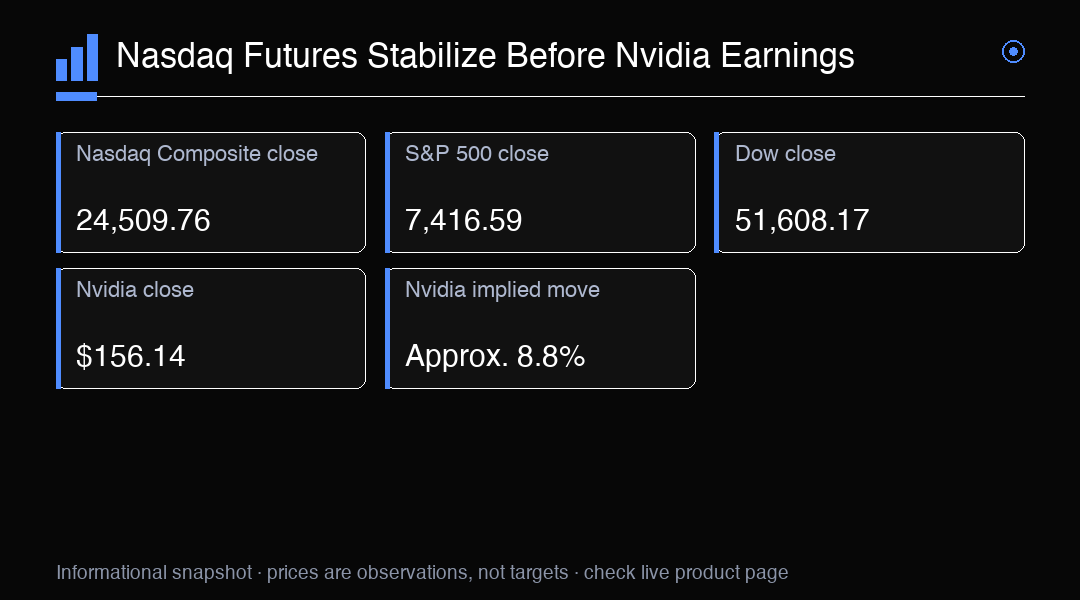
On November 16, the Nasdaq Composite fell 2.49% to close at 24,509.76. The S&P 500 lost 1.92% and finished at 7,416.59, while the Dow declined 1.41% to 51,608.17. The larger decline in the Nasdaq than in the Dow is consistent with a session in which technology weakness weighed heavily on the growth-oriented index. A single session, however, cannot show whether investors are making a durable change in their outlook or reducing risk ahead of a major company report. The closing levels provide a clear reference for comparing subsequent cash-market trading, but they do not by themselves define support, resistance or a likely path.
Semiconductor shares were especially weak. The Philadelphia Semiconductor Index fell 5.3% on November 16, and Nvidia dropped 4.1% to $156.14. Nvidia’s decline matters for broader technology sentiment because the company is a prominent chipmaker and a major focus of the market’s attention. Still, the index decline and Nvidia’s share move should be considered separately: one company’s result can affect expectations across its industry, but it cannot determine the performance of every semiconductor company or the Nasdaq as a whole. Market breadth, the response of other large constituents and subsequent earnings reports will help show whether weakness remains concentrated or spreads.
Nvidia was scheduled to report fiscal third-quarter results after the close on November 17. Consensus revenue was approximately $108.7 billion to $109 billion. That estimate gives investors a benchmark for comparing the reported result with expectations, but revenue alone will not explain the full market reaction. Investors may also examine the company’s outlook, demand signals and commentary on supply and customer spending. Those details can shape expectations, though any interpretation remains conditional until the report is released and assessed. A result near consensus could still prompt a large share-price move if other reported details differ from what investors expected.
Options pricing implied an approximately 8.8% move in Nvidia shares around the report as of November 16. That figure describes the move implied by options pricing at that time; it is not a prediction of direction or a guarantee of the eventual move. The 7.8% figure refers to Nvidia’s average earnings-day move over the previous decade. It is a historical average, not the current implied move. Keeping those measures distinct matters because one is a market-implied estimate tied to current pricing, while the other summarizes past earnings-day changes. Neither figure establishes whether Nvidia will rise or fall after its report.
The report is arriving after a sharp decline in chip shares, so the market response may reflect both the new information and the expectations already embedded in prices. If the results and outlook exceed prevailing expectations, investors could reassess recent selling. If they disappoint, or leave important questions unresolved, pressure could continue. Those are conditional possibilities, not forecasts. Even a strong headline result may be accompanied by a mixed share-price response if investors had expected more, while an apparently weaker figure may be received differently if other details reduce concern. The comparison with expectations and the company’s guidance will therefore matter alongside the reported numbers.
A second scheduled release may add another input to the November 17 session. October US retail sales were due at 8:30 a.m. ET, with consensus calling for a 0.2% monthly increase after September’s 0.8% rise. The figures may influence discussion of consumer demand and the broader economic outlook. They do not provide a direct read on Nvidia’s business, and one monthly report cannot settle the direction of either growth or monetary policy. Timing also matters: the data were scheduled before Nvidia’s after-close report, so the market could process the two events at different points in the trading day.
The expected Anthropic listing adds another technology-related event to the calendar. Anthropic was expected to price its initial public offering on November 18 and begin trading on Nasdaq under the symbol ANT on November 19. Those dates were expected events, not completed outcomes. A new listing can draw attention to investor appetite for technology companies, but the first trading sessions of one company do not establish demand across the whole sector. Anthropic’s planned debut is also separate from Nvidia’s earnings: it does not represent direct exposure to Nvidia’s results or a substitute for analyzing the chipmaker’s business.
Taken together, the calendar places several different sources of information close together: a recent index decline, Nvidia’s scheduled earnings, retail-sales data and a planned technology listing. Each can affect sentiment through a different channel. The distinction between company-specific news and index-level performance is useful when interpreting price action. Nvidia may attract outsized attention, but Nasdaq performance also depends on other constituents and broader market conditions. Likewise, a futures gain in early Asian trading is a time-specific observation, not proof that investors have resolved the concerns reflected in the previous session’s losses.
For traders following the broad Nasdaq market, NAS100 offers exposure to a broad index instrument. It is not direct Nvidia or Anthropic exposure, and it is not a hedge against either company’s share-price moves. Index performance can differ materially from the return of a single constituent because it reflects a wider basket and its weighting structure. The reported index closes and Nvidia’s closing price are reference points for this event window, not trade instructions or forecasts. Upcoming price action remains uncertain, and the distinction between cash closes, continuously changing futures and scheduled event times should remain clear when assessing the market.
Trading Insight
Nasdaq futures rose about 0.35% in early Asian trading on November 17 after the Nasdaq Composite fell 2.49% the prior session. Nvidia earnings and US retail-sales data were scheduled for November 17. NAS100 tracks broad Nasdaq exposure, not Nvidia or Anthropic directly, and is not a hedge.