


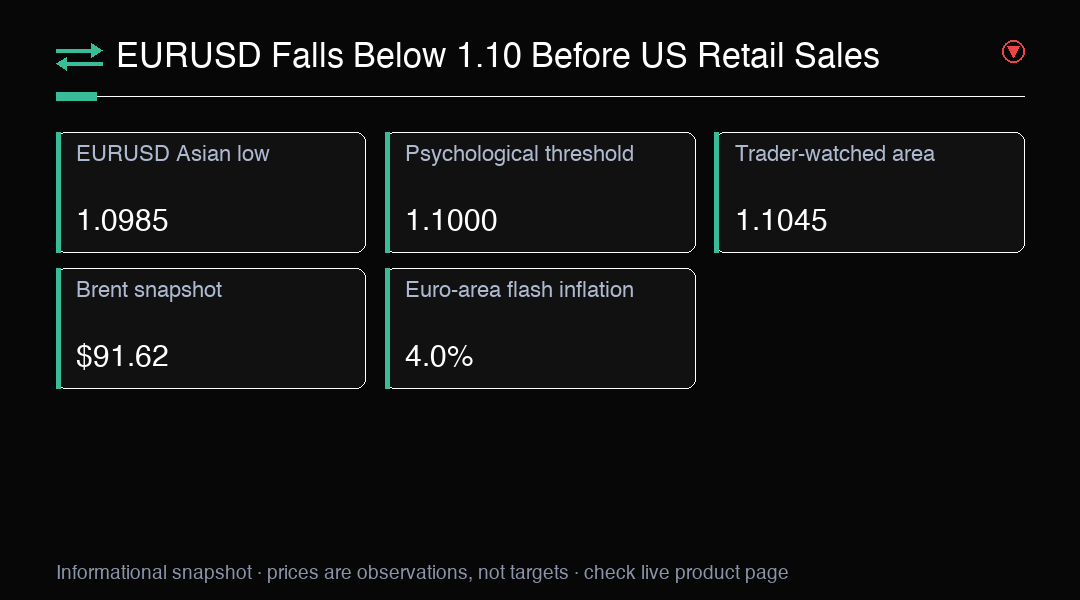
EURUSD fell to 1.0985 in Asian trading on November 17, its lowest level since April 2025. The move carried the pair below the psychologically important 1.1000 threshold, extending a break that began on November 16. The decline places attention on two contrasting parts of the near-term macro picture: US consumer demand and euro-area inflation. Neither release alone determines the pair’s direction. Traders will be assessing what each says about growth, inflation and the likely path of interest rates, while also watching whether the market can hold below 1.1000. That level is a reference point, not a guarantee of support or resistance.
The move through 1.1000 followed a fall through 1.1045, an area traders had been watching. It should be treated as a trader-observed technical area rather than independently verified support. That distinction matters: a price area can attract attention without proving that buyers will defend it or that a break will continue. EURUSD’s move below it shows that the pair had lost ground through an area participants were monitoring. The next useful evidence comes from how the exchange rate behaves around 1.1000 and whether price action stabilizes, rebounds or remains under pressure. A single session’s low does not establish a new longer-term trend.
The key scheduled US release was October retail sales, due at 8:30 a.m. ET on November 17. The consensus forecast was a 0.2% monthly increase, following September’s 0.8% rise. The comparison sets up a test of whether consumer spending continued to expand at a slower pace or showed more resilience than expected. Retail sales are one measure of household demand, but they do not capture every part of the economy. The result therefore needs context, including the size of any surprise and the details within the report. The scheduled release may affect currency trading as participants reassess the outlook, but its impact cannot be known in advance.
A stronger-than-expected retail sales result could reinforce the view that US demand remains resilient. If traders conclude that persistent demand may keep inflation pressures relevant, they could assign greater likelihood to further Federal Reserve tightening. Markets were already pricing a higher likelihood of additional tightening, a backdrop that supported the dollar. That relationship is not automatic: the report could be read alongside other data and expectations, and currency prices can respond in ways that differ from a simple interest-rate comparison. No precise probability or size for a December move is established here. The practical question is whether the release changes expectations meaningfully, rather than whether it merely beats or misses consensus.
A weaker-than-expected result could prompt a different reassessment. Slower consumer spending might temper concern that demand is keeping inflation elevated and could reduce pressure for additional tightening, depending on how traders interpret the broader evidence. That would not, by itself, prove that the dollar must fall or that EURUSD must recover. The release may also produce a brief reaction that fades as participants consider the data in context. For traders following the pair, separating the initial move from the subsequent response can help distinguish a fast reaction from a more durable change in expectations. Price behavior around 1.1000 offers one observable reference while that reassessment unfolds.
Euro-area inflation supplies the other side of the comparison. October flash inflation was 4.0%, up from 3.8%. Energy prices rose 20.8% year over year, while services inflation was 3.3%. The figures show that inflation had increased, with energy making a substantial contribution to the reported annual rise. They do not establish how persistent the increase will be or what policy decision will follow. Energy prices can move sharply, and a headline reading does not describe every component of household or business costs. Services inflation offers a separate measure to watch, but one monthly snapshot cannot settle whether underlying price pressure is broadening or easing.
The euro-area figures complicate any simple story in which weaker EURUSD means euro-area inflation has disappeared. Higher inflation can affect currency expectations if investors believe it will change the policy outlook, but the exchange rate also reflects conditions in the United States and relative expectations between the two economies. The US retail sales report was scheduled for a specific time, while the inflation figures provide recent context for the euro. Traders will be weighing both sets of information rather than treating either as a standalone signal. For readers, the useful distinction is between observed data, such as the reported inflation rates, and interpretations about what central banks may do next.
Brent traded near $91.62 in early Asian trading. That snapshot adds context because energy prices can matter to inflation readings and to expectations about future price pressure. It does not establish that oil caused the euro’s decline, nor does it show how Brent traded later in the session. The relationship between crude prices and a currency pair can run through several channels and may be overshadowed by rate expectations or other market developments. Keeping the session qualifier attached to the price is important: $91.62 describes an early Asian trading observation, not a confirmed all-day price or a forecast for the next move.
For EURUSD, the balance of near-term evidence depends on how traders compare US demand with euro-area price pressure. A resilient US spending report could support the existing view that further Fed tightening is more likely, which may continue to favor the dollar if that interpretation gains traction. A softer report could temper that view. Meanwhile, euro-area inflation rose, but the mix of energy and services prices leaves questions about persistence and policy implications. These are conditional paths, not predictions. The pair’s reaction after the scheduled data will show whether participants focus more on the growth and rate outlook, the inflation comparison, or the technical significance of trading below 1.1000.
The levels in focus serve different purposes. The 1.0985 Asian low records the latest reported session extreme and the lowest level since April 2025. The 1.1000 threshold marks the psychological boundary the pair moved below. The 1.1045 area records a level traders had watched, without treating it as confirmed support. Brent at $91.62 is an early Asian trading snapshot, while 4.0% is the October euro-area flash inflation reading. These observations should not be combined into a mechanical forecast. In particular, a move back above a round-number threshold would not alone reverse the broader decline, and a further move below the session low would not alone prove that selling will continue.
The central market question is whether EURUSD can remain below 1.1000 as traders digest the US retail sales result. A sustained response will depend on how the data changes expectations and how price behaves after the first reaction. If trading stabilizes, participants may reassess whether the break reflects a temporary push or a broader repricing. If pressure persists, the Asian low at 1.0985 remains a useful reference for describing the session, not a promised target. The euro-area inflation figures and Brent snapshot provide context, but neither settles the outlook. This is a data-sensitive market, and the available facts support scenarios to monitor rather than a certain direction.
Trading Insight
Watch EURUSD’s response around 1.1000 after the 8:30 a.m. ET retail sales release. Assess the data surprise and subsequent price action together; neither the 1.0985 low nor the 1.1045 trader-watched area guarantees the next move.