


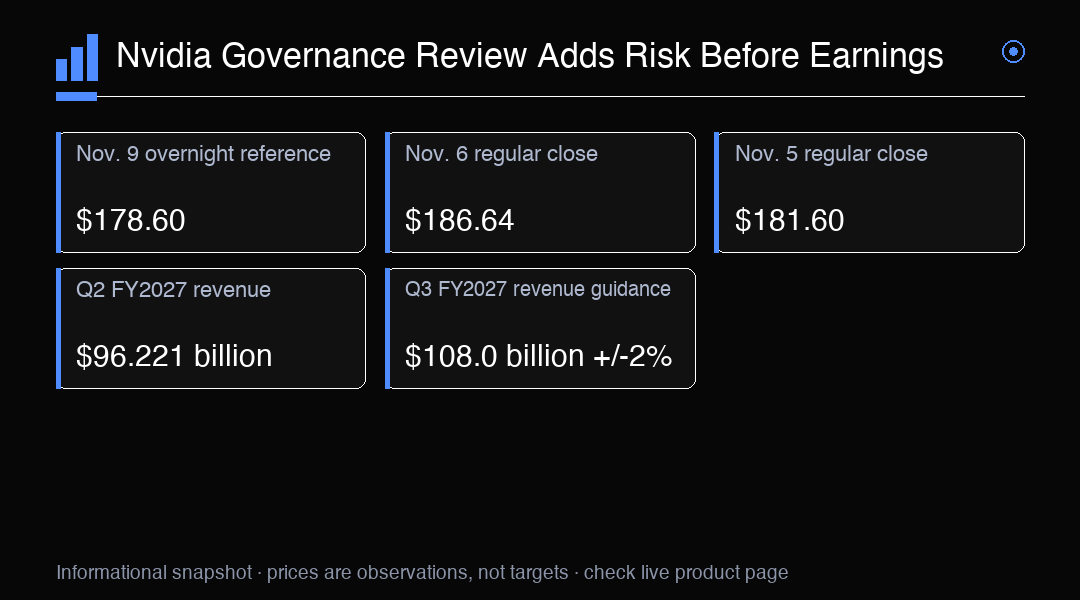
Nvidia enters a closely watched stretch with two separate issues in focus: an independent board review of whether CEO Jensen Huang was targeted by a foreign-intelligence effort, and the company’s next earnings announcement. Shares traded near $178.60 in after-hours and overnight venues on Nov. 9, more than 4% below the Nasdaq regular-session close of $186.64 on Friday, Nov. 6. That overnight indication is not a regular-session Nasdaq close. It describes activity in venues with different hours, liquidity and price formation, so it should not be treated as a settled market valuation. For investors, the distinction matters when comparing the indication with closing prices or assessing whether a move persisted during regular trading.
The board said it opened an independent review into whether Huang was targeted by a foreign-intelligence effort. It also said it had no reason to believe national security or Nvidia secrets were compromised and expressed confidence in the company’s leadership. Those statements define the board’s known position, while the review itself signals that directors consider the matter significant enough to examine. The review’s existence does not establish that wrongdoing occurred, that company information was accessed, or that any particular person acted on behalf of a government. The facts available now are limited to the board’s stated review and its assessment of compromise. Any further conclusions depend on what the review establishes.
House committee leaders have requested a closed-door briefing for Nov. 18, 2026, on the matter and Nvidia’s security protocols. A request for a briefing is an oversight step, not a finding of fact. It may keep governance and information-security questions in public discussion, but the request alone does not show that lawmakers have reached a conclusion or that Nvidia’s controls failed. The date also falls one day after Nvidia’s scheduled earnings announcement, placing two distinct events close together on the calendar. The briefing could add questions for the company to address, but its timing does not establish that the earnings event or business outlook will change.
That timing matters for investors because earnings and governance developments can shape attention at the same time, even when they concern different questions. The earnings release will provide information about demand, revenue and management’s outlook. The board review and requested briefing concern oversight, security procedures and leadership risk. Investors should avoid blending these into one explanation for each price move. The available facts do not establish that the board’s announcement caused the overnight decline, and price action alone cannot identify which market participants traded or why. Keeping the two strands separate helps prevent an unverified explanation from becoming part of an investment thesis.
Recent regular-session prices offer a firmer historical comparison. Nvidia closed at $181.60 on Thursday, Nov. 5, then finished Friday, Nov. 6, at $186.64. The Nov. 9 indication near $178.60 came from after-hours and overnight activity, including perpetual-futures venues, and should retain those qualifiers. Price differences between regular trading and overnight venues can reflect thinner liquidity, wider spreads and different participants. A move in one venue can be informative about sentiment without confirming where the stock will trade once the Nasdaq session is open. Comparisons are most useful when the venue, timestamp and session are clear.
The operating backdrop remains substantial. Nvidia recorded Q2 FY2027 revenue of $96.221 billion, up 106% year over year and 18% quarter over quarter. For Q3 FY2027, the company guided to revenue of $108.0 billion, plus or minus 2%, assuming no China Data Center compute revenue. These figures describe past performance and management’s outlook; they do not guarantee that demand, product availability or customer spending will evolve at the same pace. The guidance assumption matters when assessing what is included in the outlook. Investors should distinguish the published range from any estimate that adds revenue beyond that stated assumption.
The Nov. 17 earnings release is a key scheduled information point. Nvidia’s conference call is set for 2 p.m. PT, or 5 p.m. ET. Investors can compare actual Q3 revenue with the guidance range, listen for updates on demand and supply, and note any changes to management’s assumptions. Results may also clarify how management sees customer investment and regional restrictions affecting the business. None of those details is known in advance, and a strong or weak headline number may be interpreted differently depending on expectations already reflected in the share price. Commentary on the next period may matter alongside the completed quarter, since markets price expectations as well as results.
The governance review adds a separate uncertainty around oversight and continuity. The board has expressed confidence in Huang and the leadership team, and the company has said he remains committed to leading without interruption. Those statements are relevant to continuity, but they do not answer every question the independent review may examine. Investors can monitor for concrete updates on the review’s scope, conclusions and any changes to security procedures. Until such information is available, speculation about unverified details can distract from the distinctions between confirmed statements, open questions and market reaction. The existence of oversight activity is not itself evidence of an operational disruption.
Several scenarios remain possible without implying a preferred direction. The review could conclude without finding a security compromise, leaving earnings and business conditions as the main near-term focus. It could also identify process changes or lead to further oversight, keeping governance questions active. Separately, Nvidia could meet, exceed or fall short of the revenue outlook, with the market response depending on details as well as the headline figure. These paths can overlap, but the available information does not support assigning probabilities or linking a particular outcome to a specific price level. For that reason, scenario planning is more useful than treating any one outcome as certain.
For risk management, investors may want to distinguish regular-session trading from overnight indications, check venue and timestamp before comparing prices, and avoid treating a single move as confirmation of a lasting trend. Around earnings, gaps can occur when trading resumes, and volatility can rise as new information is absorbed. Position size, time horizon and tolerance for price swings matter more than a precise prediction. A defined plan for handling a move in either direction can help reduce decisions made under pressure, but no approach removes the risk of loss. Investors following the scheduled events can also decide in advance which new facts would change their view and which would not.
The broad market backdrop can affect large technology shares, including changes in interest-rate expectations, risk appetite and index flows. NAS100 offers broad exposure to a technology-heavy index and may provide context for market sentiment, but it is not direct exposure to Nvidia. Its performance can diverge from NVDA because it includes other constituents and responds to different company-specific and index-level factors. Monitoring NAS100 alongside Nvidia can help frame the wider market environment, while keeping the distinction between an index proxy and an individual stock clear. The coming sequence of earnings and oversight activity calls for attention to verified information, session-specific prices and the limits of each market indicator.
Trading Insight
Keep the Nov. 9 overnight indication separate from regular-session closes. Watch the Nov. 17 earnings details and any verified governance updates as distinct catalysts; neither establishes the next price direction.