


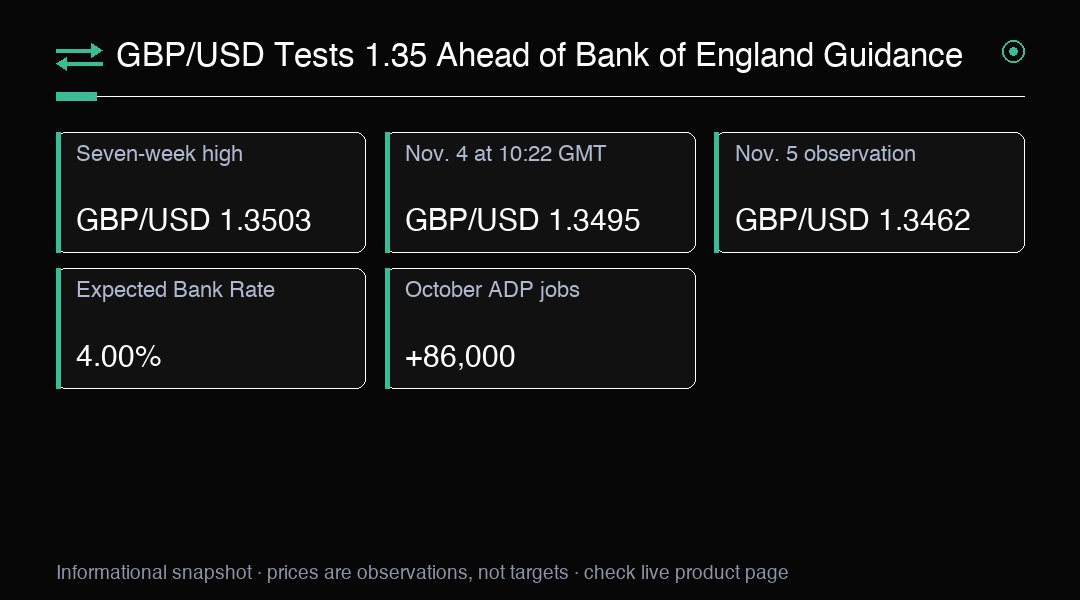
GBP/USD touched 1.3503, its highest level in more than seven weeks, as sterling extended a rally supported by a softer US dollar and expectations for a Bank of England rate increase. The pair was 1.3495 at 10:22 GMT on Nov. 4, up 0.63%, while the Nov. 5 observation was 1.3462, up 0.38%. Sterling was poised for a sixth consecutive daily gain. Those figures show a market that had already moved substantially before the policy decision. They do not establish that the rally will continue. With the expected rate change widely anticipated, traders may pay closer attention to the decision details and the Bank's explanation of what comes next.
The Bank Rate immediately before the decision was 3.75%. Markets expected a 25 basis point increase to 4.00%, which would be the first increase since August 2023. When an outcome is fully priced, the announcement itself can have less influence than any difference between expectations and the actual decision. A rate increase could therefore coexist with a weaker pound if policymakers signal limited appetite for further tightening. Conversely, a decision and accompanying guidance that leave investors expecting a firmer path could support sterling, although that response would still depend on broader currency conditions. The rate decision is a new data point; it is not, on its own, a reliable forecast of the next move in GBP/USD.
The policy challenge comes from inflation that remains above target. UK consumer price inflation was 3.5% in September, compared with the Bank's 2% target. Policymakers must judge whether current price pressure will ease over time or persist through wages and business pricing. That judgment matters because an interest rate increase can restrain demand, but it cannot directly remove the original cause of a price shock. The Bank's assessment may help traders understand how officials weigh the inflation risk against the economic cost of tighter policy. The available inflation figure is for September, so it should not be treated as a real-time reading of prices at the moment of the decision.
Markets were fully pricing the expected increase, while attention centered on the vote split, forward guidance and the Bank's inflation assessment. The vote can indicate how widely the decision is supported within the committee, but it should not be read as a complete map of future policy. Guidance may be more revealing if officials explain the conditions under which they would raise rates again or pause. Some economists expected the Bank to push back against market pricing of three to four rate increases in 2027. That was an expectation about possible communication, not a confirmed policy plan. If the Bank resists that pricing, sterling could lose some of its support even after a hike. If it leaves the question open, the market may continue to reassess the path as new data arrive.
The foreign exchange backdrop also matters. A softer dollar helped sterling, and lower US yields after Wednesday's post-election rally in stocks and Treasuries reduced support for the US currency. That relationship can influence GBP/USD independently of UK policy. A pound that holds firm against the dollar may reflect movement in either currency, or both, rather than a change in the outlook for Britain alone. Traders can distinguish these influences by watching whether dollar softness persists and how US yields respond to incoming data. A reversal in the dollar could weigh on the pair even if the Bank of England's decision is viewed as supportive. Likewise, a weaker pound need not mean that UK policy expectations have changed.
The labor-market data offer another input into the dollar side of the pair. ADP reported that US private employers added 86,000 jobs in October, above the 69,000 consensus. This result suggests hiring was stronger than expected in that private-sector measure, but one monthly estimate does not settle whether the wider labor market is resilient. Traders should compare it with the government Employment Situation report, which is scheduled for Nov. 6 at 13:30 GMT, or 08:30 ET. The distinction between the two releases matters: they cover different measures and are published on different days. A stronger government report could support expectations of persistent US economic strength, while a softer report could alter those expectations, but neither outcome guarantees a particular currency move.
Initial US jobless claims are scheduled for Nov. 5 at 13:30 GMT, or 08:30 ET. That release falls on the same day as the Bank of England decision, so the timing creates a concentrated period of event risk. The October Employment Situation report follows on Nov. 6 at the same clock time, one day later. Traders monitoring GBP/USD should keep the two releases distinct and watch how price responds as each arrives. A fast move around the UK decision may be reassessed when US claims are published; a subsequent payrolls release could then shift the dollar outlook again. This sequence makes it useful to note which event preceded a move rather than attributing all of the day's price action to one announcement.
The 1.3503 seven-week high provides a precise reference for the recent advance, while 1.3495 records the Nov. 4 price at 10:22 GMT. The Nov. 5 observation at 1.3462 shows that the pair was lower than that earlier timestamp, despite remaining up 0.38% on the stated comparison. These are dated observations, not guaranteed barriers or trading signals. The 1.35 and 1.34 areas are round-number references only. A move above or below a round number may attract attention, yet the number itself does not establish support, resistance or a future target. Traders can use the stated levels to describe what has happened while avoiding assumptions about what must happen next.
Several scenarios remain plausible after the decision. If the Bank raises rates as expected and its language leaves room for further tightening, sterling could retain support, particularly if the dollar remains soft. If the increase is accompanied by cautious guidance or a warning against the number of future hikes priced by markets, traders could reduce expectations for additional tightening and the pound could give back some gains. A surprise in the vote split or inflation assessment could also change how investors interpret the policy path. These are conditional possibilities, not forecasts. Price action may be mixed if UK policy signals and US data point in different directions, or if traders had already positioned for the expected outcome.
Risk management matters when policy decisions and labor-market releases arrive close together. Liquidity and price volatility can change around scheduled announcements, and an initial move may reverse as traders absorb the full statement and compare it with market expectations. A planned trade can account for the timing of each release, the size of potential losses and the possibility of gaps or rapid execution. The reported levels help frame recent market behavior, but they do not define a suitable entry, stop or position size. Those choices depend on an individual's time horizon, account and risk limits. Avoid treating a single headline or one price print as confirmation of a durable trend.
For the next assessment of GBP/USD, the key questions are whether the Bank's vote and guidance validate expectations for policy beyond the expected 4.00% Bank Rate, whether officials sound concerned about persistent inflation, and whether US claims and payrolls alter the dollar outlook. The pound's six-day advance and the seven-week high describe recent momentum, while the dated observations offer context for comparing later moves. None removes uncertainty about the interaction between UK policy, US data and currency-market positioning. Traders can update their view as those inputs arrive, separate confirmed results from expectations, and keep conclusions proportional to the evidence available at each point.
Trading Insight
With the expected rate increase fully priced, GBP/USD may respond more to the Bank's vote, guidance and inflation assessment than to the rate change itself. Compare that response with the US claims and payrolls releases before treating a move as durable.