


Palantir produced another extraordinary quarter, but the share-price reaction showed that exceptional growth no longer guarantees an immediate reward. Q3 revenue reached $2.313 billion, up 96% from a year earlier and 20% from the previous quarter. It was the company's first quarter above $2 billion. Adjusted and GAAP diluted earnings per share were both $0.44, ahead of the roughly $0.41 consensus estimate. Despite those figures, the stock fell about 2% to 2.6% in extended trading as investors looked beyond the headline beat.
The scale of the operating performance was equally notable. GAAP income from operations reached $1.085 billion, representing a 47% margin. Adjusted operating income was $1.427 billion with a 62% margin. Cash from operations totaled $1.205 billion, while adjusted free cash flow reached $1.216 billion. These figures indicate that growth is not being purchased through uncontrolled spending. Palantir is converting a large share of incremental revenue into profit and cash, a combination that distinguishes it from many high-growth software companies.
US commercial activity remained the strongest part of the business. Revenue from that segment rose 148% year over year and 29% quarter over quarter to $984 million. US government revenue grew 96% from a year earlier and 18% sequentially to $953 million. Commercial revenue therefore exceeded government revenue in the United States for the first time. Combined US revenue reached $1.937 billion, up 119% year over year. This crossover supports the view that Palantir's artificial-intelligence platform is gaining traction beyond its traditional public-sector base.
Customer expansion metrics also pointed to strong product adoption. Net dollar retention reached 165%, up 8 percentage points from the previous quarter. That means existing customers, as a group, spent substantially more than they did in the comparable prior period. The company also closed 212 deals worth at least $1 million, including 107 worth at least $5 million and 64 worth at least $10 million. Large deal counts and strong retention suggest the platform is becoming more deeply embedded in customer workflows rather than being used only for small experiments.
The cautious part of the story lies in contract-value growth. Total contract value was $2.918 billion, up 6% year over year, while US commercial contract value reached $1.463 billion, up 11%. Those rates are positive, but they are far below the 96% expansion in recognized revenue. Contract value and revenue are not directly interchangeable because deal timing, duration, options, and termination clauses differ. Even so, the gap gives traders a reason to ask whether current revenue growth can remain near present levels once earlier bookings flow through the income statement.
Remaining deal value offers a more balanced signal. US commercial remaining deal value rose 79% year over year and 4% sequentially to $6.517 billion. That backlog-like measure provides visibility, but it is not guaranteed revenue. Contract options may not be exercised, and many agreements include termination provisions. Investors should therefore treat remaining deal value as evidence of demand rather than a promise of future sales. The distinction is especially important when valuation assumes sustained, unusually high growth.
Management raised full-year revenue guidance to $8.530 billion to $8.534 billion and projected Q4 revenue of $2.649 billion to $2.653 billion. Full-year US commercial revenue is expected to exceed $3.559 billion, representing growth of at least 143%. Adjusted operating-income guidance also moved higher to $5.245 billion to $5.249 billion, while adjusted free-cash-flow guidance stands at $4.8 billion to $5.0 billion. These targets show confidence that strong demand and operating leverage can persist through year-end.
Why did the shares fall after such strong results? The safest answer is that expectations were already extremely high. A stock priced for exceptional execution can decline when results are merely excellent or when one forward indicator grows more slowly than the headline income statement. The after-hours move should not be assigned to one cause with certainty. Contract-value growth, valuation, profit-taking, and broader AI-sector sentiment may all have contributed. What is clear is that traders demanded more than another earnings beat.
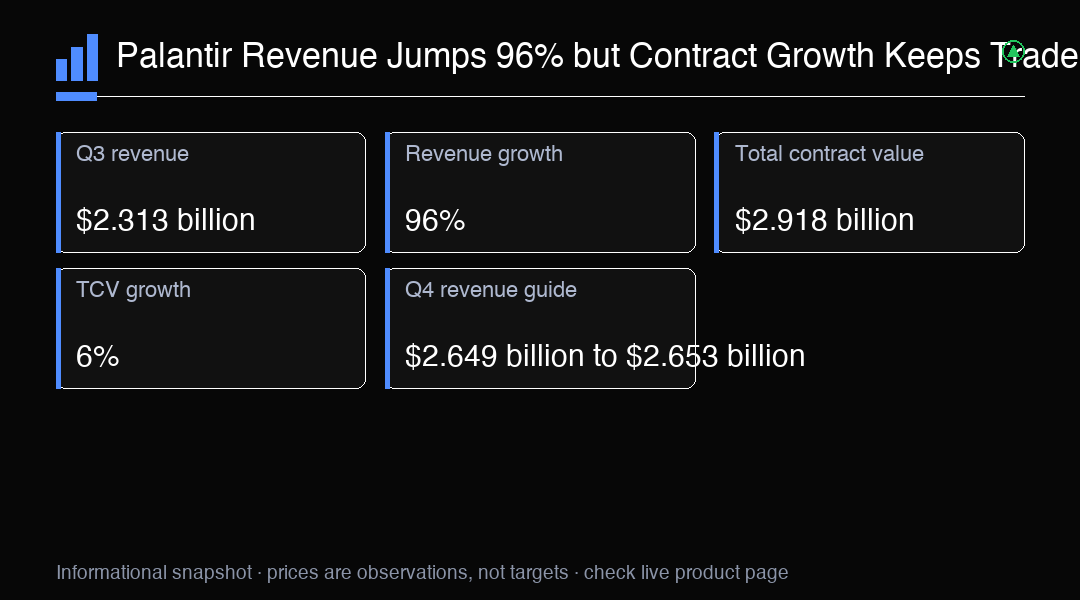
For market participants, the central debate is growth durability. Revenue of $2.313 billion and a 96% annual increase define current momentum. Total contract value of $2.918 billion and 6% growth define the main area of scrutiny. Q4 revenue guidance of $2.649 billion to $2.653 billion sets the next measurable hurdle. If new contract growth accelerates while margins remain high, the market may become more comfortable with the company's long-term trajectory. If contract activity stays subdued relative to revenue, concerns about future deceleration could intensify even if near-term results remain strong.
Several risks deserve attention. Palantir remains heavily exposed to the United States, and large contracts can create uneven quarterly comparisons. Government and commercial purchasing cycles may shift, customer options may not convert, and the rapid pace of AI spending could normalize. High margins also make future comparisons more demanding because investors may expect both growth and efficiency to improve together. At the same time, the strong cash position, expanding commercial base, and high retention rate provide meaningful resilience if demand remains broad.
The quarter confirms that Palantir is executing at a rare level, but it also shows how quickly the market's standard has risen. The business delivered record revenue, high margins, strong cash generation, and a historic commercial crossover. Traders nevertheless focused on whether contract growth can replenish the pipeline fast enough to support the next phase. That makes bookings quality, remaining deal value, Q4 revenue, and customer expansion the most important indicators for the next earnings cycle. A constructive follow-through would require both strong conversion of existing commitments and broader new demand. Margin strength alone cannot settle the durability question, while faster contract formation without disciplined execution would introduce a different risk. The strongest outcome would combine renewed contract acceleration, continued retention, and sustained cash conversion.
Trading Insight
Palantir's 96% revenue growth and 62% adjusted operating margin show exceptional execution, while total contract value grew only 6%. Q4 revenue guidance of $2.649 billion to $2.653 billion becomes the next hurdle. Watch whether new contract growth accelerates, because sustained bookings would support the growth case while another wide gap could deepen valuation concerns.